

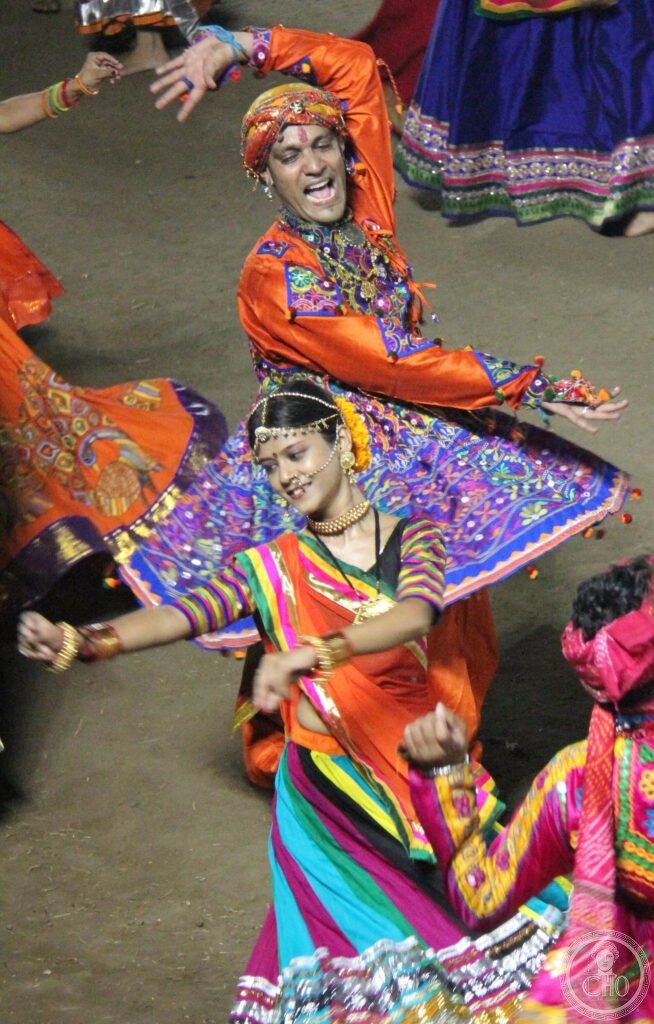
A circular women’s dance performed during Navaratri, Gujarat’s Nine Nights festival honoring the mother goddess—now danced across the Indian diaspora by people of all ages.
In UNESCO’s words
Garba is a ritualistic and devotional dance that is performed on the occasion of the Hindu festival of Navaratri, which is dedicated to the worship of the feminine energy or ‘Shakti’. The dance takes place around a perforated earthenware pot lit with an oil lamp, or an image of the mother goddess Amba. The dancers move around the centre in a counter-clockwise circle, using simple movements while singing and clapping their hands in unison. Starting with slow circular movements, the tempo slowly builds up to a frenzied whirling. The practitioners and bearers of Garba are broad and inclusive, from the dancers to the musicians, social groups, craftspeople and religious figures involved in the festivities and preparations. Garba is transmitted across generations in urban and rural areas through practice, performance, imitation, and observation. Many schools and universities offer professional courses and workshops in dance, music, costume and ornament design, landscape planning, sound and light design, all of which contribute to Garba creations. The practice is also transmitted by NGOs, government agencies, choreographers, musicians and the media. Garba fosters social equality by diluting socio-economic, gender and religious structures. It continues to be inclusive of diverse and marginalized communities, thus strengthening social bonds.
Official description, UNESCO Intangible Cultural Heritage List — Garba of Gujarat
At a glance
Garba is a ritualistic and devotional dance performed during Navaratri, the Hindu festival dedicated to worshipping Shakti, the feminine energy. Dancers move counter-clockwise in circles around a perforated earthenware pot lit with an oil lamp, or an image of the mother goddess Amba. The dance begins with slow circular movements and gradually accelerates, accompanied by singing and hand-clapping in unison. Simple movements characterize the practice, making it accessible to participants of all backgrounds.
Origins & history
Garba is transmitted across generations through practice, performance, imitation, and observation in both urban and rural areas. Beyond traditional family transmission, schools and universities now offer professional courses and workshops in dance, music, costume and ornament design, landscape planning, and sound and light design. NGOs, government agencies, choreographers, musicians and the media also play roles in passing on the knowledge and practice of Garba to new generations.
The practice
Practitioners of Garba include dancers, musicians, social groups, craftspeople and religious figures who prepare for and participate in the festivities. The dance takes place around the central symbol—a perforated pot with an oil lamp or an image of Amba—with dancers moving counter-clockwise. The performance starts slowly and builds to a frenzied whirling pace, with participants singing and clapping their hands together in rhythm.
Cultural significance
Garba fosters social equality by diluting socio-economic, gender and religious structures, remaining inclusive of diverse and marginalized communities. This inclusivity strengthens social bonds within the community. The practice serves both as devotional worship of the feminine energy and as a means of reinforcing connections among participants across generations, making it central to the cultural identity and continuity of the communities that practise it.
Key facts
- Country: India
- Inscribed: 2023
- UNESCO list: Representative List of the Intangible Cultural Heritage of Humanity
- UNESCO reference: 01962
- UNESCO vocabulary: Dance; Rituals; Vocal music
- Map: Gujarat — the locality named in UNESCO’s official description of this element
- Related World Heritage site: Historic City of Ahmadabad (a different UNESCO designation, not the place of the tradition)
Where to experience it
Garba thrives in Gujarat, where it is performed during Navaratri celebrations at fairs, community feasts, and temples throughout the region. The dance remains central to the festival's rituals, drawing practitioners across generations in both urban and rural areas. Many schools, universities, and cultural organizations offer workshops in garba dance, music, and related arts, making the tradition accessible to learners of all backgrounds. Communities with significant Gujarati populations in India and abroad also host Navaratri celebrations where garba is danced, keeping the practice alive far beyond its birthplace.
Sources & resources
- UNESCO — official element page: Garba of Gujarat
- UNESCO — open data record: Intangible Heritage List, reference 01962
- UNESCO — official video: UNESCO film on this element — embedded on this page
- UNESCO — official photograph: A pottery artisan making the Garbha-deep / earthen pot in which the oil lamp is placed — Moving Pixels Pvt. Ltd., India, 2022
- Reference — Wikipedia (secondary): Garba (dance) — consulted as a secondary reference, not as confirmation
- Cultural Heritage Online: Our archive and city guides

Find it on the map
See this place and what’s around it →📷 Become a Cultural Heritage Online photographer
Share your photos of places: they stay published under your name as the author. The more they're seen, the more you get noticed — and soon a contest will reward the most appreciated photos.
Log in or sign up free to add a photo