
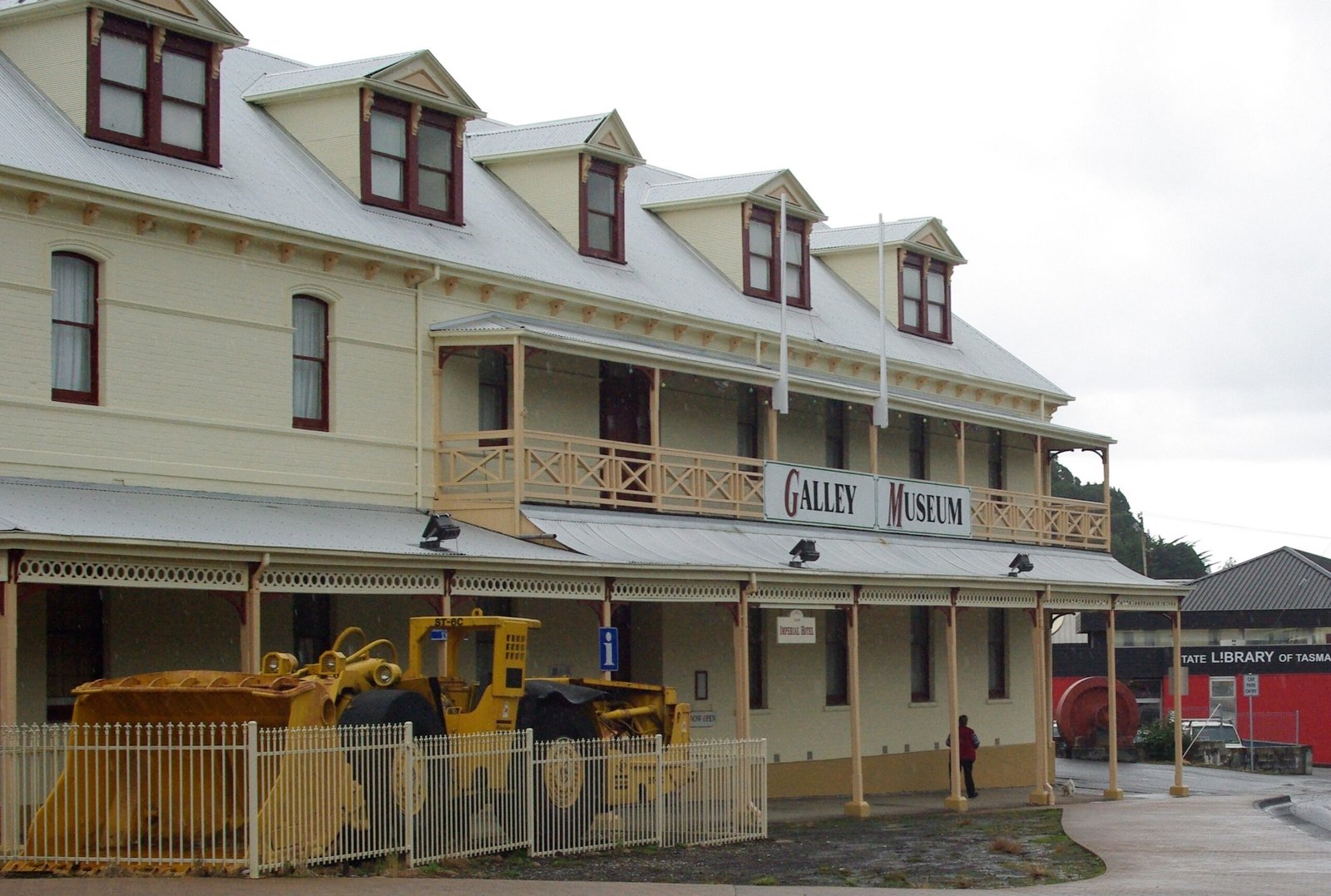
A photographic archive housed in a converted 1897 hotel, preserving the mining heritage and visual memory of Tasmania’s west coast.
At a glance
The Galley Museum occupies Driffield Street in Queenstown, documenting the region’s rich but turbulent mining past. The building itself—once the Imperial Hotel—has served multiple purposes as a mining office and youth hostel before becoming a cultural repository.
History
Built as the Imperial Hotel in 1897, the structure reflects the era when Queenstown thrived as a mining centre. It later adapted to serve the community as a mining office and hostel, finally finding purpose as a museum dedicated to preserving west coast mining history.
Photographer Eric Thomas assembled much of the museum’s extensive collection, both capturing images and processing them for preservation. His work forms a significant portion of the photographic record now held here.
What you see
The former Imperial Hotel building retains its 19th-century character while functioning as a modern museum space. Its conversion demonstrates adaptive reuse of heritage architecture for cultural purposes.
Cultural significance
One of two west coast Tasmanian institutions preserving mining community records, the Galley Museum holds material evidence of localities and operations that no longer exist. The collection represents, in some cases, the last surviving documentation of these historical sites.
Its extensive holdings from the 1912 North Mount Lyell Mining disaster provide crucial documentation of this significant industrial catastrophe. An object from the museum was selected for the 10 Objects 10 Stories exhibition in Hobart in 2016, affirming its importance to Tasmanian cultural heritage.
Key facts
- Country: Australia
- Location: Queenstown, Tasmania
- Coordinates: -42.07835, 145.55671
- Building constructed: 1897 (as Imperial Hotel)
- Focus: Mining heritage photography and materials
Practical information & getting there
The museum is located on Driffield Street in Queenstown. Detailed opening hours and visitor information should be confirmed before planning your visit.
Sources & resources
Find it on the map
See this place and what’s around it →📷 Become a Cultural Heritage Online photographer
Share your photos of places: they stay published under your name as the author. The more they're seen, the more you get noticed — and soon a contest will reward the most appreciated photos.
Log in or sign up free to add a photoIs this page about you?
This page is read by travellers and heritage enthusiasts who find it on Google. Tell us how you are connected to this place and we will take it from there.