
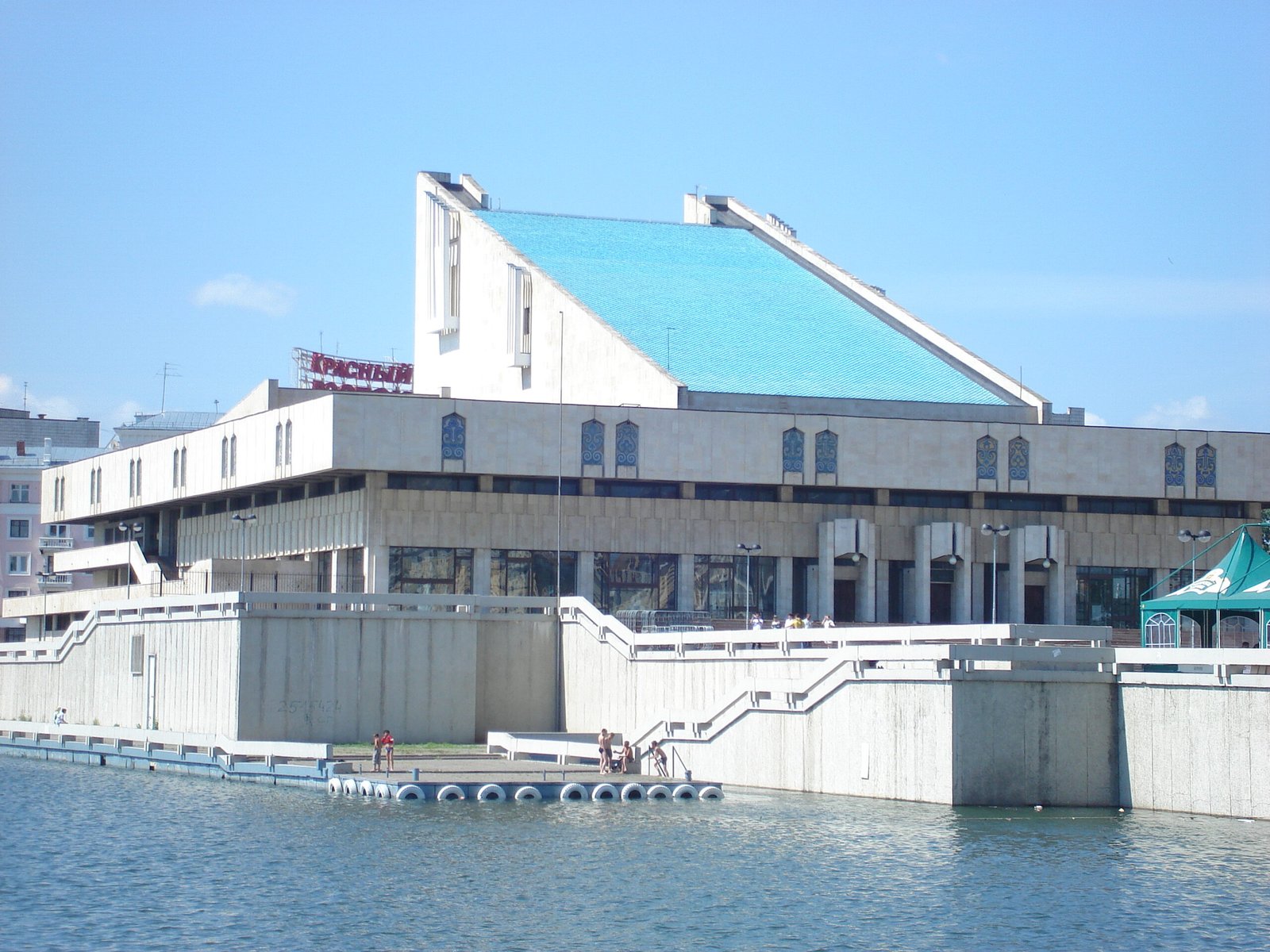
On the shore of Lake Kaban stands the leading stage of Tatar-language drama, a company born from amateur performances and Soviet-era constraint alike.
At a glance
The Galiaskar Kamal Tatar Academic Theatre traces its roots to December 22, 1906, when the troupe “Sayar” (The Traveler) gave the first public performance of a Tatar play in modern times. Renamed in 1939 after playwright Galiaskar Kamal, the company has occupied its present brutalist building on the Kaban lakeshore since 1987. It remains Kazan’s foremost venue for Tatar-language theater.
History
Tatar theater began quietly. Amateur groups staged free performances in private houses through the mid-19th century, drawing small audiences and borrowing repertoire from Russian and foreign playwrights. Gabdrakhman Ilyasi’s 1886 play “Unhappy Girl,” likely influenced by the Turkish playwright İbrahim Şinasi, was the first published Tatar-language work; both plays confronted the common practice of arranged marriage. “Sayar” turned amateur effort into professional practice in 1906 and became the leading Tatar company of its era. The 1939 renaming honored Galiaskar Kamal, and decades later the troupe settled into its current home overlooking the Kaban lakes.
What you see
The 1987 building presents the blunt geometry typical of late Soviet brutalism. Concrete mass meets the lakeshore setting directly, without ornament softening the transition. Inside, the theater equips audiences with translation devices for those who do not speak Tatar. The result is a working house built for language, not spectacle.
Cultural significance
Because Tatarstan held “autonomous republic” status rather than “union republic” status within the USSR, Moscow denied it a film studio granted to other republics. Tatar actors, directors and producers had nowhere else to channel their craft. Theater absorbed talent that elsewhere might have gone to cinema. That concentration, the article suggests, helps explain the troupe’s commercial success and the enduring popularity of theater among Tatars. The repertoire today still favors Tatar playwrights alongside Russian and foreign works.
Key facts
- Founded: December 22, 1906, as the troupe “Sayar”
- Renamed after Galiaskar Kamal: 1939
- Current building occupied: 1987
- Location: shore of Lake Kaban, Kazan, Russia
- Architectural style: brutalist
Practical information & getting there
The theater sits on the Kaban lakeshore within central Kazan, reachable by the city’s public transport network. Performances are staged primarily in Tatar; translation devices are available for non-Tatar speakers, so you need not fear the language barrier. Check the official website for current schedules and ticketing before you plan a visit.
Sources & resources
Find it on the map
See this place and what’s around it →📷 Become a Cultural Heritage Online photographer
Share your photos of places: they stay published under your name as the author. The more they're seen, the more you get noticed — and soon a contest will reward the most appreciated photos.
Log in or sign up free to add a photoIs this page about you?
This page is read by travellers and heritage enthusiasts who find it on Google. Tell us how you are connected to this place and we will take it from there.