
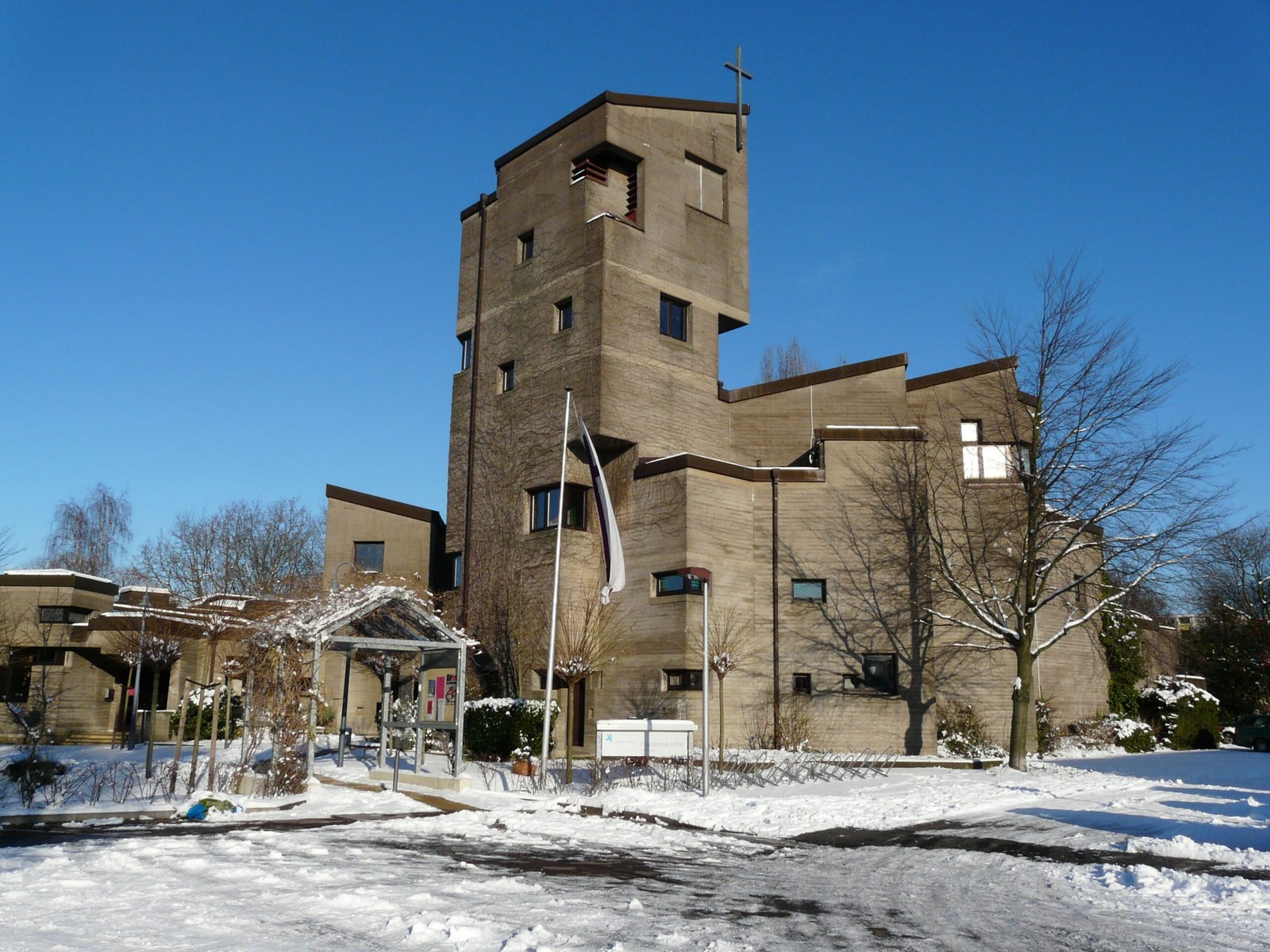
A striking Brutalist Protestant church in the Rhineland, the Friedenskirche demonstrates the sculptural possibilities of concrete in sacred architecture during the postwar era.
At a glance
This Peace Church stands on Schellingstraße in Monheim-Baumberg as a bold statement of modern faith. Built between 1968 and 1974, it represents a confident moment in German Protestantism and architectural ambition. The church’s concrete forms mark the streetscape with authority and contemplative presence.
History
The Friedenskirche was constructed during a period of Protestant church renewal in West Germany. Completed in 1974, it served the Monheim-Baumberg community as a new center for worship and gathering in an evolving residential area of the Rhineland.
What you see
Architect Walter Maria Foerderer designed the church in the Brutalist idiom, the dominant language of serious architecture in the early 1970s. Raw concrete (béton brut) forms the primary material, shaped into expressive volumes that convey both weight and spiritual aspiration. The exterior’s geometric severity invites contemplation; the interior spatial experience rewards close attention to how light and mass interact.
Cultural significance
The Friedenskirche exemplifies postwar German Protestantism’s embrace of modernism. It stands alongside other Brutalist churches across Europe as evidence that the movement’s austerity and honesty appealed deeply to religious communities seeking contemporary forms for timeless purposes.
Key facts
- Location: Schellingstraße 13, Monheim-Baumberg, Germany
- Coordinates: 51.118°N, 6.8942°E
- Built: 1968–1974
- Architect: Walter Maria Foerderer
- Style: Brutalism
- Denomination: Protestant
Practical information & getting there
The Friedenskirche is located in Monheim am Rhein, in the western Rhineland region near Düsseldorf. The nearest major transport hub is Düsseldorf; from there, local trains and buses serve Monheim. For opening times and service schedules, contact the church directly or check local tourism resources for current information.
Sources & resources
Find it on the map
See this place and what’s around it →📷 Become a Cultural Heritage Online photographer
Share your photos of places: they stay published under your name as the author. The more they're seen, the more you get noticed — and soon a contest will reward the most appreciated photos.
Log in or sign up free to add a photoDo you manage this place?
This page is read by travellers and heritage enthusiasts who find it on Google. Keep it accurate — and make it work for you. Free for non-profit heritage institutions.