

Inaugurated as a designated municipal airport in the early 1920s and chosen in 1926 as the foundational operating headquarters of Deutsche Luft Hansa, Berlin-Tempelhof stands as one of the world’s most iconic aviation monuments. Its curving terminal complex, cantilevered aircraft canopy, and vast open airfield (Tempelhofer Feld) synthesize twentieth-century air transport history, geopolitical drama, and extraordinary urban reinvention.
At a glance
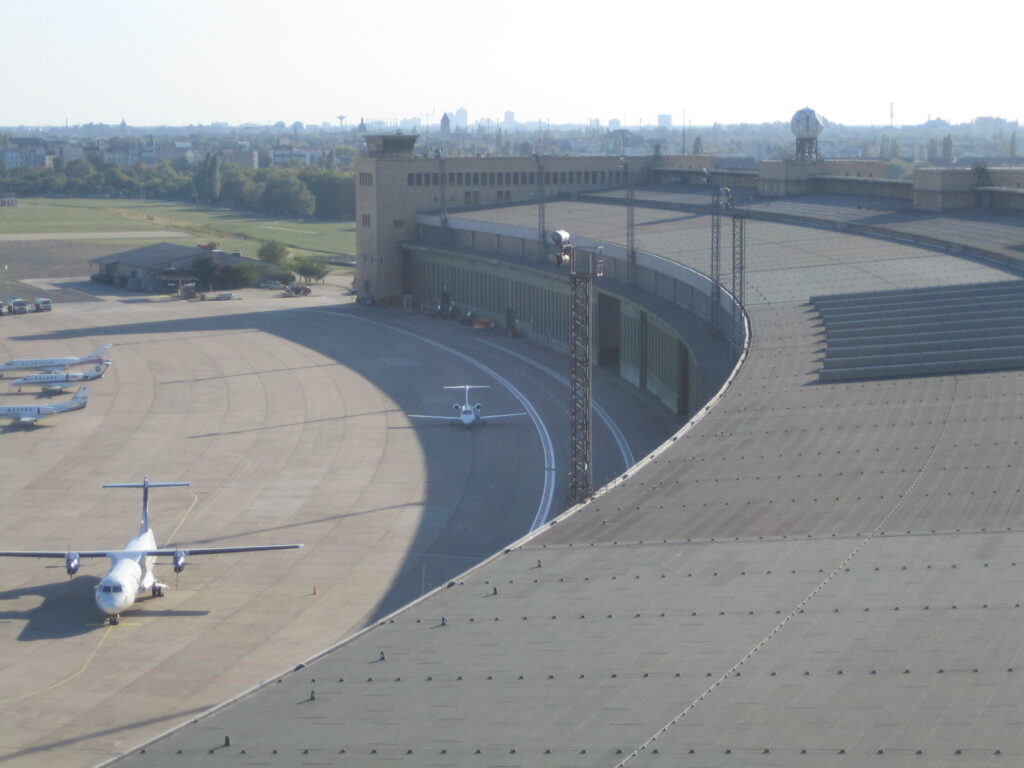
Situated in the south-central Berlin borough of Tempelhof-Schöneberg, Flughafen Tempelhof is celebrated as the “mother of modern airports.” Designated by the Berlin municipality in 1923, it became the corporate base and maintenance nexus of Deutsche Luft Hansa upon the airline’s formation in January 1926. While the surviving monumental limestone terminal was redesigned under architect Ernst Sagebiel during the late 1930s, the site remains inextricably linked to the birth of scheduled European commercial flight and the 1948–1949 Berlin Airlift. Today, the terminal is protected as a national monument, while its 300-hectare flying grounds serve as Berlin’s largest public open-air park.
Key facts
- Location: Platz der Luftbrücke 5, 12101 Berlin-Tempelhof, Germany
- Airline founding connection: Primary flight base and maintenance hub of Deutsche Luft Hansa from January 6, 1926
- Architectural redesign: Ernst Sagebiel (1936–1941); celebrated for its 1.2-kilometer-long curving terminal and 40-meter cantilevered aircraft hangar canopy
- Historic milestones: 1926 first scheduled Luft Hansa night passenger flights; 1948–1949 Allied Berlin Airlift supply hub
- Decommissioning: Commercial flight operations ceased on October 30, 2008
- Current status: Protected architectural ensemble; terminal hosts guided historical tours and cultural exhibitions; runway field is open public parkland
- Coordinates: 52.48065, 13.38892 · open in Google Maps
History and aviation heritage
Historically utilized as military parade grounds by Prussian monarchs, Tempelhof became an early experimentation ground for aviation pioneers, including Orville Wright, who conducted demonstration flights here in 1909. Following the First World War, the Weimar city administration established regular landing concessions. On January 6, 1926, the merger of Aero Lloyd and Junkers Luftverkehr at the nearby Hotel Kaiserhof created Deutsche Luft Hansa, concentrating Germany’s civil airfleet and pilot training schools at Tempelhof.
During the interwar years, Tempelhof handled the densest network of continental scheduled routes, welcoming trimotor Junkers and Rohrbach airliners. Following mid-century reconstruction and the division of Berlin, Tempelhof achieved worldwide fame during the Soviet blockade of 1948–1949, when American and British transport planes landed around the clock to sustain the isolated civilian population. After serving regional passenger routes throughout the Cold War, the airport closed permanently in 2008, preserved intact following a historic citizen referendum.
Architecture and spatial design
The airport complex remains one of the largest single building structures in Europe by surface area. Designed to handle millions of international transit passengers, the terminal features a sweeping concave arc faced with light Jura limestone. The engineering triumph of the complex is the monumental steel-framed apron roof, which extends 40 meters out over the tarmac without support columns, allowing aircraft to taxi underneath and discharge passengers protected from adverse weather.
The landside entrance faces Platz der Luftbrücke, anchored by a semi-circular forecourt and the dramatic 1951 Berlin Airlift Memorial (Luftbrückendenkmal). Beneath the passenger concourse lies an extensive multi-level labyrinth of baggage conveyor shafts, railway freight tunnels, and subterranean civil defense shelters that offer an archaeological cross-section of twentieth-century German infrastructure.
What you see today
Tempelhof today presents an extraordinary dual identity. The vast former airfield, known as Tempelhofer Feld, is open daily sunrise to sunset as an unrestricted public park where thousands of Berliners cycle along former asphalt runways, cultivate community gardens, and watch migratory birds across open grasslands.
The monumental terminal building itself is accessible via regular guided architectural and historical tours operated by the municipal management authority. Visitors can explore the preserved 1950s ticket halls, passenger transit lounges, underground air-raid shelters, and walk along the roof terrace overlooking the entire Berlin skyline.
Practical information and visits
- Park access: Tempelhofer Feld is completely free and accessible daily through multiple entrances on Tempelhofer Damm, Columbiadamm, and Oderstraße.
- Terminal tours: Daily guided tours in German and English explore the hidden spaces, aircraft hangars, and Cold War installations. Online pre-booking via the official website is required.
- Airlift Memorial: The memorial and information square at Platz der Luftbrücke can be visited freely at all times.
Getting there
Tempelhof is exceptionally well connected by Berlin’s public transit network. Take the U-Bahn line U6 directly to “Platz der Luftbrücke” (for terminal tours and the main memorial) or “Paradestraße”. Alternatively, the southern and eastern perimeter entrances to the field are served directly by the Ringbahn S-Bahn lines (S41/S42) at “Tempelhof” station and U-Bahn line U8 at “Boddinstraße” and “Leinestraße”.
Related enterprise history
This place card documents the physical airport complex, Ernst Sagebiel’s architecture, and the Tempelhofer Feld park. For the corporate history of the airline, interwar aircraft design, and the 1926 merger at Hotel Kaiserhof, read our companion magazine feature on the founding history of Lufthansa (1926).
Sources
- Landesdenkmalamt Berlin (Denkmaldatenbank): Official protected architectural heritage record for the Flughafen Tempelhof ensemble (Obj.-Dok.-Nr. 09055092).
- Lufthansa Group Corporate History & Archives: Institutional records documenting the January 1926 merger of Deutscher Aero Lloyd and Junkers Luftverkehr at Tempelhof.
- Tempelhof Projekt GmbH: Official public management guide to the terminal building, visitor exhibition circuits, and preservation of Tempelhofer Feld.
- OpenStreetMap: Spatial boundary, runways, and terminal footprint of Flughafen Tempelhof (Relation 10466358), Berlin, Germany.
Find it on the map
See this place and what’s around it →📷 Become a Cultural Heritage Online photographer
Share your photos of places: they stay published under your name as the author. The more they're seen, the more you get noticed — and soon a contest will reward the most appreciated photos.
Log in or sign up free to add a photo