

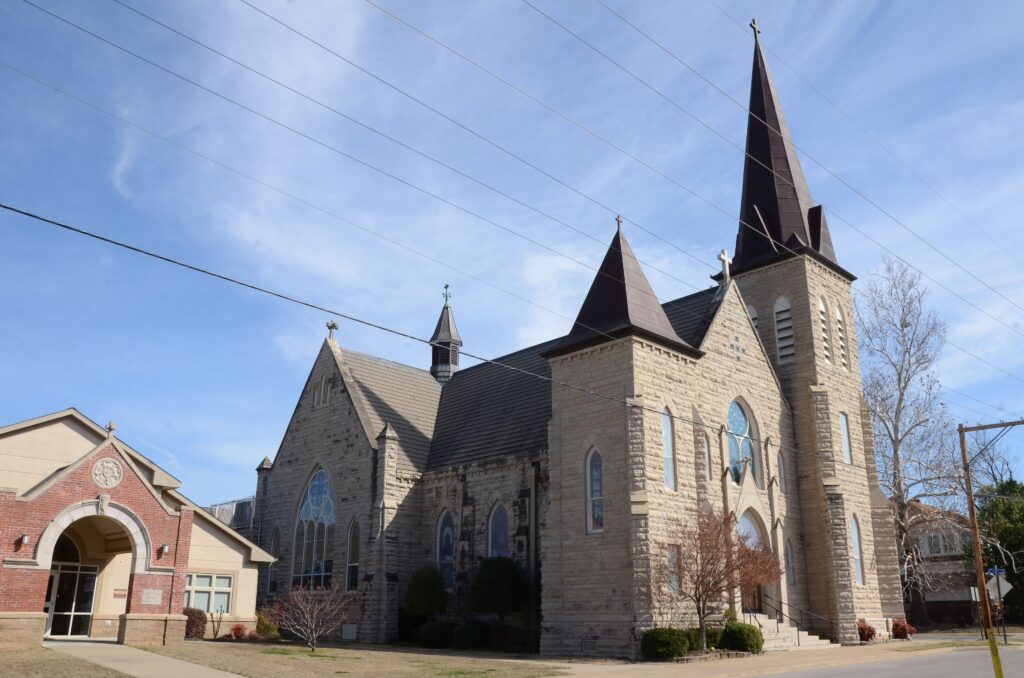
A large limestone church in Fort Smith, Arkansas, built between 1901 and 1904 to a design by local architect William Hornor Blakely.
At a glance
The First Evangelical Lutheran Church stands at 1115 North D Street in Fort Smith, Arkansas. It is a large limestone structure laid out on a cruciform plan. Two towers flank the main facade. The building replaced an earlier church completed in 1869, which stood nearby and is still used by the congregation for education.
History
The congregation was formally established in 1852 by German immigrants to the area. Its first church was completed in 1869. When the present building was raised between 1901 and 1904, the older church was not demolished but converted to educational use. The design came from William Hornor Blakely, a prominent Fort Smith architect.
What you see
The church is built of limestone. Its plan is cruciform. A pair of towers rises on either side of the main facade. The massing is substantial, appropriate to a congregation whose first building had already served for more than thirty years.
Cultural significance
The building was listed on the National Register of Historic Places in 2017. The listing recognises both the architecture and the congregation’s long presence in Fort Smith, which began with German immigrants in 1852.
Key facts
- Country: United States
- City: Fort Smith, Arkansas
- Coordinates: 35.3842, -94.4017
- National Register of Historic Places: listed 2017
Practical information & getting there
The church is at 1115 North D Street in Fort Smith, Arkansas. The source does not provide opening hours or entrance details, so check locally before visiting.
Sources & resources
Find it on the map
See this place and what’s around it →📷 Become a Cultural Heritage Online photographer
Share your photos of places: they stay published under your name as the author. The more they're seen, the more you get noticed — and soon a contest will reward the most appreciated photos.
Log in or sign up free to add a photoIs this page about you?
This page is read by travellers and heritage enthusiasts who find it on Google. Tell us how you are connected to this place and we will take it from there.
This entry stays online and free either way — and a free account lets you add to it yourself.