

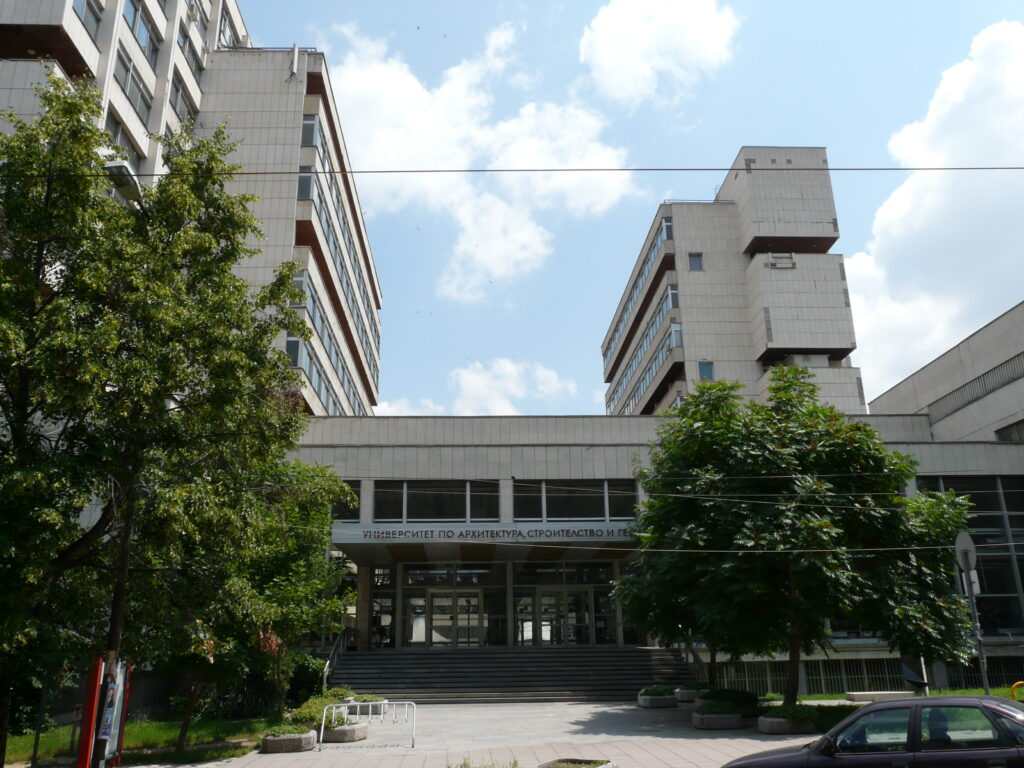
The Faculty of Architecture of the University of Architecture, Civil Engineering and Geodesy works in Building A of the university complex on Hristo Smirnenski Boulevard in Sofia, where architecture has been taught since 1943.
At a glance
The university, known by its Bulgarian initials UASG, was founded in 1942 as the first higher technical school in Bulgaria. Its architecture specialty opened a year later, and the Faculty of Architecture followed in 1951 with eight chairs. The faculty teaches architecture over five and a half years, along with urbanism and landscape architecture, and runs a master's programme in the conservation of cultural heritage. Its studios and lecture rooms are in the same walled complex in the Dolen Lozenets quarter.
Key facts
- Faculty of Architecture of the University of Architecture, Civil Engineering and Geodesy
- University founded in 1942; architecture specialty opened in 1943; faculty formed in 1951
- Eight chairs, from urban planning to the history and theory of architecture
- Architecture degree: master's after secondary school, 5.5 years, 11 semesters
- Master's in conservation of cultural heritage: three semesters, for graduates in architecture and construction
- Dean's office in Building A, second floor, room A-212
- Sofia's monument register lists a sgraffito inside the old university building
History
The school has changed name five times without leaving the field. It opened in 1942 as the Higher Technical School. In 1945 it became the State Polytechnic, in 1953 it separated as the Civil Engineering Institute, in 1963 it was renamed the Higher Civil Engineering Institute, and in 1977 the Higher Institute of Architecture and Civil Engineering. The present name came in 1990, and on 21 July 1995 the National Assembly turned it into a university by decision. Institutional accreditation followed on 15 November 2001.
Architecture was there from the start. The specialty opened in 1943, one year after the founding of the first higher technical school in Bulgaria. The Faculty of Architecture itself was established in 1951 with eight chairs, and the same eight divisions still organise the teaching: urban planning, history and theory of architecture, technology of architecture, industrial buildings, residential buildings, public buildings, interior and design for architecture, and drawing and modelling.
The complex stands on Hristo Smirnenski Boulevard in Dolen Lozenets, and the faculty occupies Building A. The dean's office is on the second floor, in room A-212. Sofia's electronic register of monuments and artistic elements records one work inside the old university building: a monumental sgraffito on the top floor, listed as an interior decorative element and described as in excellent condition. The register gives the address as Hristo Smirnenski Boulevard 1, Dolen Lozenets. No source consulted here dates the construction of the building or names its architect, so this page leaves both open.
What you see
Teaching is organised around projects. Students in architecture work in studios under practising architects, and the programme runs over eleven semesters and five and a half years, ending in a master's degree taken after secondary school. The faculty also teaches urbanism, at bachelor's and master's level, landscape architecture and landscape planning, and spatial planning for graduates coming from other degrees. Its own description of the architecture course names the care of historic monuments among the subjects students meet, beside housing, public buildings and sustainable urban planning.
The conservation programme is the faculty's shortest route into heritage work. It takes three semesters and admits graduates in architecture, construction and geodesy, or in landscape architecture. Its courses cover the modern theory of conserving immovable cultural property, the way public ideas about significance have changed, Bulgarian and international law, the legal and spatial instruments of protection, traditional building materials and techniques, and the methods of survey, documentation, condition assessment and design for conservation, restoration and adaptation. It closes on sustainable management and on making cultural property accessible and intelligible to the public. Graduates work as conservators and restorers, in the construction and adaptation of historic buildings, in cultural institutions and in heritage policy. The faculty offices receive visitors on weekday mornings.
Practical information
- Address: ul. Hristo Smirnenski 1, 1046 Sofia, Dolen Lozenets quarter
- University switchboard +359 2 963 52 45; [email protected]
- Faculty of Architecture office: [email protected], +359 88 495 1079; [email protected]
- Deans' office in Building A, second floor, room A-212; reception 10:00 to 12:00
- A working faculty: studios and lecture rooms, with visits by arrangement
Getting there
The university occupies a walled complex on Hristo Smirnenski Boulevard, in the Dolen Lozenets quarter south of the centre of Sofia. Building A faces the boulevard, and the dean's office is on its second floor.
Nearby
- Yuzhen Park (South Park)
- Zaimov Park
- National Palace of Culture (NDK)
Sources
Find it on the map
See this place and what’s around it →📷 Become a Cultural Heritage Online photographer
Share your photos of places: they stay published under your name as the author. The more they're seen, the more you get noticed — and soon a contest will reward the most appreciated photos.
Log in or sign up free to add a photoIs this page about you?
This page is read by travellers and heritage enthusiasts who find it on Google. Tell us how you are connected to this place and we will take it from there.
This entry stays online and free either way — and a free account lets you add to it yourself.