

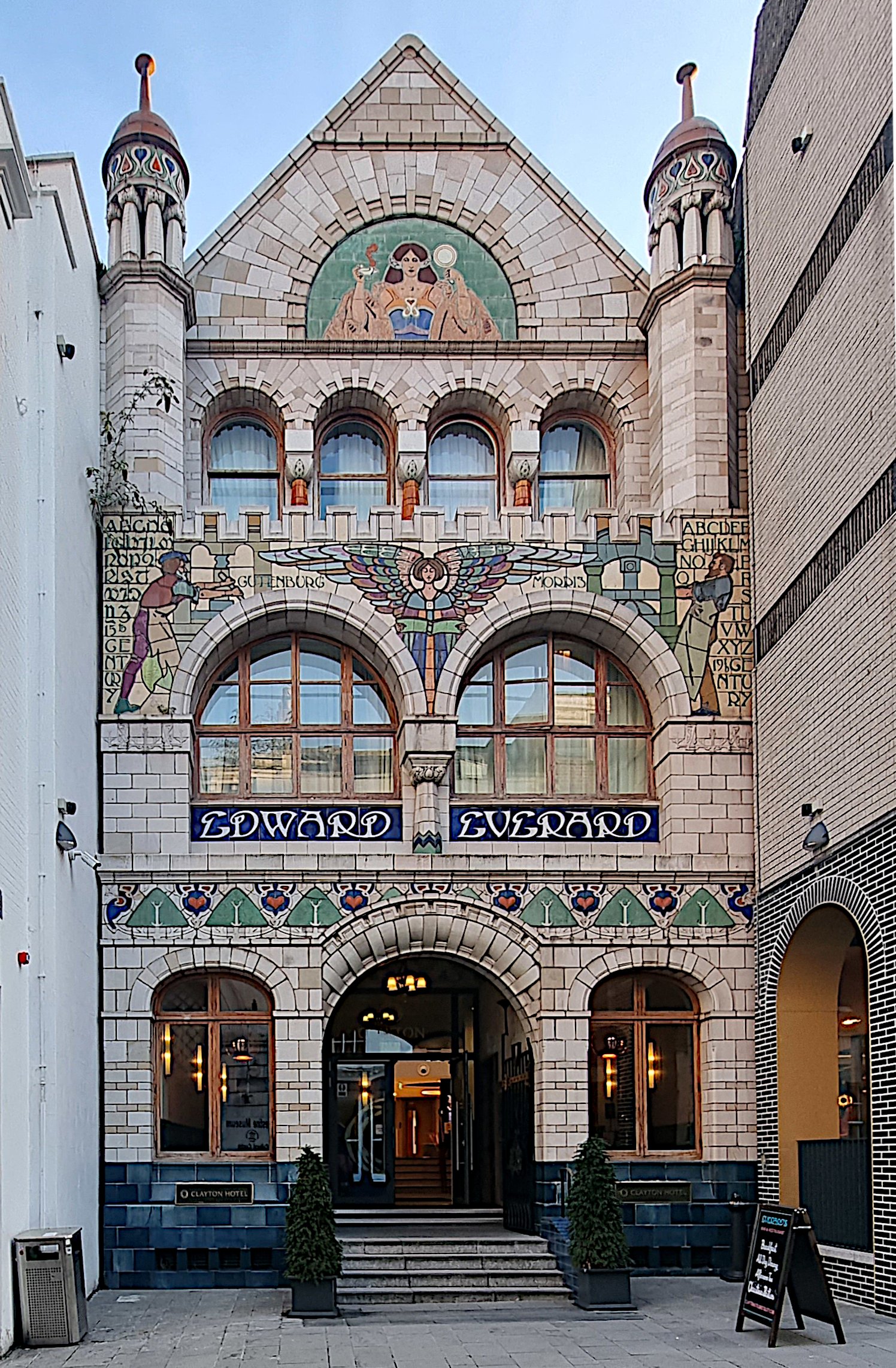
A masterwork of decorative tilework celebrating the history of printing, this Grade II* listed facade on Broad Street survives as Britain’s largest Doulton Carrara ware composition.
At a glance
Built in 1900–01 as the main works for printer Edward Everard, the building combined industrial function with artistic ambition. While the structure behind it was demolished in 1970, its spectacular ceramic tile facade was preserved and now anchors a modern hotel on the same site.
History
Henry Williams designed the building in 1900–01 to house Edward Everard’s printing operations. William James Neatby, chief designer for Doulton and Co., created the innovative Modern Style facade—a pioneering use of Doulton Carrara ware on this scale. The structure stood for seventy years before most of it was demolished in 1970, though the facade’s historical and artistic significance prompted its preservation. It was later incorporated into a NatWest bank office building, and subsequently converted to the Clayton Hotel, which opened in 2022.
What you see
The facade’s composition reflects both function and symbolism. A triple archway spans the ground floor, with paired arches on the first floor and four on the upper level. Above them stands a female figure holding a lamp and a mirror, embodying Light and Truth—ideals central to printing and literature. The arches deliberately echo the Church of St John the Baptist nearby on Broad Street, creating visual dialogue with Bristol’s architectural heritage.
The red brick building is adorned with Doulton Carrara ware tilework celebrating printing’s pioneers: William Morris and Johannes Gutenberg. Typefaces representing their contributions appear behind each figure, making the facade itself a tribute to typographic history.
Cultural significance
Everard’s Printing Works represents a rare fusion of commercial purpose and artistic expression in Edwardian Britain. Neatby’s tilework demonstrates the sophistication of decorative ceramics in early twentieth-century design, while the building’s symbolism—linking printing innovation to classical ideals—reflects the era’s reverence for both craft and enlightenment. Its survival as Britain’s largest Doulton Carrara ware facade makes it a landmark of industrial heritage and applied art.
Key facts
- Location: 37–38 Broad Street, Bristol, United Kingdom
- Coordinates: 51.45581, −2.59457
- Built: 1900–01
- Architect: Henry Williams
- Facade designer: William James Neatby (chief designer for Doulton and Co.)
- Original client: Edward Everard (printer)
- Grade II* listed building
- Largest decorative Doulton Carrara ware tile facade in Britain
Practical information & getting there
The facade is visible on Broad Street in central Bristol. The site now houses the Clayton Hotel, which opened in 2022 and is accessible to visitors. Broad Street is a major thoroughfare in Bristol’s city centre, easily reached by public transport or on foot from nearby attractions.
Sources & resources
Find it on the map
See this place and what’s around it →📷 Become a Cultural Heritage Online photographer
Share your photos of places: they stay published under your name as the author. The more they're seen, the more you get noticed — and soon a contest will reward the most appreciated photos.
Log in or sign up free to add a photoIs this page about you?
This page is read by travellers and heritage enthusiasts who find it on Google. Tell us how you are connected to this place and we will take it from there.