

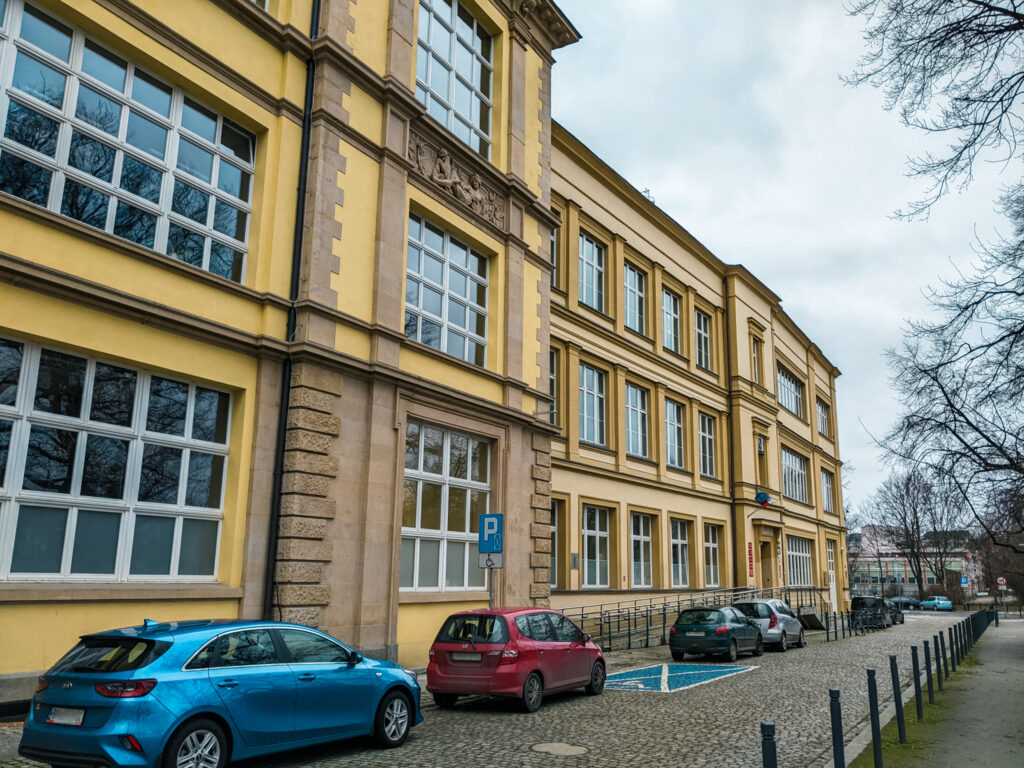
The Eugeniusz Geppert Academy of Art and Design works from a brick school building on plac Polski in Wrocław. The building went up in 1866 and 1867, and the Polish academy took it over in 1946.
At a glance
The academy is the state art school of Wrocław. It has five faculties, teaching painting, sculpture and art mediation, graphics and media art, ceramics and glass, and interior architecture, design and scenography. It occupies the building at plac Polski 3/4, on the south bank of the Odra, which is entered in the Polish register of monuments. Teaching began with the academic year that opened on 15 October 1946.
Key facts
- State art academy in Wrocław, teaching in five faculties
- Building of 1866-67 at plac Polski 3/4, entered in the register of monuments
- School founded in January 1946 by the painter Eugeniusz Geppert, its first rector
- First academic year opened on 15 October 1946
- Named the State Higher School of Fine Arts (PWSSP) from 1949, Academy of Fine Arts from 1996
- Eugeniusz Geppert added to the name in 2008
- Doctoral school in fine arts and in conservation of works of art, taught in English
History
A school of fine arts has stood in Wrocław for more than two hundred years. The one established by the Prussian king Friedrich Wilhelm II in 1791 had Carl O. Bach as its first rector. Hans Poelzig and the architect Max Berg later led it. Oscar Moll, a student of Matisse, was its last rector before National Socialism brought a break in its existence. The war left the building at plac Polski ruined in part.
The Polish school began in January 1946. The Minister of Culture and Art sent the painter Eugeniusz Geppert to Wrocław to found a higher school of fine arts. The city gave it two buildings: the former Municipal School of Crafts and Artistic Industry, and the former Academy of Art and Arts and Crafts at plac Polski. The first academic year opened on 15 October 1946. Studies began with painting, drawing and sculpture, and workshops for ceramics, glass, wood and metal followed, on a ministry instruction to train designers for the glass and ceramics industry of Lower Silesia.
The school carried the name State Higher School of Fine Arts from 1949 and became the Academy of Fine Arts in 1996; in 2008 it took the name of Eugeniusz Geppert. The main building at plac Polski was rebuilt and finished in 1964, with interiors designed by members of the staff. The five faculties of today were formed over those decades. A theatre of its own, the Teatr Sensybilistyczny, came in 1957, and the quarterly Format has appeared since 1991. A renovated wing opened in 2001, and in 2012 the academy put into use the Centre for Applied Arts.
What you see
The building at plac Polski is a brick school of the 1860s. Its walls are on the monument register, and it stands among the public buildings of the south bank. Inside are the studios of the five faculties, the rectorate, and the workshops that carry the teaching of ceramics and glass, of wood and metal, of printmaking and of conservation. The interiors were designed by teachers of the academy itself.
The Centre for Applied Arts of 2012 adds studios, laboratories and exhibition rooms to the older building. The academy runs galleries and a programme of competitions, among them the Eugeniusz Geppert Competition, the National Exhibition of Young Painting and the International Drawing Competition, the successor of the Drawing Triennale.
Practical information
- Address: plac Polski 3/4, 50-156 Wrocław
- Five faculties: painting and drawing; sculpture and art mediation; graphics and media art; ceramics and glass; interior architecture, design and scenography
- Doctoral school in fine arts and in conservation of works of art, taught in English
- Galleries and the competition programme are open to visitors; the studios are working space
- A state academy, founded in 1946 and named after Eugeniusz Geppert since 2008
Getting there
The building stands on plac Polski in the old centre of Wrocław, a few minutes on foot from the National Museum and the Sand Bridge to Ostrów Tumski.
Nearby
- National Museum in Wrocław
- Ostrów Tumski and the cathedral of St John the Baptist
- Market Square (Rynek)
- Sand Bridge (Most Piaskowy)
Sources
Find it on the map
See this place and what’s around it →📷 Become a Cultural Heritage Online photographer
Share your photos of places: they stay published under your name as the author. The more they're seen, the more you get noticed — and soon a contest will reward the most appreciated photos.
Log in or sign up free to add a photoIs this page about you?
This page is read by travellers and heritage enthusiasts who find it on Google. Tell us how you are connected to this place and we will take it from there.
This entry stays online and free either way — and a free account lets you add to it yourself.