
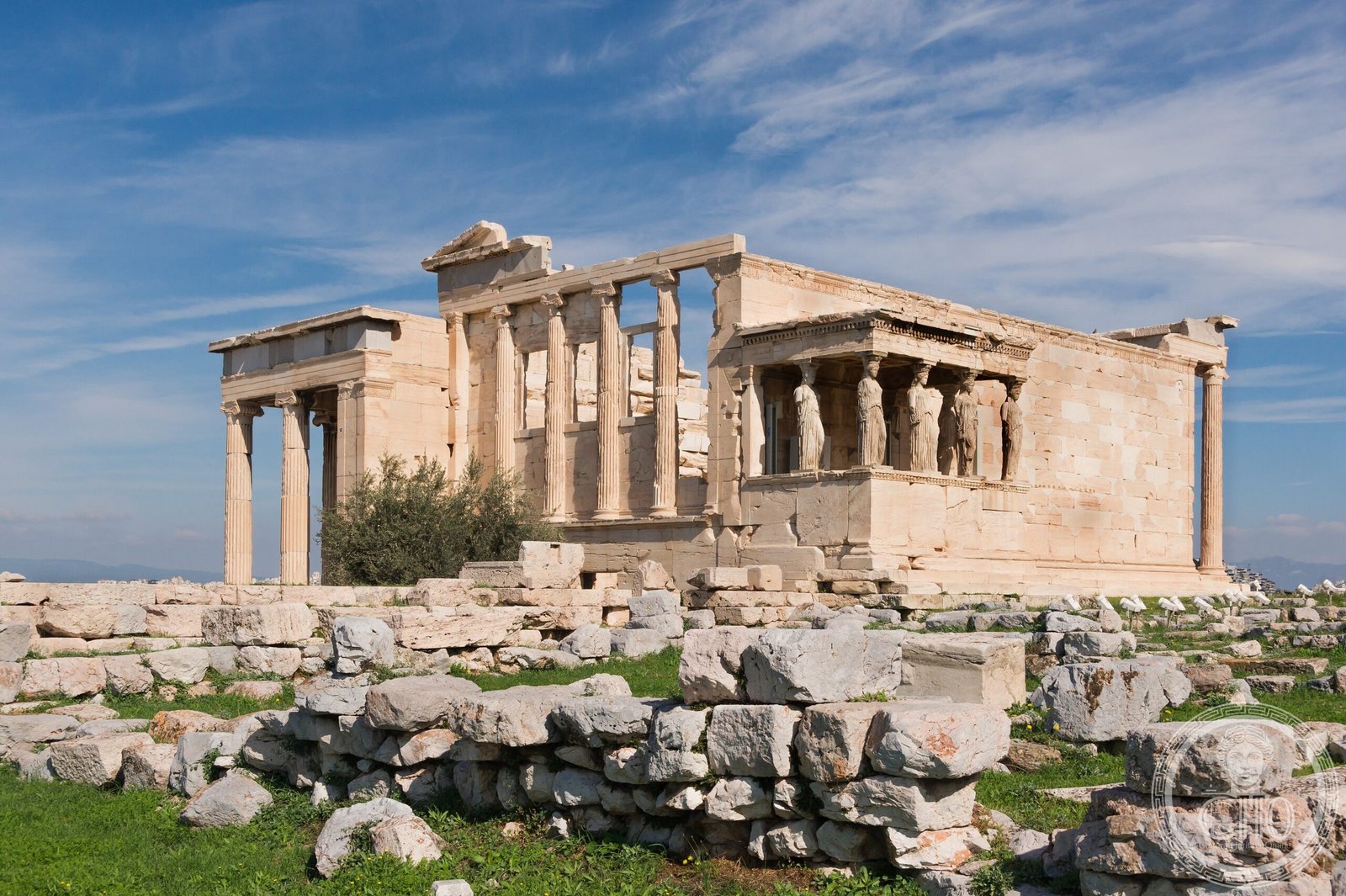
An asymmetrical Ionic temple on the north side of the Acropolis, dedicated to Athena and housing her ancient wooden statue. Its unconventional design and layered history make it one of classical archaeology’s most enigmatic monuments.
At a glance
The Erechtheion stands as an exception to Greek classical canon. Its irregular footprint, multi-chambered interior, and dual religious purpose defied architectural symmetry. The building housed the venerated statue of Athena Polias and served as a shrine to multiple deities across overlapping cults.
History
The precise construction date remains disputed. Traditionally dated to c. 421–406 BCE, recent scholarship favours the 430s, potentially as part of Pericles’ broader Acropolis programme. The Ionic temple succeeded multiple earlier buildings on the site, each layer reflecting evolving religious practices. The joint cult of Athena and Poseidon-Erechtheus appears ancient, rooted in Homeric tradition and sustained through classical Greek texts.
Scholarly consensus has fragmented over what the building actually represents. Ancient sources, particularly the geographer Pausanias, refer to both a Temple of Athena Polias and a separate Erechtheion, yet whether these were one structure or two remains unresolved. Alternative locations proposed for the true Erechtheion include the Arrephorion, Sanctuary of Zeus Polieus, Sanctuary of Pandion, and Dörpfeld foundations.
Official Athenian decrees adopted neutral language, calling it simply “the temple on the Acropolis within which is the ancient statue.”
What you see
The Erechtheion’s most distinctive feature is its asymmetrical composition, an anomaly in Greek temple design. This irregularity reflects either the site’s topography or the complex, evolving nature of the cults it served—or possibly an incomplete phase of a larger symmetrical plan. Its post-classical history of reuse, damage, and spoliation has further complicated interpretation of its interior arrangement and religious functions.
The temple exemplifies the classical Ionic order at its finest, with refined proportions that would profoundly influence Hellenistic, Roman, and later Greek Revival architecture throughout the Mediterranean world.
Cultural significance
The Erechtheion represents a watershed in classical architectural thought. Rather than rigid adherence to symmetrical order, it demonstrates how religious complexity and site constraints could generate innovation. Its influence extended across centuries of Western architecture, serving as a model for revival movements centuries later.
Key facts
- Location: North side of the Acropolis, Athens, Greece
- Coordinates: 37.9721°N, 23.7265°E
- Architectural order: Ionic
- Traditional construction dates: c. 421–406 BCE
- Recent scholarly dating: 430s BCE
- Primary dedication: Athena Polias
Practical information & getting there
The Erechtheion is accessible as part of the Acropolis archaeological site. Consult official Acropolis ticketing and visitor information for current hours and admission requirements. You can combine a visit with the nearby Parthenon and Acropolis Museum to experience the full scope of classical Athenian religious architecture.
Sources & resources
Find it on the map
See this place and what’s around it →📷 Become a Cultural Heritage Online photographer
Share your photos of places: they stay published under your name as the author. The more they're seen, the more you get noticed — and soon a contest will reward the most appreciated photos.
Log in or sign up free to add a photoIs this page about you?
This page is read by travellers and heritage enthusiasts who find it on Google. Tell us how you are connected to this place and we will take it from there.