
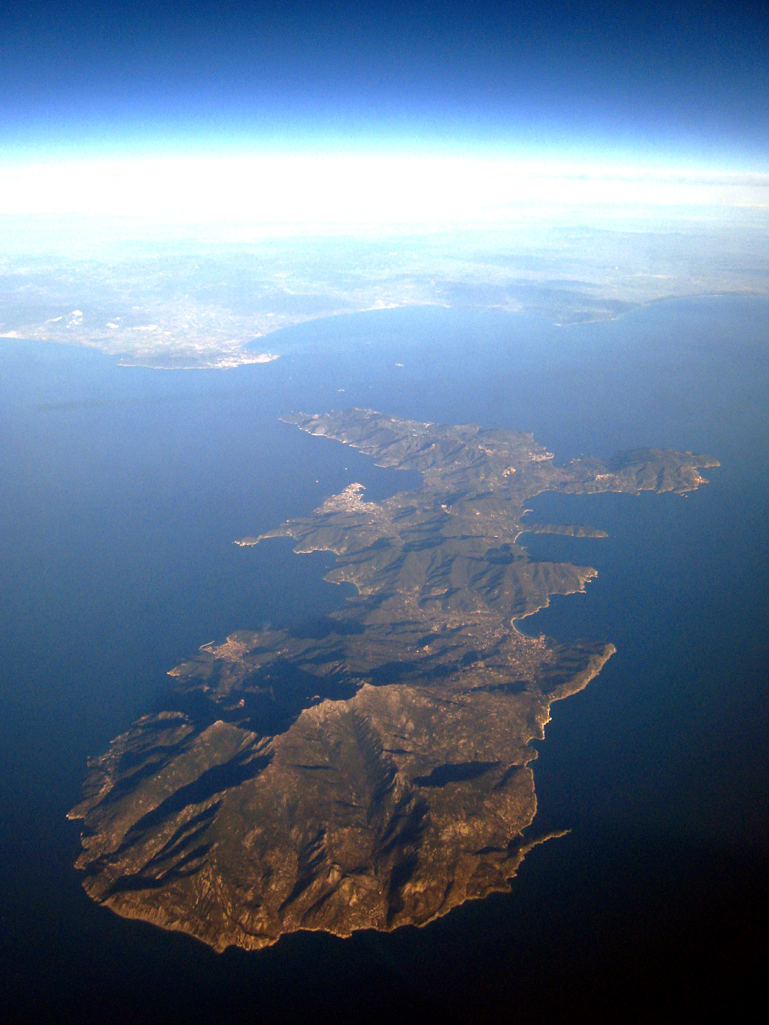
The third largest island in Italy and the largest of the Tuscan Archipelago, ten kilometres off the mainland: a granite massif rising to 1,019 metres, seven municipalities, and the two houses where Napoleon spent his exile.
At a glance
- Surface
- 223.5 km², third largest Italian island
- Extent
- 27 km east to west, 18 km north to south
- Highest point
- Monte Capanne, 1,019 m — the highest summit of the archipelago
- Municipalities
- Seven, all in the province of Livorno
- Protection
- Parco Nazionale dell’Arcipelago Toscano
- Distance from the mainland
- About 10 km
Overview
Elba lies between the Piombino channel to the east, the Tyrrhenian Sea to the south and the Corsica channel to the west, about ten kilometres from the Tuscan coast. At 223.5 square kilometres it is the third largest island in Italy and by a wide margin the largest of the Tuscan Archipelago.
Its seven municipalities are Campo nell’Elba, Capoliveri, Marciana, Marciana Marina, Porto Azzurro, Portoferraio and Rio, with some thirty-one thousand residents between them. The count is recent: until the end of 2017 there were eight, and Rio Marina and Rio nell’Elba merged into the single comune of Rio on 1 January 2018 after a referendum.
History
The island belongs to the Parco Nazionale dell’Arcipelago Toscano together with Pianosa, Capraia, Gorgona, Montecristo, Giglio and Giannutri, the largest protected marine area in Europe.
Its best-known chapter is short and consequential. Napoleon Bonaparte was sovereign of Elba for less than a year, and the two residences he used are now state museums of the Ministry of Culture, administered by the regional directorate of national museums in Tuscany: the Palazzina dei Mulini in Portoferraio, high above the harbour, and Villa San Martino in the countryside behind it.
The other history here is geological and industrial. The iron of the eastern side was worked from Etruscan times and made the island a mining district into the twentieth century; the granite of the western massif built churches across the Mediterranean.
What you see
The west is dominated by the granite massif of Monte Capanne, at 1,019 metres the highest point of the whole archipelago, with a view that takes in Elba, the Tuscan coast, Corsica and the minor islands. The traverse of the island on foot crosses it, moving between cliffs and dunes, garrigue and Mediterranean scrub, rocky summits and flowering plateaus, with wild boar and mouflon along the way.
The settlements each keep a distinct character: Portoferraio with its Medicean fortifications, Capoliveri on its ridge, Marciana in the mountains, Porto Azzurro, Marina di Campo, Rio and San Piero. At San Piero in Campo the MUM – Museo Mineralogico Luigi Celleri holds the minerals that made the island famous among collectors.
Practical information
- Getting there: ferries from Piombino to Portoferraio, Rio Marina and Cavo, about an hour’s crossing
- Napoleonic museums: Palazzina dei Mulini and Villa San Martino, both state museums — check current opening and any restoration closures with the Direzione regionale Musei nazionali Toscana before travelling
- MUM – Museo Mineralogico Luigi Celleri: via Cavour 73, San Piero in Campo, comune di Campo nell’Elba
- Walking: the island traverse is best done with local guides; footwear for rock and scrub, water carried
Sources
- Parco Nazionale dell’Arcipelago Toscano, official page on the Isola d’Elba (surface, extent, Monte Capanne, the seven comuni) — islepark.it
- Regione Toscana, Legge Regionale 5 dicembre 2017 n. 65, establishing the comune of Rio by merger, effective 1 January 2018
- Ministero della Cultura, entries for the Museo nazionale delle residenze napoleoniche “Palazzina dei Mulini” and “Villa S. Martino”
- Ministero della Cultura, Catalogo generale dei Beni Culturali, entry for MUM – Museo Mineralogico Luigi Celleri
See the place
Find it on the map
See this place and what’s around it →Historical events at this place (1)
📷 Become a Cultural Heritage Online photographer
Share your photos of places: they stay published under your name as the author. The more they're seen, the more you get noticed — and soon a contest will reward the most appreciated photos.
Log in or sign up free to add a photo