
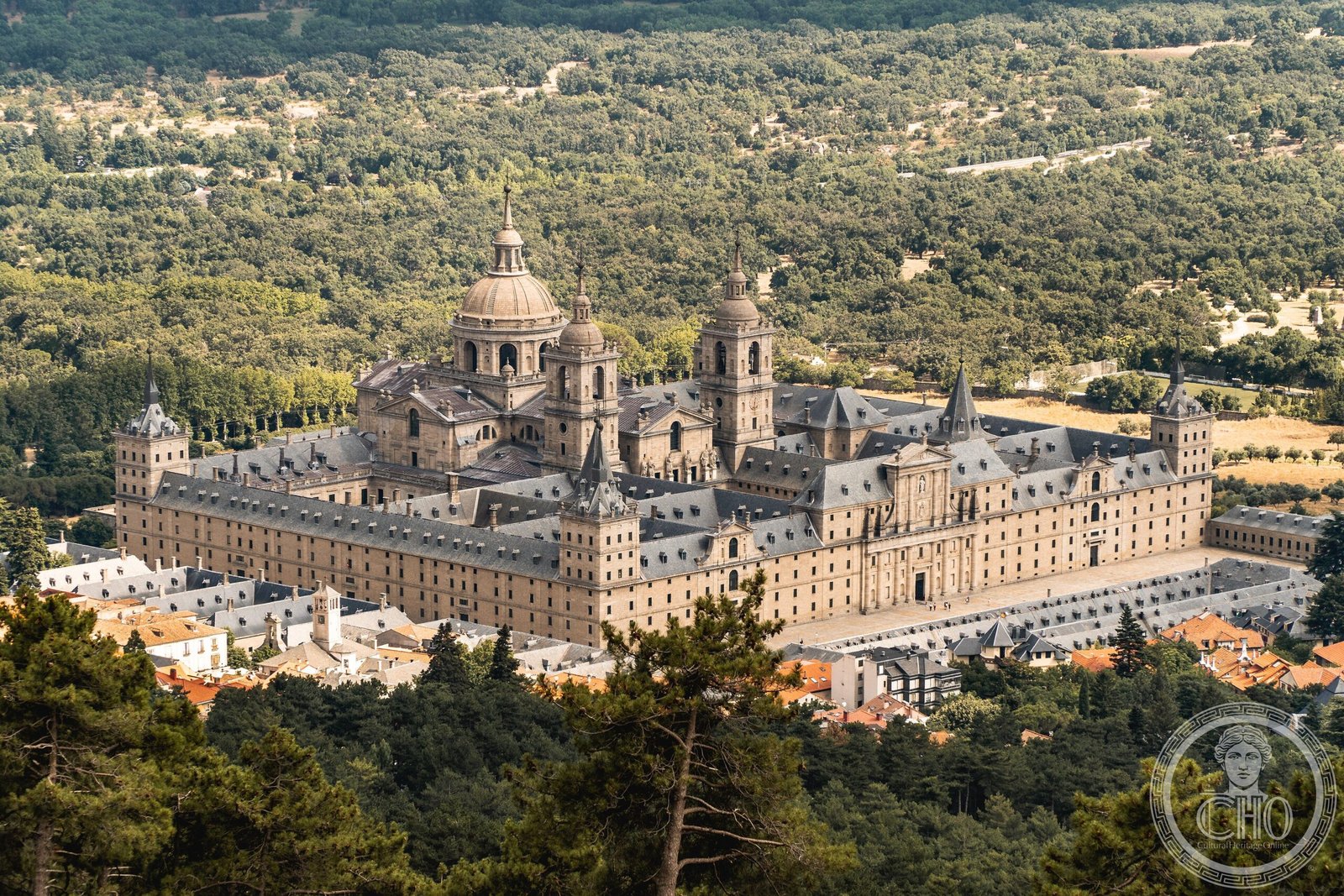
Philip II’s monumental palace-monastery northwest of Madrid stands as the largest Renaissance building ever constructed, merging royal power and Catholic faith in a single architectural statement.
At a glance
El Escorial is a sprawling royal residence 45 kilometres northwest of Madrid, serving simultaneously as monastery, basilica, palace, pantheon, library, museum, school, and hospital. Built over two decades for Spain’s most powerful Renaissance king, it represents an unparalleled fusion of secular and sacred authority. The complex encompasses not only the main monastery but also La Granjilla de La Fresneda, a royal hunting lodge five kilometres distant.
History
King Philip II commissioned the complex in 1563, engaging Spanish architect Juan Bautista de Toledo, who had earned his reputation working on St. Peter’s Basilica in Rome and serving the royal viceroy in Naples. Construction continued until 1584, creating a monument intended to showcase Spain’s position as the Christian world’s leading power.
Originally established with a community of Hieronymite monks, El Escorial later became home to the Order of Saint Augustine. A boarding school, the Real Colegio de Alfonso XII, operated within its walls and continues today. UNESCO recognised the site as a World Heritage monument in 1984.
What you see
El Escorial’s massive footprint encompasses two distinct architectural complexes. The main monastery combines palace and religious spaces in a layout that reflects both royal governance and spiritual devotion. Every element serves the dual purpose of displaying monarchical might while advancing the Catholic faith—a visual theology of power made stone.
Cultural significance
Few buildings so completely embody the ambitions of a single ruler or era. El Escorial stands as the physical manifestation of 16th-century Spanish dominance, when the kingdom controlled vast territories and the Catholic Counter-Reformation shaped European politics. The complex demonstrates how Renaissance architecture could serve simultaneously as a seat of government and a place of monastic contemplation.
Key facts
- Country: Spain
- Location: San Lorenzo de El Escorial, 45 km northwest of Madrid
- Coordinates: 40.59°N, 4.15°W
- Built: 1563–1584
- Commissioned by: King Philip II
- Architect: Juan Bautista de Toledo
- UNESCO World Heritage Site: Designated 1984
- Annual visitors: More than 500,000
Practical information & getting there
The complex lies in the town of San Lorenzo de El Escorial, accessible from Madrid by road—approximately 45 kilometres northwest of the capital. The site attracts hundreds of thousands of visitors annually, many arriving as day-trippers from Madrid. For current opening hours, ticket prices, and detailed visiting information, consult official tourism resources.
Sources & resources
Find it on the map
See this place and what’s around it →📷 Become a Cultural Heritage Online photographer
Share your photos of places: they stay published under your name as the author. The more they're seen, the more you get noticed — and soon a contest will reward the most appreciated photos.
Log in or sign up free to add a photoIs this page about you?
This page is read by travellers and heritage enthusiasts who find it on Google. Tell us how you are connected to this place and we will take it from there.