
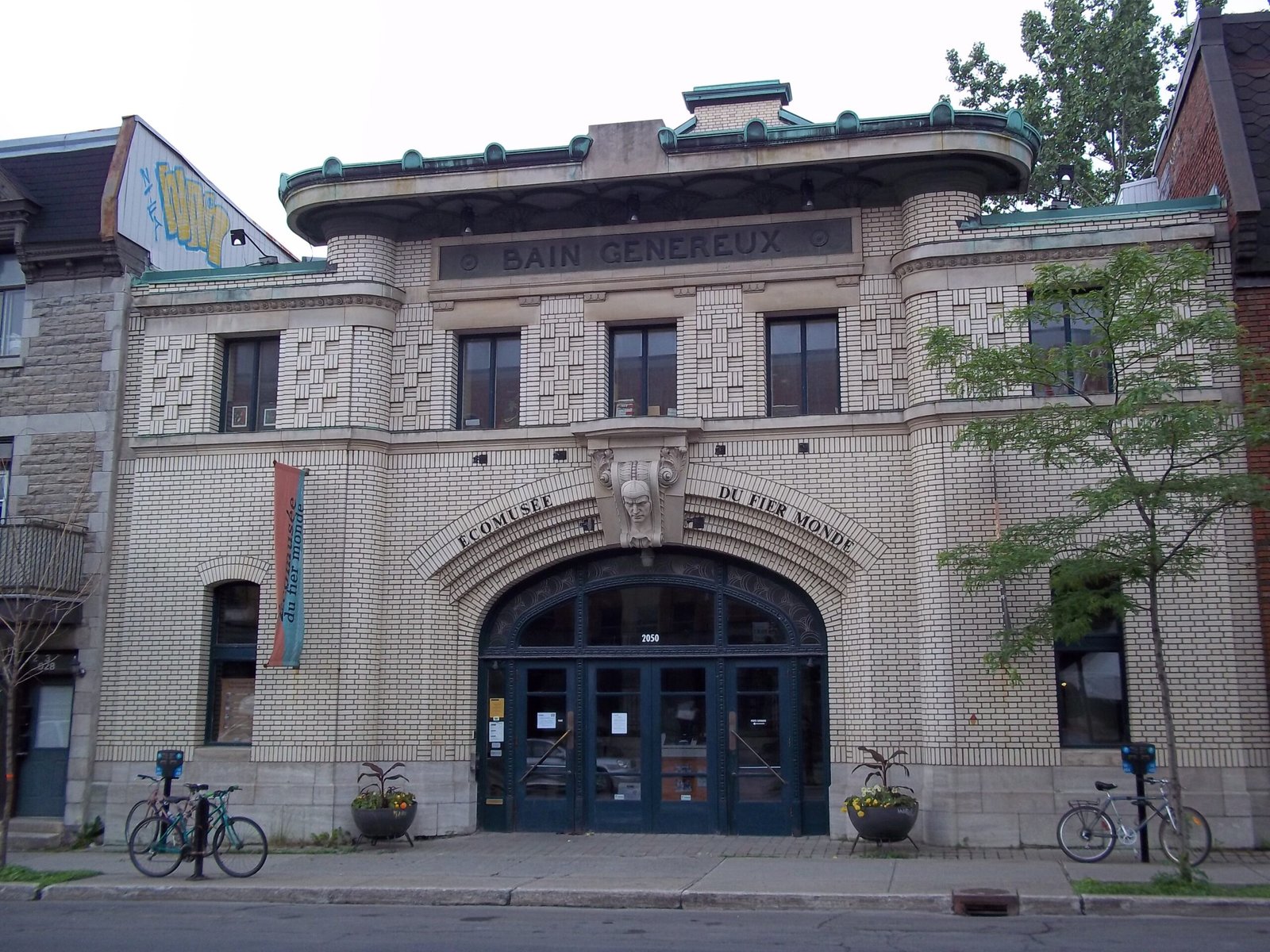
A community ecomuseum dedicated to the industrial heritage and working-class history of Montreal’s Centre-Sud neighbourhood, whose name translates to “Ecomuseum of the Proud People.”
At a glance
The Écomusée du fier monde preserves and interprets the social and industrial legacy of Centre-Sud, one of Montreal’s historic working-class districts. Rather than a traditional museum building, it functions as a community ecomuseum—an institution that engages residents and extends across multiple sites and narratives within the neighbourhood itself.
History
Centre-Sud developed as a hub for manufacturing and labour in Montreal’s industrial era. The ecomuseum emerged as a response to the need to document and celebrate the contributions of working-class communities whose stories were often overlooked in mainstream heritage institutions.
What you see
The ecomuseum operates across the neighbourhood rather than within a single building, connecting visitors to sites of industrial and residential significance. Its structure reflects the concept of community-centred heritage interpretation, weaving together physical spaces, archival materials, and resident knowledge.
Cultural significance
The institution validates and amplifies voices typically marginalised in heritage narratives. It demonstrates how working-class history—shaped by labour, manufacturing, immigration, and community resilience—forms a vital part of Montreal’s urban identity and Canadian industrial heritage.
Key facts
- Location: Montreal, Canada
- Coordinates: 45.5204°N, 73.5638°W
- Focus: Industrial and working-class history of Centre-Sud neighbourhood
- Type: Community ecomuseum
Practical information & getting there
The Écomusée du fier monde is located in the Centre-Sud neighbourhood of Montreal. For current visiting hours, exhibitions, and community programmes, consult the institution’s website or contact them directly. The neighbourhood is accessible by public transit.
Sources & resources
Find it on the map
See this place and what’s around it →📷 Become a Cultural Heritage Online photographer
Share your photos of places: they stay published under your name as the author. The more they're seen, the more you get noticed — and soon a contest will reward the most appreciated photos.
Log in or sign up free to add a photoIs this page about you?
This page is read by travellers and heritage enthusiasts who find it on Google. Tell us how you are connected to this place and we will take it from there.