

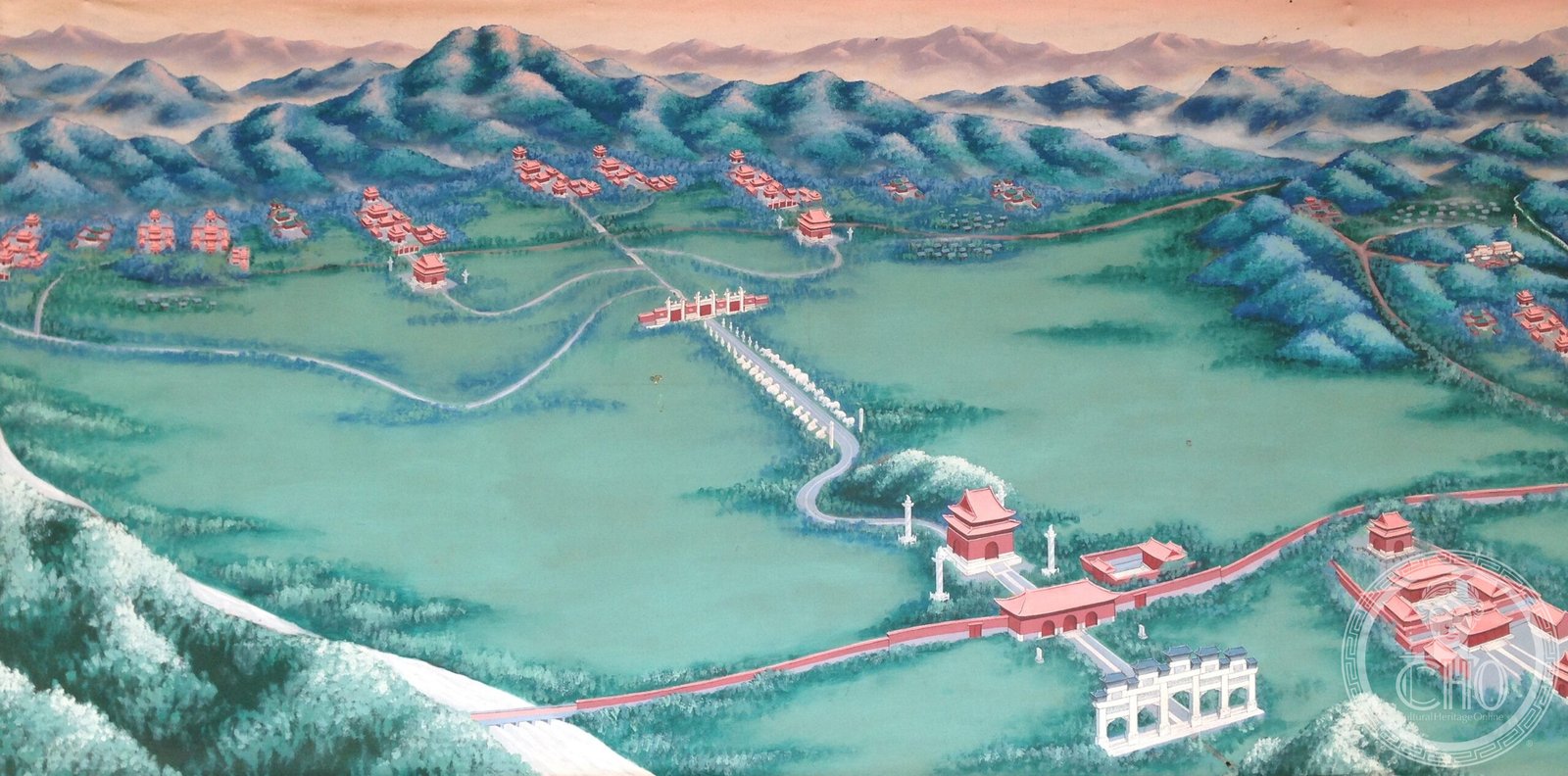
An imperial mausoleum complex housing five emperors, fifteen empresses, and over a hundred other members of the Qing court, set within a vast sacred landscape 125 kilometres northeast of Beijing.
At a glance
The Eastern Qing Tombs represent China’s largest, most complete, and best-preserved imperial mausoleum complex. Five emperors—Shunzhi, Kangxi, Qianlong, Xianfeng, and Tongzhi—rest here alongside fifteen empresses, 136 imperial concubines, three princes, and two princesses. The site stretches across 80 square kilometres, surrounded by four mountains: Changrui, Jinxing, Huanghua, and Yingfei Daoyang.
History
Established during the Qing dynasty (1644–1912), the Eastern Qing Tombs became the burial ground for successive imperial families. The complex grew over centuries as each emperor and his court were interred according to traditional Qing ceremonial practices. The preservation of five imperial tombs within one complex reflects the dynasty’s stability and organizational capacity.
What you see
The mausoleum complex showcases imperial Qing funerary architecture at its most elaborate. Structures include ceremonial halls, spirit ways, and individual imperial tombs arranged across the mountainous terrain. The site’s scale and architectural cohesion demonstrate the sophistication of Qing imperial planning and construction.
Cultural significance
The Eastern Qing Tombs stand as testimony to the Qing dynasty’s power, wealth, and cultural refinement. As the final resting place of some of China’s most significant emperors—including the Kangxi and Qianlong emperors, who presided over periods of expansion and cultural flourishing—the complex holds immense historical weight. Its integrity and completeness make it invaluable for understanding imperial funerary practices and late-imperial Chinese civilization.
Key facts
- Country: China
- Location: Zunhua County, Tangshan, Hebei Province
- Distance from Beijing: 125 kilometres (78 miles) northeast
- Area: 80 square kilometres
- Imperial burials: 5 emperors, 15 empresses, 136 concubines, 5 princes and princesses
- Coordinates: 40.1858°N, 117.6469°E
Practical information & getting there
The Eastern Qing Tombs are accessible from Beijing by road, approximately two hours’ drive northeast. Consult local tourism offices for current opening hours, entry fees, and guided tour options. The site’s scale means planning several hours for a meaningful visit.
Sources & resources
Find it on the map
See this place and what’s around it →📷 Become a Cultural Heritage Online photographer
Share your photos of places: they stay published under your name as the author. The more they're seen, the more you get noticed — and soon a contest will reward the most appreciated photos.
Log in or sign up free to add a photo