
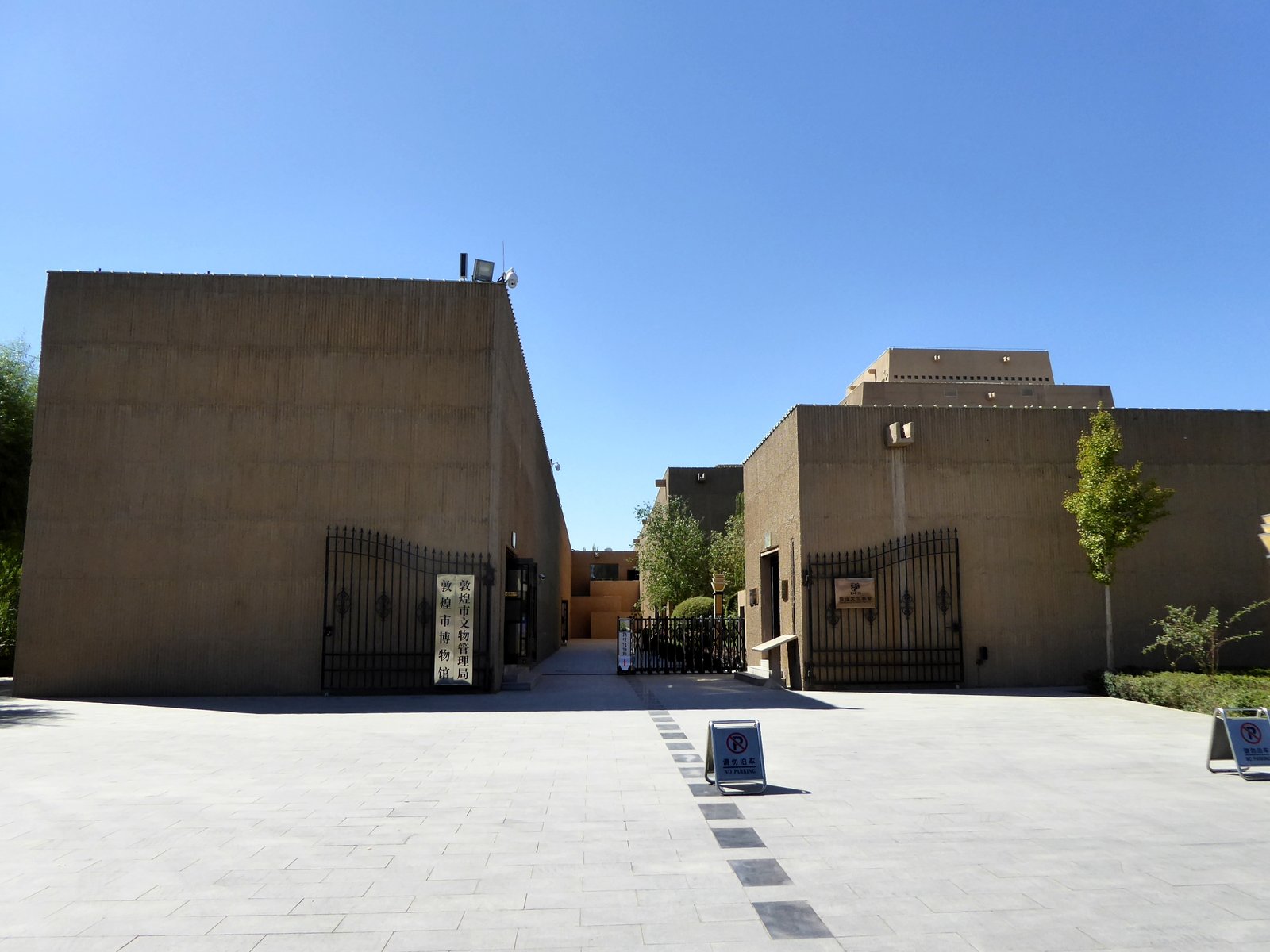
A repository of treasures from the Silk Road, this museum preserves manuscripts, artifacts, and textiles that illuminate China’s cultural exchanges across centuries.
At a glance
Dunhuang Museum holds manuscripts and objects retrieved from the Mogao Caves, one of the world’s most significant Buddhist archaeological sites. The collection spans Chinese and Tibetan cultures, revealing domestic life and artistic traditions of the ancient Silk Road.
History
The museum’s core collection derives from the Mogao Caves, a complex of nearly 500 rock-cut temples carved between the 4th and 14th centuries. Cave 17, sealed for centuries, yielded thousands of manuscripts and documents when discovered—a repository of religious texts, administrative records, and literary works that transformed understanding of medieval Central Asia.
What you see
The museum is organized into three focused exhibitions. One examines Cave 18 of the Mogao complex and its artistic significance. A second explores tombs of early Chinese dynasties, displaying burial goods and ritual objects. The third showcases decorative textiles: brocade, grosgrain, silk, and other fabrics that demonstrate the region’s mastery of textile arts and its role in Silk Road trade.
Cultural significance
Dunhuang Museum serves as a window into the cosmopolitan world of medieval Central Asia. The artifacts illuminate the intersection of Chinese, Buddhist, Persian, and Indian cultures at a crossroads of commerce and faith. The manuscripts and textiles are primary witnesses to intellectual life, artistic technique, and daily practice along the ancient Silk Road.
Key facts
- Location: Dunhuang, Gansu Province, China
- Coordinates: 40.12863°N, 94.66041°E
- Primary collections: Mogao Caves manuscripts, early dynasty tombs, Silk Road textiles
Practical information & getting there
The museum is located in Dunhuang, a historic oasis town in northwestern China on the Silk Road. For current hours, admission fees, and visiting conditions, consult local tourism resources or the museum directly before your visit.
Sources & resources
Find it on the map
See this place and what’s around it →📷 Become a Cultural Heritage Online photographer
Share your photos of places: they stay published under your name as the author. The more they're seen, the more you get noticed — and soon a contest will reward the most appreciated photos.
Log in or sign up free to add a photoIs this page about you?
This page is read by travellers and heritage enthusiasts who find it on Google. Tell us how you are connected to this place and we will take it from there.