

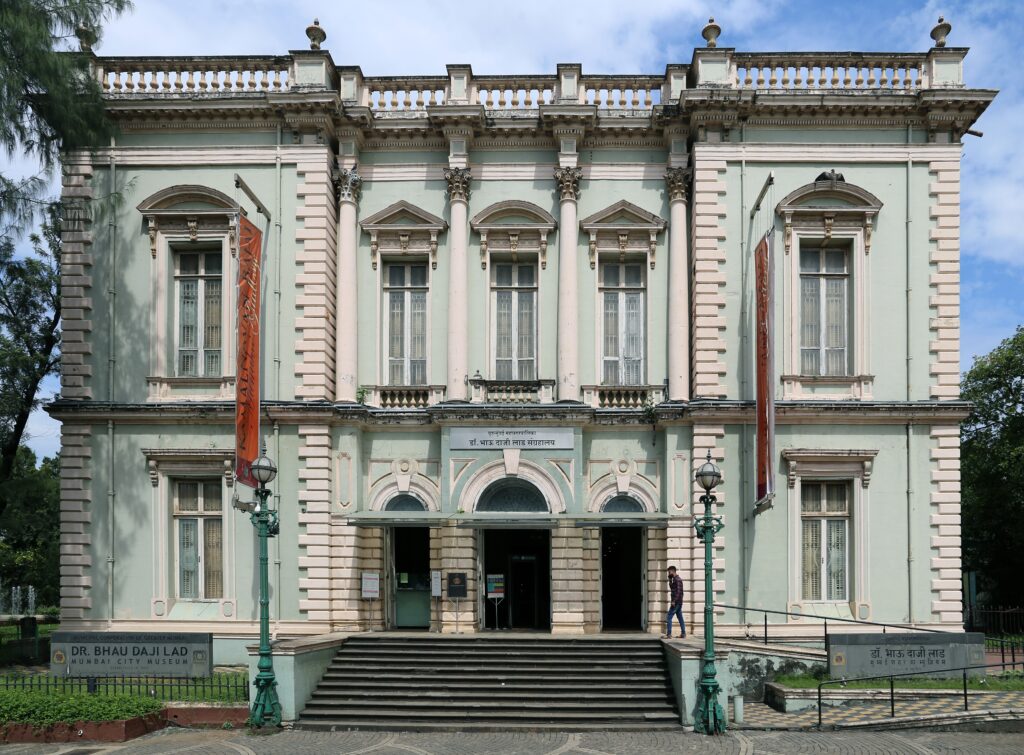

The former Victoria and Albert Museum of Bombay, paid for by public subscription and opened in 1872 inside the Victoria Gardens at Byculla. By the museum’s own account it was the first building in colonial Bombay put up specifically to house a museum.
At a glance
The Dr. Bhau Daji Lad Museum is the city museum of Mumbai and, by its own account, the oldest museum in the city. Its collection began in 1855; its present home, a two-storey building with a Palladian exterior and a High Victorian interior of cast iron, gilding and patterned tiles, opened on 2 May 1872 as the Victoria and Albert Museum, Bombay. It stands in the grounds of Jijamata Udyan, the garden laid out in the 1860s as the Victoria Gardens, and is an institution of the Municipal Corporation of Greater Mumbai. In 1975 it took the name of Dr. Bhau Daji Lad, the physician and historian who raised much of the money to build it. A restoration led by INTACH won a UNESCO Asia-Pacific Heritage Award of Excellence in 2005.
Key facts
- Where: Veer Mata Jijabai Bhosale Udyan (Rani Baug), 91/A Dr Babasaheb Ambedkar Road, Byculla East, Mumbai 400027, Maharashtra
- Collection founded: 1855, as the Government Central Museum, in the Town Barracks in the Fort
- Foundation stone: laid by Governor Bartle Frere in November 1862 (the museum gives 19 November)
- Opened in this building: 2 May 1872, as the Victoria and Albert Museum, Bombay
- Design: first conceived by George Birdwood, revised by a Public Works Department engineer and completed by the architects Scott McClelland & Co., according to the museum
- Renamed: Dr. Bhau Daji Lad Museum, 1 November 1975
- Restoration: INTACH, with the Municipal Corporation and the Jamnalal Bajaj Foundation, 2003–2008; reopened 4 January 2008
- Recognition: UNESCO Asia-Pacific Heritage Awards for Culture Heritage Conservation, Award of Excellence, announced in Bangkok on 1 September 2005
- Coordinates: 18.979472, 72.834806 · open in Google Maps
History
The museum was born of an exhibition. When London prepared the Great Exhibition of 1851, and Paris its Universal Exhibition of 1855, the Bombay Presidency sent crafts, raw materials and manufactured goods to both. The duplicates of the objects sent to Paris stayed behind and became the nucleus of a new collection, set up in 1855 in the Town Barracks in the Fort as the Government Central Museum. Dr. George Buist, editor of the Bombay Times, was its first secretary and curator.
The barracks were not a safe home. In 1857 they were requisitioned for British troops and many objects were damaged; what survived was moved to the Town Hall, the building that now houses the Asiatic Society, where it stayed for years. In 1858 a group of citizens decided that the first important public institution of the city would be a museum with a natural history and botanical garden. A public meeting in the Town Hall, chaired by the merchant Jugonnath Sunkarsett and attended by Hindu, Muslim, Christian and Parsi patrons, was called to raise the money for a building dedicated to Queen Victoria.
The two secretaries of the Museum Committee were Dr. Bhau Daji Lad and Dr. George Birdwood. The museum credits Bhau Daji as the most persuasive of the fundraisers: Rs 1,16,141 came from public subscription and the government added Rs 1,00,000. It still took ten years. Governor Bartle Frere laid the foundation stone in November 1862, and the Victoria and Albert Museum, Bombay, opened to the public on 2 May 1872.
In 1903 Cecil L. Burns, principal of the School of Art, took charge. He set about repairing a building that had already fallen into disrepair, had three-dimensional models and dioramas made to show life in Bombay and the growth of the city, and sent the stuffed animals to the Haffkine Institute and the larger archaeological pieces to the Prince of Wales Museum. On 1 November 1975 the museum was renamed after Bhau Daji Lad, who had also been the first Indian Sheriff of the city.
By the late 1990s the building was in poor condition. INTACH, the Indian National Trust for Art and Cultural Heritage, visited in 1997, and in February 2003 a tripartite agreement between the Municipal Corporation, the Jamnalal Bajaj Foundation and INTACH created the museum trust that restored it. The museum records algae across the facade, plant roots deep in the walls, cast-iron columns separating from the walls and the original colours and gilding covered by off-white paint. About four thousand objects were conserved. UNESCO, announcing the award in September 2005, said the project established a new benchmark for the conservation of museums in India and the region. The galleries reopened on 4 January 2008. After a long closure during the pandemic and a further round of repairs by the municipality, the museum reopened again on 8 January 2025.
What you see
The photograph shows the entrance front: two storeys, painted a pale sea green, with every frame, band and moulding picked out in cream. The two ends of the facade are treated as solid blocks, edged with stacked cream blocks, and each has a single tall window on each floor, the upper one under a curved pediment. Between them the centre opens up. On the upper storey four columns with dark, deeply carved Corinthian capitals frame three windows whose pediments alternate, triangular, curved, triangular, each window standing on a small balustraded balcony. Above, a toothed cornice runs the full width, and the roofline is a continuous balustrade with urns at the corners.
The ground floor is quieter. Three arched doorways, the middle one larger, sit under a flat modern canopy, with a keystone over the central arch and, above it, a Marathi board naming the Brihanmumbai municipal corporation and the museum. A broad flight of steps leads up from the forecourt between two green cast-iron lamp standards with globe lanterns. Low stone signs stand on either side, one in Devanagari script and one in English, which reads Dr. Bhau Daji Lad Mumbai City Museum, Established in 1855. Long red exhibition banners hang from the two end blocks.
The photograph stops at the door. According to the museum, the interior holds what the facade only announces: wrought-iron galleries and staircase railings, arched iron supports and Corinthian capitals imported from England, Minton floor tiles, etched glass and gilding, much of it brought back in the 2003–2008 restoration.
Practical information
- The building is a working museum run under the Municipal Corporation of Greater Mumbai, with galleries on the history of the city and on the decorative and industrial arts.
- It is closed on Wednesdays. Check current hours with the museum before a visit.
- The museum stands inside the grounds of Jijamata Udyan; the entrance front faces Dr Babasaheb Ambedkar Road.
- The east garden of the museum, with its colonial statues and the Elephanta elephant, is part of the visit.
Getting there
Byculla station on the Mumbai suburban railway is about 400 metres from the museum, a short walk south-west. City buses stop at Jijamata Udyan, directly outside, on Dr Babasaheb Ambedkar Road. From the Fort and Chhatrapati Shivaji Maharaj Terminus the museum lies about 4.5 km to the north.
Nearby
- Jijamata Udyan, the garden around the museum. It was established in 1861 as the Victoria Gardens and now also holds the city zoo.
- The Elephanta elephant, in the museum’s east garden: a stone elephant from Elephanta Island, which the museum dates to the 6th century and counts among the city’s most important artefacts.
- The Gas Lamp, also in the east garden, which once stood at the Metro cinema crossing.
- Further south, about 4.5 km away: Chhatrapati Shivaji Maharaj Terminus, the Victorian Gothic railway terminus of the city.
Sources
- Dr. Bhau Daji Lad Mumbai City Museum, Museum Story: founding in 1855, the 1857 move, the 1858 meeting, the subscription, the 1862 foundation stone, the 1872 opening, the design history, Burns, the 1975 renaming. Read in the Internet Archive copy; the live site blocks automated reading.
- Dr. Bhau Daji Lad Mumbai City Museum, Restoration: the INTACH project, the 2003 agreement, the condition of the building, the objects conserved.
- UNESCO Bangkok, media release of 1 September 2005: the Award of Excellence in the 2005 Asia-Pacific Heritage Awards and the jury’s citation.
- ETV Bharat, January 2025: the reopening of 8 January 2025 after the municipal renovation, and the Wednesday closing day.
- Lyla Bavadam, “Rooting for a garden”, Frontline 28/10, May 2011: the Victoria Gardens established in 1861.
- OpenStreetMap / Nominatim: position and address, returned as Dr Baba Saheb Ambedkar Marg (Victoria Garden Road), Byculla East, Mumbai 400027.
- Wikipedia, Dr. Bhau Daji Lad Museum, for cross-checking dates.
Find it on the map
See this place and what’s around it →📷 Become a Cultural Heritage Online photographer
Share your photos of places: they stay published under your name as the author. The more they're seen, the more you get noticed — and soon a contest will reward the most appreciated photos.
Log in or sign up free to add a photoIs this page about you?
This page is read by travellers and heritage enthusiasts who find it on Google. Tell us how you are connected to this place and we will take it from there.