
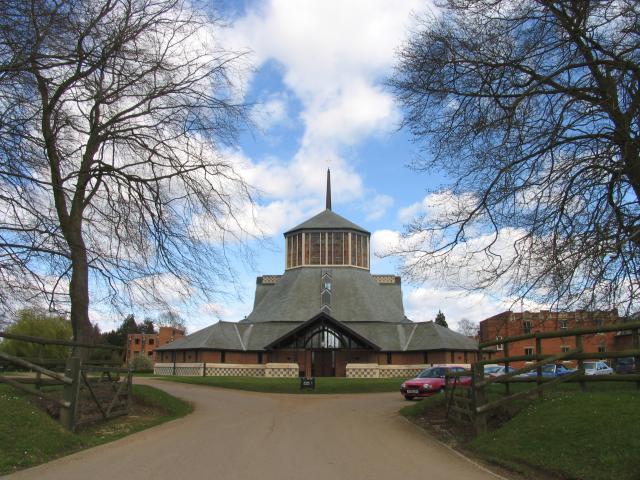
A Benedictine monastery founded by French monks who fled anti-clerical legislation, Douai Abbey stands as a refuge of religious continuity in rural Berkshire.
At a glance
Douai Abbey is a working Benedictine community nestled near Thatcham in Upper Woolhampton. The abbey church holds Grade II* status on the National Heritage List for England, recognizing its architectural and historical importance.
History
The monastery traces its roots to St. Edmund’s Abbey in Douai, France, where a monastic community had long thrived. In 1903, anti-clerical legislation in France prompted the monks to seek refuge abroad. They relocated to Woolhampton, establishing themselves in the English countryside and continuing their religious life under the jurisdiction of the Roman Catholic Diocese of Portsmouth.
What you see
The abbey church, the focal point of the complex, earns its Grade II* listing through distinctive architectural merit. The building reflects the monastic traditions of the Benedictine order while adapting to its English setting in the early twentieth century.
Cultural significance
Douai Abbey embodies the broader history of religious displacement and resilience across Europe. The community’s transplantation from France to England illustrates how monastic life persisted despite political upheaval, and the abbey remains an active centre of Christian contemplation and worship.
Key facts
- Location: Upper Woolhampton, near Thatcham, Berkshire, United Kingdom
- Coordinates: 51.4092, −1.1718
- Founded at current location: 1903
- Original community: St. Edmund’s Abbey, Douai, France
- Denomination: Roman Catholic (Benedictine)
- Abbey church grade: II* (National Heritage List for England)
Practical information & getting there
Douai Abbey is located near the village of Thatcham in Berkshire. As an active monastic community, visiting arrangements should be confirmed in advance. The site is accessible by road from Reading and other nearby towns.
Sources & resources
Find it on the map
See this place and what’s around it →📷 Become a Cultural Heritage Online photographer
Share your photos of places: they stay published under your name as the author. The more they're seen, the more you get noticed — and soon a contest will reward the most appreciated photos.
Log in or sign up free to add a photoIs this page about you?
This page is read by travellers and heritage enthusiasts who find it on Google. Tell us how you are connected to this place and we will take it from there.