
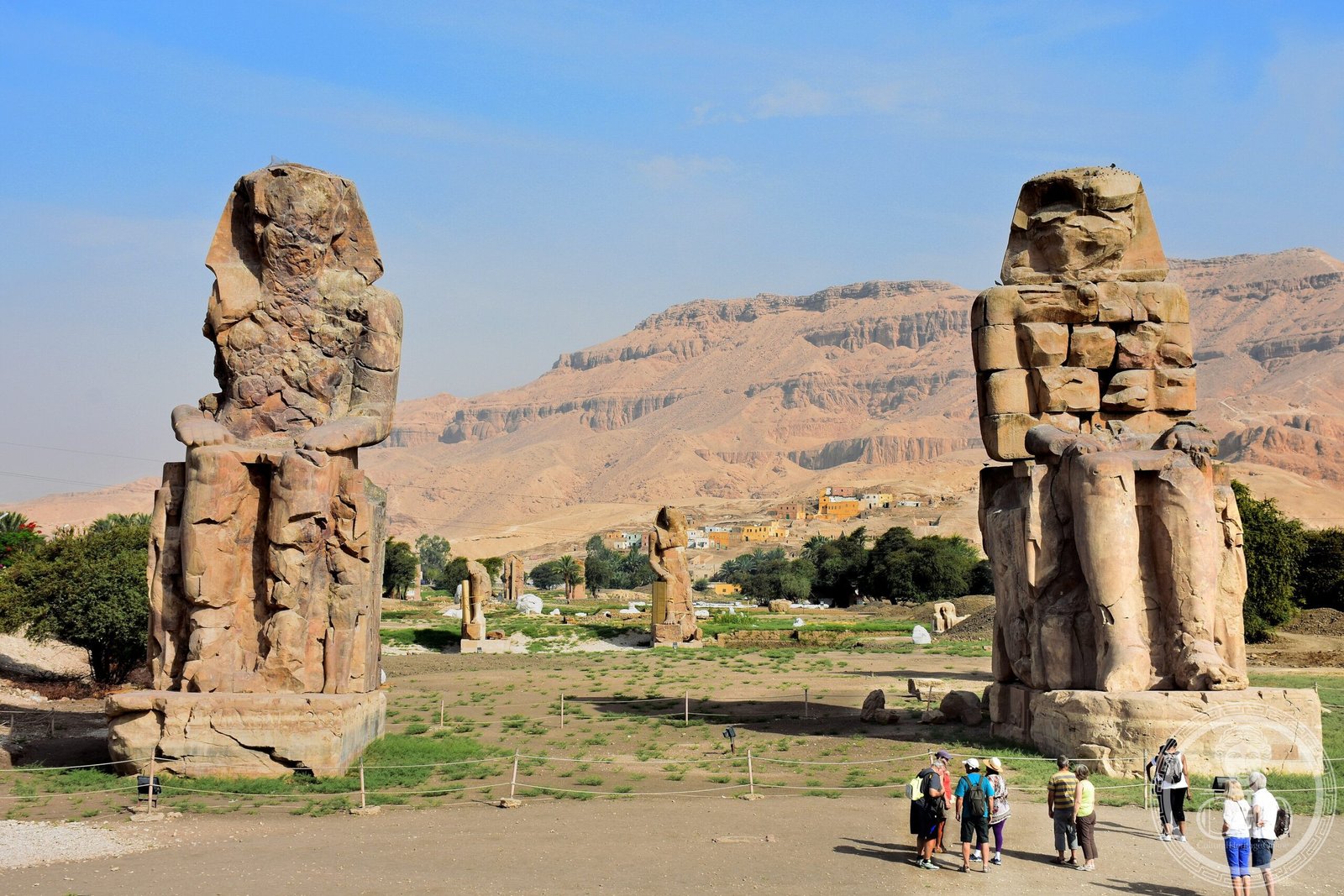
Two colossal stone statues of Pharaoh Amenhotep III stand sentinel before his mortuary temple, their massive forms bearing witness to over three millennia of history, myth, and human inscription.
At a glance
Towering at the entrance to the Mortuary Temple of Amenhotep III—the largest temple in the Theban Necropolis—these statues have commanded attention since 1350 BC. Ancient Greeks, Romans, and early modern travelers all knew them well. Today they remain among Egypt’s most recognizable monuments, their surfaces dense with Roman-era graffiti.
History
The statues were erected during the reign of Amenhotep III as guardian figures for his mortuary temple complex. By the Greco-Roman period, they had become famous landmarks. Between AD 20 and 250, visitors carved 107 inscriptions in Greek and Latin into the stone, many referencing the Greek mythological king Memnon. The northern colossus bore the brunt of this attention, as it was mistakenly identified with the legendary figure.
This misidentification proved remarkably durable. Scholars continue to debate how the northern statue’s association with Memnon connected to the Greek name for the entire Theban Necropolis as the Memnonium.
What you see
Each statue depicts Amenhotep III in a seated position, carved from local limestone and rising to monumental height. The sculptures exemplify royal iconography of the Eighteenth Dynasty. Weathered by millennia, they retain their essential power—geometric forms abstracted by time itself.
Cultural significance
The Colossi represent a unique bridge between ancient Egypt and the Greco-Roman world. They demonstrate how classical visitors appropriated and reinterpreted Egyptian monuments through their own mythological lens. The inscriptions themselves offer invaluable evidence of tourism, pilgrimage, and cultural encounter in antiquity.
Key facts
- Country: Egypt
- City: Luxor
- Coordinates: 25.72055556, 32.61055556
- Erected: circa 1350 BC
- Carved inscriptions: 107 (Greek and Latin, AD 20–250)
Practical information & getting there
The Colossi stand on the west bank of the Nile near Luxor, accessible by road. They remain unroofed and exposed, visible at all times. Visitor facilities and guided tours are available in Luxor. Check local conditions and travel advisories before visiting.
Sources & resources
Find it on the map
See this place and what’s around it →📷 Become a Cultural Heritage Online photographer
Share your photos of places: they stay published under your name as the author. The more they're seen, the more you get noticed — and soon a contest will reward the most appreciated photos.
Log in or sign up free to add a photoIs this page about you?
This page is read by travellers and heritage enthusiasts who find it on Google. Tell us how you are connected to this place and we will take it from there.