
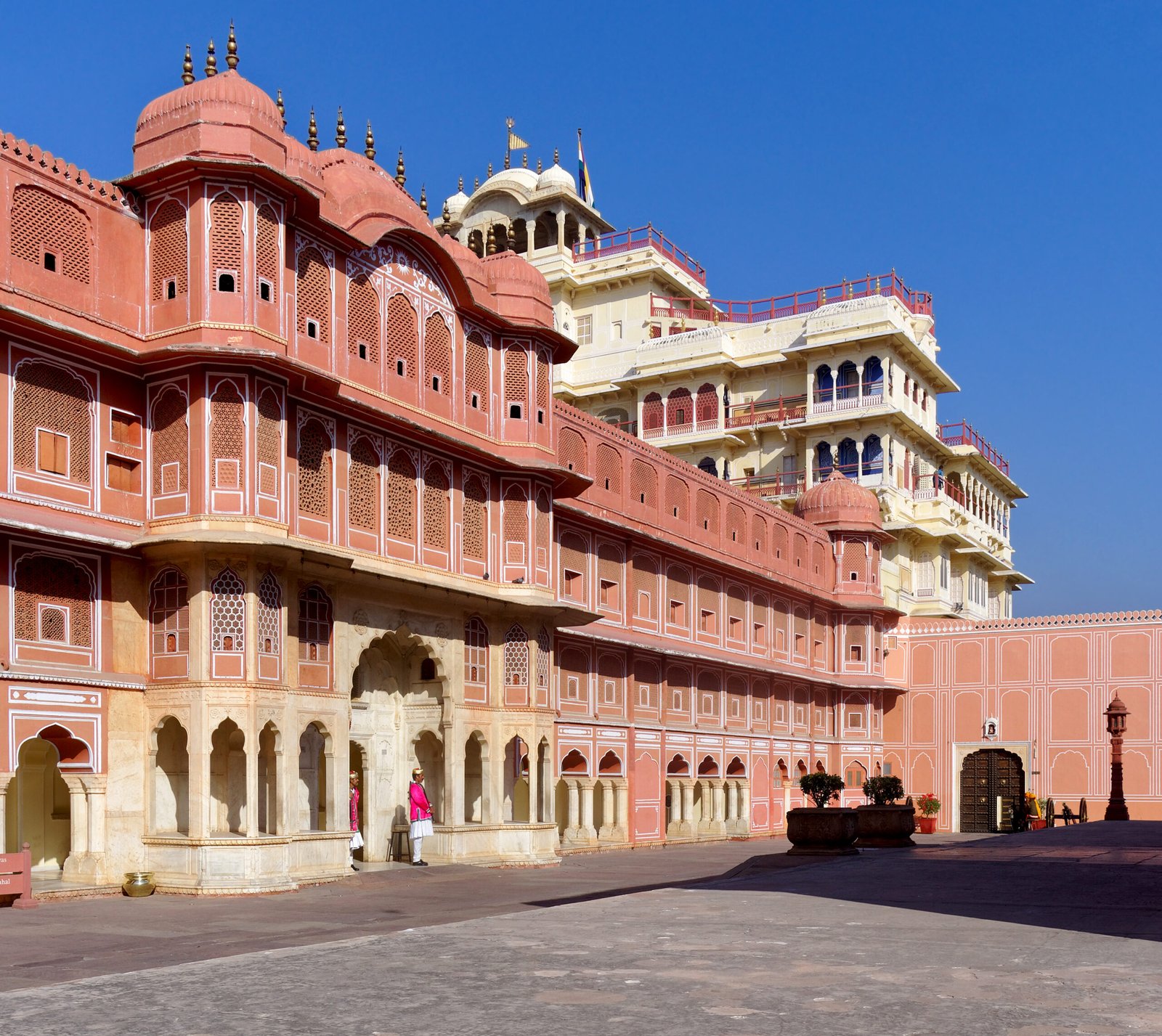
A living palace where royal residence, museum, and administrative functions coexist within a complex that merges Mughal and Rajput architectural traditions.
At a glance
The City Palace stands as both a functioning royal residence and cultural institution in the heart of Jaipur. Built according to vastushastra principles, it served as the ceremonial and administrative seat of the Maharaja during Jaipur’s reign as a kingdom until 1949. Today it remains home to the ruling family while housing the Maharaja Sawai Man Singh II Museum, making it a rare example of a palace that bridges heritage conservation and contemporary royal life.
History
Construction began shortly after Maharaja Sawai Jai Singh II established Jaipur as his new capital in 1727, moving his court from Amber. The palace was completed by 1732. For over two centuries, it functioned as the administrative heart of Jaipur State and hosted religious and cultural ceremonies. When Jaipur became capital of the modern Indian state of Rajasthan in 1949, the palace transitioned to its current dual role as museum and private residence.
What you see
The palace complex combines Mughal and Rajput architectural elements within a design governed by vastushastra, the traditional Indian system of architecture and spatial arrangement. The compound encompasses multiple buildings, courtyards, galleries, and formal spaces arranged to balance ceremonial grandeur with functional living quarters. The integration of museums, restaurants, and administrative offices within the historic structure demonstrates adaptive use while preserving its essential character.
Cultural significance
The City Palace represents a continuity of royal patronage across centuries—from its role as a centre of arts, commerce, and industry under the Maharajas to its present function as a repository of dynastic heritage. It exemplifies the transition of Indian princely states into the modern Indian republic, remaining an active symbol of Rajasthan’s royal history while serving contemporary educational and cultural purposes through its museum and foundation work.
Key facts
- Location: Jaipur, Rajasthan, India (26.9257°N, 75.8236°E)
- Construction: begun 1727, completed 1732
- Founder: Maharaja Sawai Jai Singh II
- Current use: Royal residence, museum, and administrative offices
- Museum: Maharaja Sawai Man Singh II Museum
- Architectural style: Mughal and Rajput, designed according to vastushastra
Practical information & getting there
The City Palace remains partially accessible to visitors through the museum while sections continue as private royal residence. The palace complex includes galleries, restaurants, and exhibition spaces. Jaipur is well-connected by air, rail, and road to major Indian cities. For current visiting hours, admission fees, and guided tour availability, check the official Maharaja Sawai Man Singh II Museum Trust information.
Sources & resources
- City Palace, Jaipur – Wikipedia
- Cultural Heritage Online
Find it on the map
See this place and what’s around it →📷 Become a Cultural Heritage Online photographer
Share your photos of places: they stay published under your name as the author. The more they're seen, the more you get noticed — and soon a contest will reward the most appreciated photos.
Log in or sign up free to add a photoIs this page about you?
This page is read by travellers and heritage enthusiasts who find it on Google. Tell us how you are connected to this place and we will take it from there.