
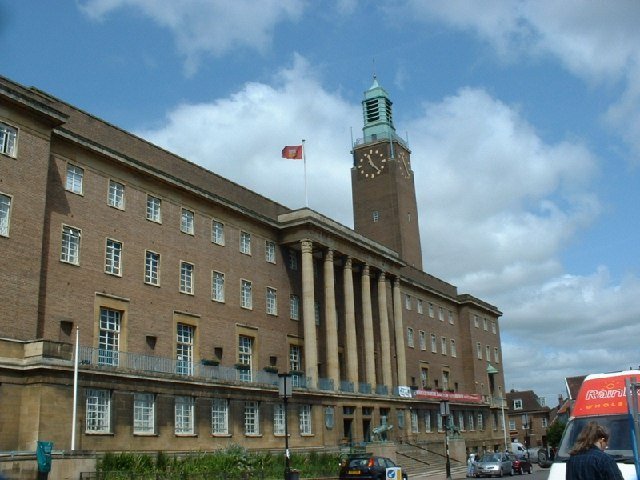
An Art Deco masterpiece completed in 1938, Norwich City Hall stands as one of twelve heritage buildings designated as particularly significant to the city’s cultural identity.
At a glance
City Hall is a Grade II* listed building that serves as the municipal seat for Norwich, Norfolk. Its completion in 1938 marked a defining moment in the city’s architectural modernization. The building is recognized as part of the Norwich 12—an elite grouping of heritage structures of exceptional historical importance to the region.
History
Built in the 1930s during the height of Art Deco design, City Hall was completed in 1938. Its construction reflected Norwich’s aspirations as a forward-thinking municipal center. The building was formally designated as Grade II* listed in 1971, a distinction acknowledging its architectural merit and cultural significance within the broader landscape of Norfolk heritage.
What you see
The building exemplifies Art Deco principles characteristic of its era. Its design combines geometric forms, streamlined ornamentation, and modern materials typical of the interwar modernist movement. The structure functions as the operational and ceremonial heart of Norwich’s local government.
Cultural significance
City Hall holds particular importance as one of only twelve buildings selected for the Norwich 12 designation. This status reflects its dual significance as both an architectural achievement and a symbol of civic identity. The building represents a pivotal moment in twentieth-century English municipal design and continues to serve as the primary administrative center for the city.
Key facts
- Location: Norwich, Norfolk, United Kingdom
- Completed: 1938
- Architectural style: Art Deco
- Listed status: Grade II* (1971)
- Designation: One of the Norwich 12 heritage buildings
- Coordinates: 52.6286°N, 1.2917°E
Practical information & getting there
City Hall remains an active municipal building in central Norwich. Visitors interested in exploring the architecture should check with Norwich City Council for opening hours and access availability, as the building remains a functional government office.
Sources & resources
Find it on the map
See this place and what’s around it →📷 Become a Cultural Heritage Online photographer
Share your photos of places: they stay published under your name as the author. The more they're seen, the more you get noticed — and soon a contest will reward the most appreciated photos.
Log in or sign up free to add a photoIs this page about you?
This page is read by travellers and heritage enthusiasts who find it on Google. Tell us how you are connected to this place and we will take it from there.