
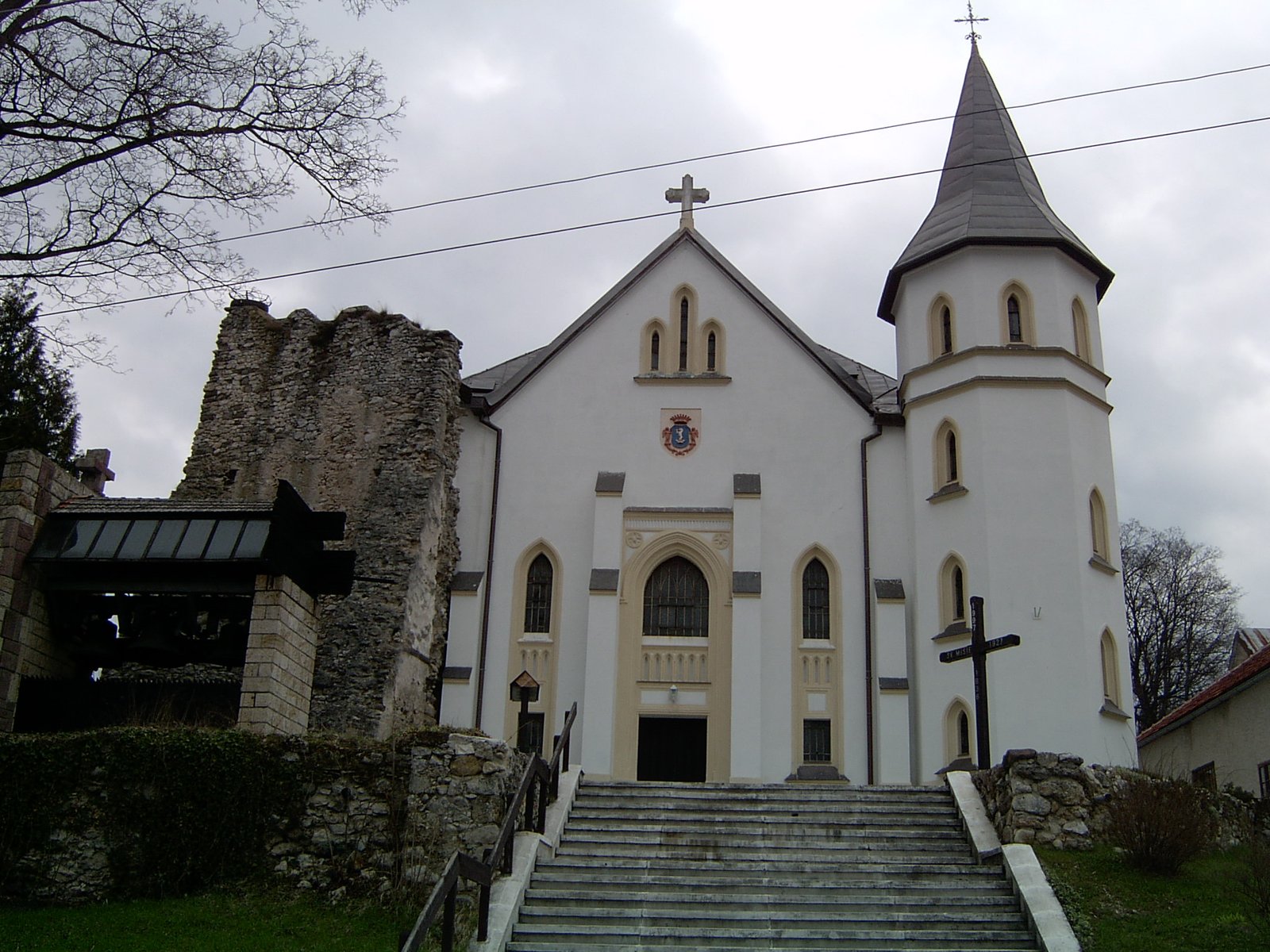
A neogothic church in central Slovakia, built in 1912–1913 on the site of a medieval gothic predecessor. Its most distinctive feature is a leaning tower wall—partially original, partially reconstructed—that stands in unexpected symbiosis with the modern structure.
At a glance
The Church of the Holy Trinity combines two distinct architectural eras. The original medieval gothic church, damaged by centuries of settling on marshland, was demolished in 1912. Its successor—a neogothic building with three aisles and a hexagonal lateral tower—was completed within two years. Most remarkably, portions of the old tower wall remain standing alongside the new church, a physical testament to construction mishaps and preservation decisions made over a century ago.
History
The original gothic church stood for nearly 600 years before structural decay forced its demolition. By the late 19th century, the stone vault had cracked extensively despite reinforcement by thick pillars, a consequence of the building’s foundation on marshland. Baron František Révay, the church’s patron, authorized its removal.
The new neogothic structure rose quickly between 1912 and 1913, employing modern building methods including a concrete foundation slab. During demolition of the old tower, the adjacent wall of the new church began to crack. Rather than proceed with complete removal, workers rebuilt the old tower wall to roof height, where it remains standing today.
What you see
The current church displays neogothic design with three aisles and a hexagonal lateral tower housing a staircase to the gallery. Its most unusual feature is the partial survival of the medieval tower wall—a rectangular structure originally measuring 8.6 × 7.2 meters with walls up to 1.5 meters thick, constructed from square, raw stone with accentuated corners.
The medieval tower once stood 45 meters tall, its pyramid-shaped roof visible for kilometers. It held four historic bells, the largest cast in 1704, and bore a tower clock on three sides; a sundial preceded it on the southern wall. Today only the lower portion of the original tower survives, incorporated structurally into the newer building and leaning 45 centimeters from vertical.
Cultural significance
The Church of the Holy Trinity exemplifies both medieval ecclesiastical ambition and early 20th-century preservation pragmatism. Once among the most monumental sacred buildings in the Turiec region, it anchored its community through bells that rang across surrounding lands. The decision to preserve rather than demolish the failing medieval tower reveals the complexities of restoration work and the sometimes imperfect outcomes of balancing old and new construction.
Key facts
- Country: Slovakia
- City: Mošovce
- Coordinates: 48.91°N, 18.89°E
- Original church: Gothic, approximately 600 years old at demolition (late 14th century onward)
- Rebuilt: 1912–1913 (neogothic)
- Patron: Baron František Révay
- Original tower height: 45 meters
- Largest bell (Obecný): cast 1704, 900 kg
Practical information & getting there
Mošovce is located in the Turiec region of central Slovakia. Visitors can reach the Church of the Holy Trinity by road. The hybrid structure—part medieval ruin, part modern church—remains an active parish building and local landmark, visible in the town’s landscape.
Sources & resources
Find it on the map
See this place and what’s around it →📷 Become a Cultural Heritage Online photographer
Share your photos of places: they stay published under your name as the author. The more they're seen, the more you get noticed — and soon a contest will reward the most appreciated photos.
Log in or sign up free to add a photoIs this page about you?
This page is read by travellers and heritage enthusiasts who find it on Google. Tell us how you are connected to this place and we will take it from there.