
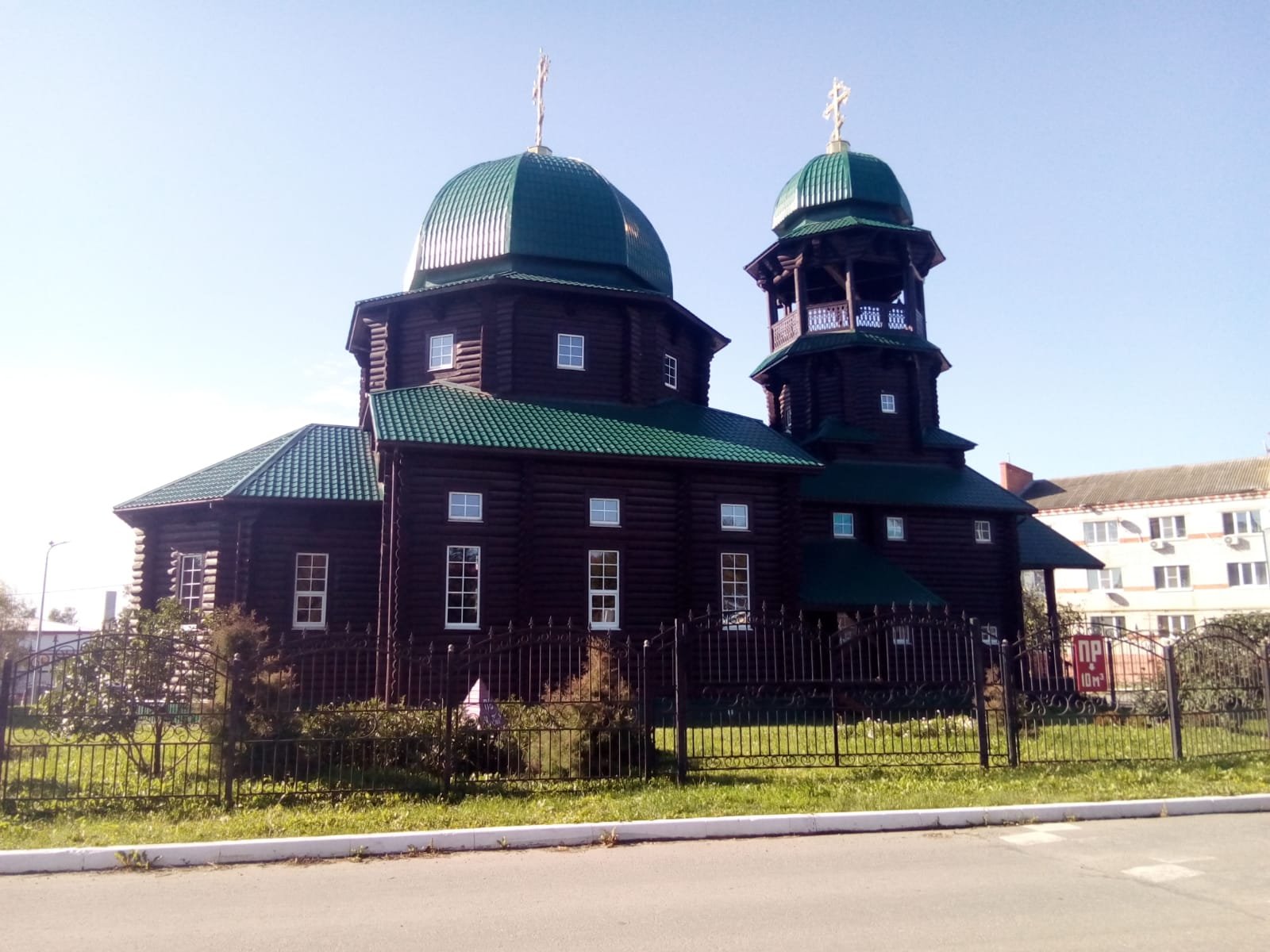
A parish church rebuilt three times over two and a half centuries, standing today in the village of Alikovo as the spiritual center of its Chuvash Orthodox community.
At a glance
The Church of the Assumption of the Virgin belongs to the Cheboksary-Chuvash diocese of the Moscow Patriarchate. It sits in Alikovo, seat of the Alikovsky District in the Chuvash Republic. The parish once served eighteen surrounding settlements and thousands of households. Its story is one of repeated destruction and rebuilding rather than a single architectural moment.
History
The parish traces to August 1744, when a wooden church rose in the center of Alikovo. Empress Elizabeth Petrovna sent the newly built temple a printed liturgical book in 1745, a gift recorded in an inscription naming Alikovo’s “newly-baptized” congregation. Bells arrived from Yadrin in 1755. Violence reached the church in 1774, when priests serving there were killed during Pugachev’s Rebellion. Parishioners funded a new wooden building in 1782, then rebuilt it again in 1901 at their own expense. Soviet authorities forced churches to close from 1930 onward. A hurricane in 1936 tore the entire upper structure, bells included, from the building. Worship did not return until 1991, when services resumed in a prayer house at parishioners’ insistence. A new church building was consecrated on 26 August 2015, with Metropolitan Varnava of Chuvashia presiding, funded by local settlements, schools, organizations and residents well beyond the district.
What you see
Little detailed description of the fabric survives in the record. What is documented is continuity of form: successive wooden churches on the same site, each replacing storm or state damage with parish-funded rebuilding. The 2015 structure is the latest of these, raised through collective local giving rather than a single patron. Visitors encounter a modest village church shaped more by communal endurance than by singular design.
Cultural significance
The church anchored an unusually large rural parish. Eighteen villages and over a thousand households once depended on it for worship and record-keeping. Its adjoining parish school, opened in 1845 in nearby Norusovo and moved to Alikovo in 1854, extended that role into education under the Kazan Province church-school system. The building’s survival through Pugachev’s uprising, Soviet closure, and a destructive storm makes it a marker of Chuvash Orthodox resilience. Its 2015 reconsecration, drawing support from across the district, underscores continued local attachment.
Key facts
- Location: Alikovo, Alikovsky District, Chuvash Republic, Russia
- Diocese: Cheboksary-Chuvash diocese, Moscow Patriarchate
- First church founded: August 1744
- Rebuilt: 1782 and 1901 (wooden structures)
- Upper structure and bells destroyed by hurricane: 1936
- Services resumed in a prayer house: 1991
- New church consecrated: 26 August 2015, by Metropolitan Varnava of Chuvashia
Practical information & getting there
The church stands in the village of Alikovo, roughly 55.738°N, 46.7489°E, in the Chuvash Republic of the Russian Federation. It functions as an active parish church, so services follow the diocesan calendar rather than tourist hours. Check the diocesan website before traveling, since opening times and access are not otherwise documented.
Sources & resources
Find it on the map
See this place and what’s around it →📷 Become a Cultural Heritage Online photographer
Share your photos of places: they stay published under your name as the author. The more they're seen, the more you get noticed — and soon a contest will reward the most appreciated photos.
Log in or sign up free to add a photoIs this page about you?
This page is read by travellers and heritage enthusiasts who find it on Google. Tell us how you are connected to this place and we will take it from there.