
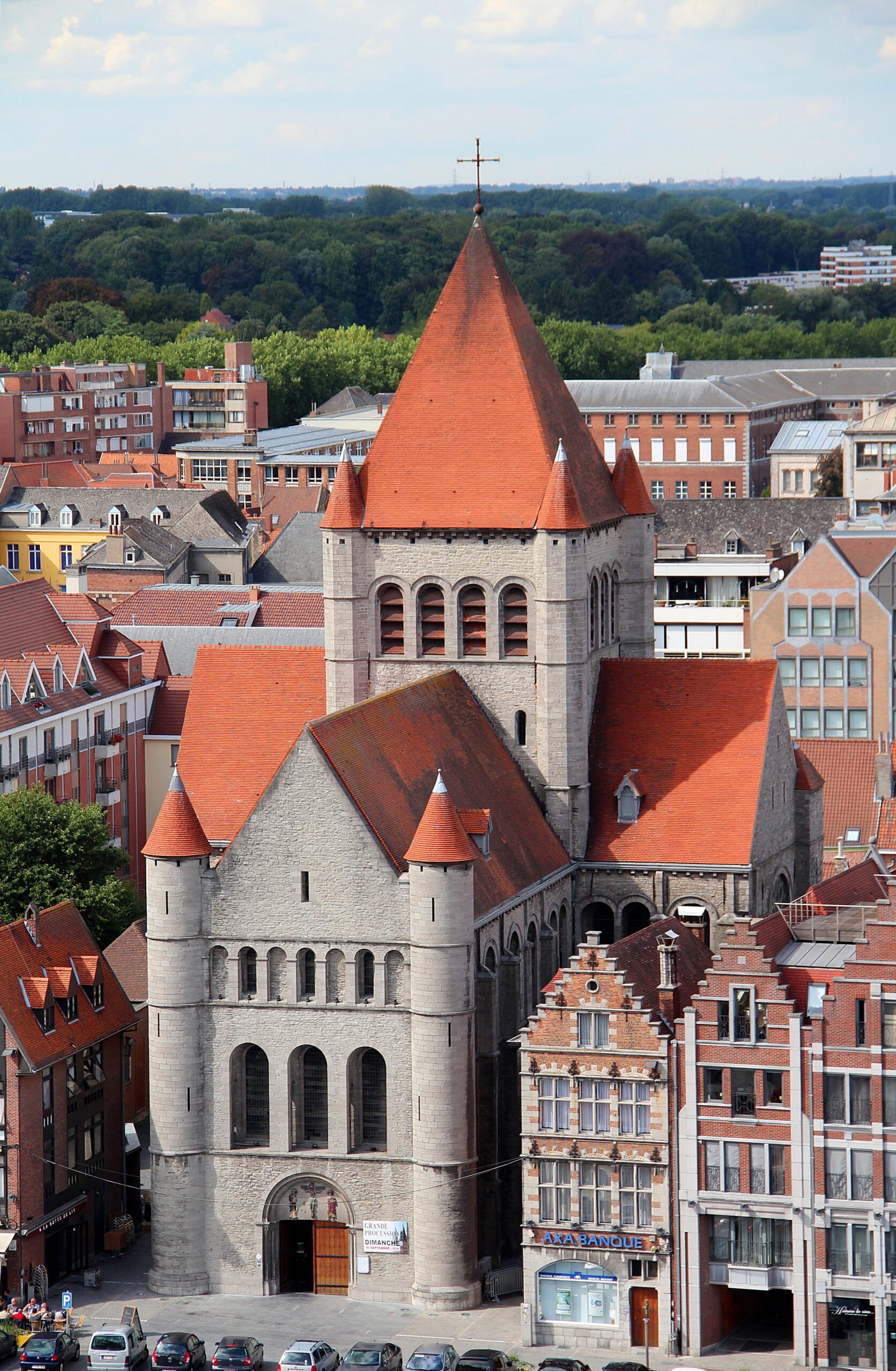
A Romanesque parish church on Tournai’s Grand-Place, rebuilt after World War II bombing, housing remarkable Late Gothic sculptures by Jean Delemer and Robert Campin from 1428.
At a glance
Saint Quentin stands at the civic heart of Tournai. Though its core dates to around 1200, the building has been substantially remade twice: once in the late 15th century through major reconstruction, and again after 1945 following wartime destruction. The church retains its Romanesque character despite these interventions.
History
The church has been documented since the 10th century. The current structure was built around 1200. In the late 15th century, a major campaign transformed the interior, reconstructing the chancel, adding an ambulatory, and replacing earlier side chapels—work partially funded by wealthy tapestry maker Pasquier Grenier and his wife Marguerite de Lannoye, who were buried within.
German bombing in 1940 devastated the building during World War II. Post-war reconstruction was extensive; the church reopened in 1968. Its present facade and tower date from this modern restoration period.
What you see
The building’s Romanesque foundation endures, though the current facade and tower are 20th-century reconstructions. The ambulatory and lateral chapels reflect 15th-century Gothic aspirations. Inside, two wooden sculptures command attention: Late Gothic works carved by Jean Delemer, painted by Robert Campin, and dated 1428. These pieces are historically significant as early examples of such sculptural sophistication in the region.
Cultural significance
Saint Quentin anchors Tournai’s Grand-Place and represents continuous religious and civic life across ten centuries. The Delemer-Campin sculptures occupy a crucial position in Northern European art history, demonstrating the technical and artistic mastery of early 15th-century workshop practice. The church’s reconstruction also reflects post-war European commitment to restoring cultural heritage.
Key facts
- Country: Belgium
- City: Tournai
- Coordinates: 50.6067, 3.385
- Current building: circa 1200; major 15th-century reconstruction; post-1945 restoration
- Notable artworks: Wooden sculptures by Jean Delemer (carved) and Robert Campin (painted), 1428
Practical information & getting there
The church is located on the Grand-Place, Tournai’s main square, making it easily accessible from the town centre. Specific opening hours and visiting conditions are best confirmed locally before your visit.
Sources & resources
Find it on the map
See this place and what’s around it →📷 Become a Cultural Heritage Online photographer
Share your photos of places: they stay published under your name as the author. The more they're seen, the more you get noticed — and soon a contest will reward the most appreciated photos.
Log in or sign up free to add a photoIs this page about you?
This page is read by travellers and heritage enthusiasts who find it on Google. Tell us how you are connected to this place and we will take it from there.