
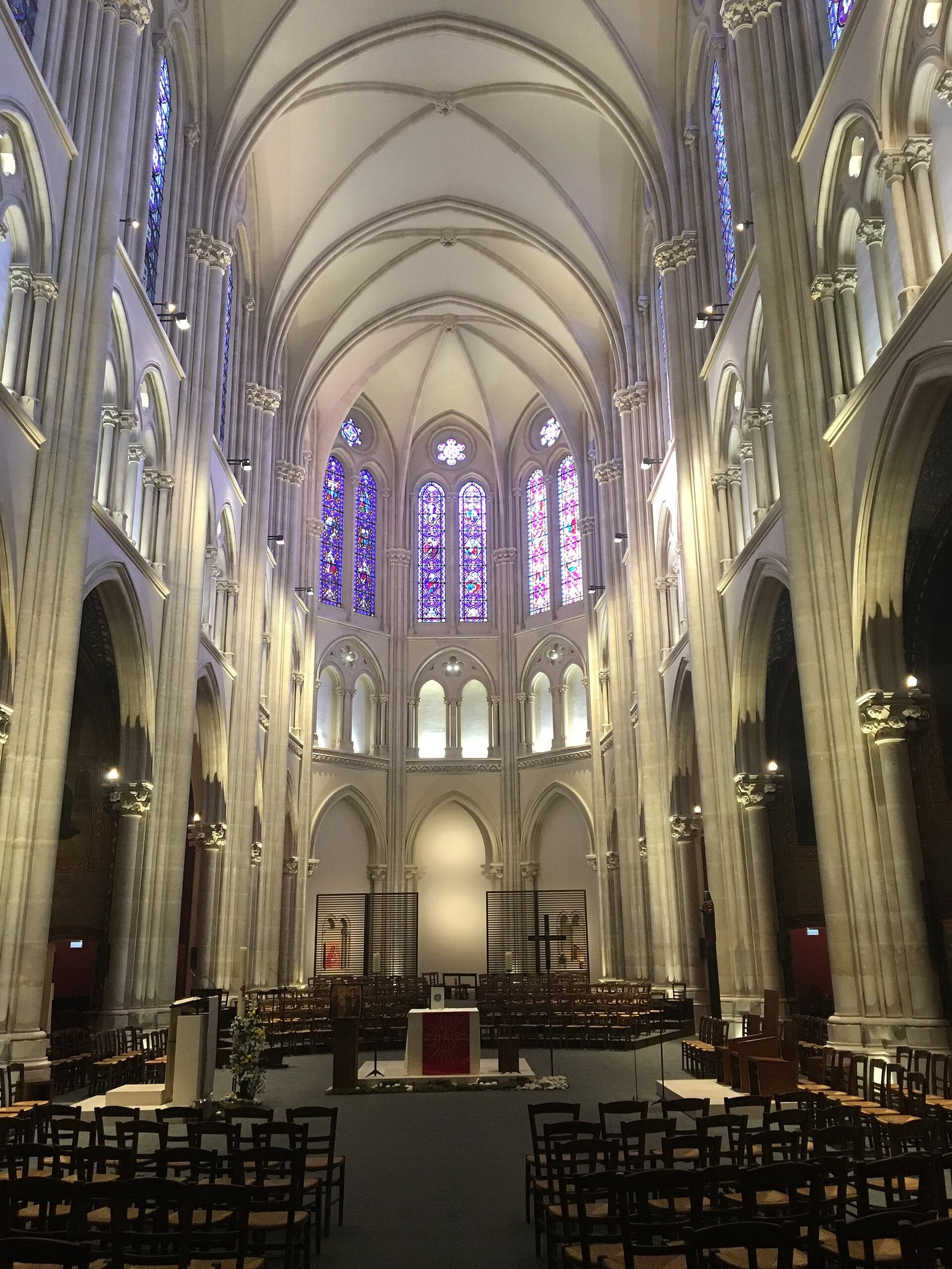
A Neo-Gothic chapel dedicated to the founder of the Jesuits, built in the heart of Paris’s Left Bank and still active as a Jesuit spiritual center.
At a glance
Located on Rue de Sèvres in the 6th arrondissement, this modest but striking chapel serves the Jesuit community of Paris. Though not a formal parish church, it functions as a living center of Jesuit worship and education, intimately connected to the nearby Centre Sèvres theological faculty.
History
Constructed between 1855 and 1858, the Church of Saint-Ignace was designed by Magloire Tournesac (1805–1875), a Jesuit father and architect. The building commemorates Saint Ignace de Loyola, the Spanish mystic who founded the Society of Jesus in the 16th century. Its artwork includes depictions of Jesuit missionaries martyred in Japan during the 1860s, a testament to the order’s global missionary reach.
What you see
The chapel exemplifies the Neo-Gothic revival style popular in mid-19th-century France. Its design balances architectural ambition with intimate scale, creating a space suited both to personal devotion and communal liturgy. The interior contains religious artworks with particular emphasis on scenes of missionary sacrifice.
Cultural significance
This chapel represents the Jesuits’ enduring presence in Paris and their commitment to intellectual and spiritual life in the modern era. Its connection to Centre Sèvres, the faculty of philosophy and theology for French Jesuits, makes it a focal point for Catholic theological education and pastoral ministry in the capital.
Key facts
- Built 1855–1858
- Designed by Jesuit architect Magloire Tournesac
- Dedicated to Saint Ignace de Loyola, founder of the Society of Jesus
- Neo-Gothic style
- Address: 33 Rue de Sèvres, 6th arrondissement, Paris
- Coordinates: 48.85064, 2.32629
- Country: France
Practical information & getting there
The church is situated on the Left Bank, accessible by Metro (Sèvres-Babylone station serves the area). Mass times and visiting hours should be confirmed directly with the Jesuit community, as this remains an active place of worship rather than a tourist site.
Sources & resources
Find it on the map
See this place and what’s around it →📷 Become a Cultural Heritage Online photographer
Share your photos of places: they stay published under your name as the author. The more they're seen, the more you get noticed — and soon a contest will reward the most appreciated photos.
Log in or sign up free to add a photoIs this page about you?
This page is read by travellers and heritage enthusiasts who find it on Google. Tell us how you are connected to this place and we will take it from there.