
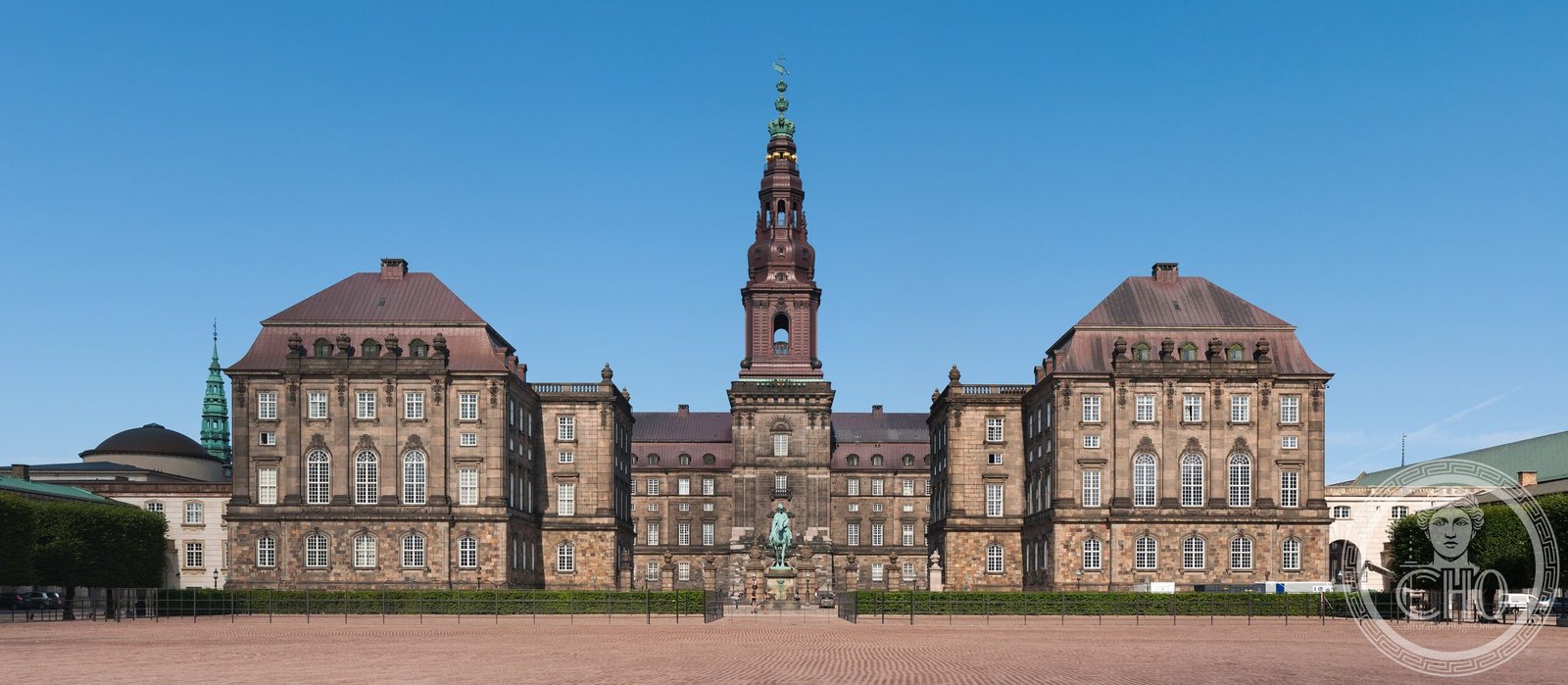
The seat of Denmark’s Parliament, Prime Minister, and Supreme Court, Christiansborg Palace is the world’s only building housing all three branches of government. Its architectural layers—from Baroque to Neo-baroque—chronicle Danish power across centuries.
At a glance
Christiansborg Palace stands on Slotsholmen, a small islet in central Copenhagen, serving as the unified home of Denmark’s legislative, executive, and judicial powers. The Danish monarch also maintains royal apartments within its walls, including reception rooms, a chapel, and stables. The palace is thus known colloquially as Rigsborgen, ‘the castle of the realm.’
History
The first castle was erected on this site in 1167. From the fifteenth century onward, successive buildings served as the seat of central administration. Until 1794, it functioned as the principal residence of Danish kings; after 1849, it became the seat of parliament.
Two major fires reshaped the palace’s physical form. The 1794 fire and the 1884 fire each prompted extensive rebuilding, layering distinct architectural periods across the complex. The present structure, the third palace to bear the name Christiansborg, was completed in 1928.
What you see
The main palace, finished in 1928, displays the Neo-baroque historicist style that dominated late nineteenth-century institutional architecture. Its grand facades and ornamental detail reflect the ambitions of Denmark’s political establishment.
The chapel, dating to 1826, represents an earlier neoclassical idiom—restrained and elegant. The showgrounds, constructed between 1738 and 1746, preserve original Baroque styling, their age and design marking them as the palace’s oldest surviving components.
Cultural significance
Christiansborg Palace embodies Denmark’s constitutional history. As the unified seat of legislature, executive, and judiciary—a distinction unmatched globally—it symbolizes the nation’s democratic structure and the integration of power within a single symbolic and functional space. The name Christiansborg has become shorthand for the Danish political system itself.
Key facts
- Country: Denmark
- City: Copenhagen
- Coordinates: 55.676°N, 12.579°E
- Original construction: 1167
- Current building completed: 1928
- Architectural styles: Baroque (1738–1746), Neoclassical (1826), Neo-baroque (1928)
- UNESCO status: Not listed
Practical information & getting there
Christiansborg Palace is owned and operated by the Danish Government through the Palaces and Properties Agency. Several sections are open to the public, allowing visitors to experience the rooms where Denmark’s three branches of government convene. The palace occupies Slotsholmen in the heart of Copenhagen’s city center, making it readily accessible by foot or public transport.
Sources & resources
Find it on the map
See this place and what’s around it →📷 Become a Cultural Heritage Online photographer
Share your photos of places: they stay published under your name as the author. The more they're seen, the more you get noticed — and soon a contest will reward the most appreciated photos.
Log in or sign up free to add a photoIs this page about you?
This page is read by travellers and heritage enthusiasts who find it on Google. Tell us how you are connected to this place and we will take it from there.