

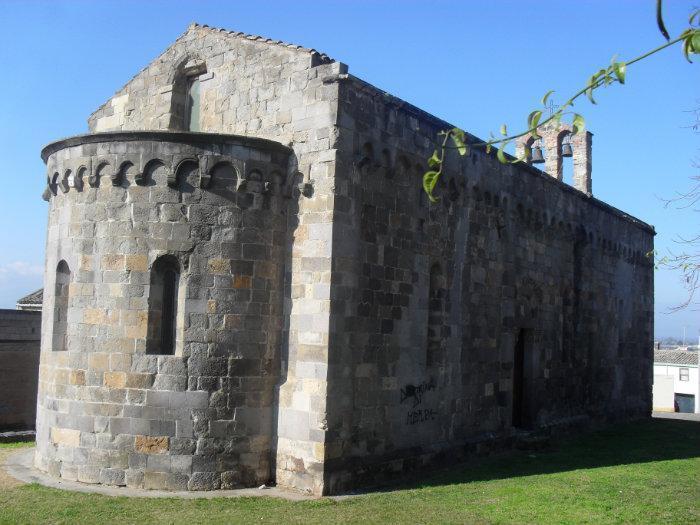
The church of San Geminiano stands on a low hill called su Cunventu above Samassi, in the Campidano plain of southern Sardinia. It is a single-nave Romanesque building in dark vulcanite, raised over a Byzantine tomb and probably rebuilt in the thirteenth century, and it keeps inside the marble funeral monument of Emanuele Castelvì, carved in 1586 by Scipione Aprile.
At a glance
- Type
- Romanesque parish church
- Dedication
- San Geminiano, bishop of Modena (San Gemiliano in local usage)
- Period
- Byzantine remains of the tenth century; Romanesque building probably thirteenth century
- Style
- Sardinian Romanesque in local vulcanite
- Location
- Via San Geminiano, Samassi, Province of Sud Sardegna, Sardinia, Italy
- Coordinates
- 39.4833° N, 8.9084° E
Overview
Samassi lies in the Campidano plain, close to the river Mannu, in the province of Sud Sardegna. The site has been occupied since prehistory and shows a continuity of settlement into the Byzantine age. The church of San Geminiano rises on a small hill known as su Cunventu, a name that may preserve the memory of an ancient monastic holding. Its architecture is deliberately plain, in the manner of most medieval churches on the island: a single room, walls of squared stone, and ornament concentrated in a few carved details.
History
The church was built over a chamber tomb of the Byzantine era. In its Romanesque walls are set fragments of tenth-century Middle Byzantine marble, parts of a presbytery balustrade cut for an earlier building and reused here; one fragment carries rosettes and a cross above a bunch of grapes. The original dedication was to San Mamiliano. The title is documented in 1118, when the church belonged to the Camaldolese monastery of San Mamiliano on the island of Montecristo, off the Tuscan coast.
No document records the date of the rebuilding that gave the church its present form. Scholars place it probably in the thirteenth century, in vulcanite extracted from the quarries of Serrenti, a few kilometres to the north. The dedication to San Geminiano, bishop of Modena, replaced the earlier one, and the building has served the community of Samassi as its parish church ever since.
What you see
The façade is a plain gable divided into three narrow bays by flat pilaster strips, with a bell gable of two openings at the apex. The portal has a carved architrave resting on two foliate capitals, and above it a raised relieving arch springs from two small corbels cut with human faces. Along the sides and around the semicircular apse runs a continuous band of small round arches on corbels, and narrow single-light windows open in the side walls, three of them in the apse.
Inside, the single nave has a wooden roof and walls of exposed stone, articulated by corner pilasters that rise from a continuous base. The church preserves the wooden statue of its patron saint and the funeral monument of Emanuele Castelvì, dated 1586 and signed by the sculptor Scipione Aprile: a marble and trachyte ensemble in which the deceased kneels on the sarcophagus, supported by two lions in white marble.
Cultural significance
San Geminiano belongs to the dense network of rural Romanesque churches that document the medieval Campidano, and its fabric records two distinct building phases: the Byzantine marbles reused in the walls and the thirteenth-century Romanesque construction that incorporated them. The 1118 record ties the church to the Camaldolese monastery of Montecristo, one of the mainland religious houses that held property in Sardinia. The Castelvì monument adds a later layer, that of the Spanish-era aristocracy whose tombs fill the island’s churches.
Practical information
- Address
- Via San Geminiano, 09030 Samassi (SU), Sardinia
- Visits
- Open for parish services; during the Monumenti Aperti weekends it stays open on Saturday and Sunday, 9:00–13:00 and 15:00–18:00
- Admission
- Free
Getting there
Samassi is in the Campidano plain, about 40 km north-west of Cagliari. By car it is reached from the SS131 Carlo Felice, leaving the dual carriageway at the Samassi exit and following the signs for the village; the church stands on the low hill on the edge of the built-up area. The nearest airport is Cagliari Elmas, about 45 km to the south.
Sources & resources
Find it on the map
See this place and what’s around it →📷 Become a Cultural Heritage Online photographer
Share your photos of places: they stay published under your name as the author. The more they're seen, the more you get noticed — and soon a contest will reward the most appreciated photos.
Log in or sign up free to add a photo