

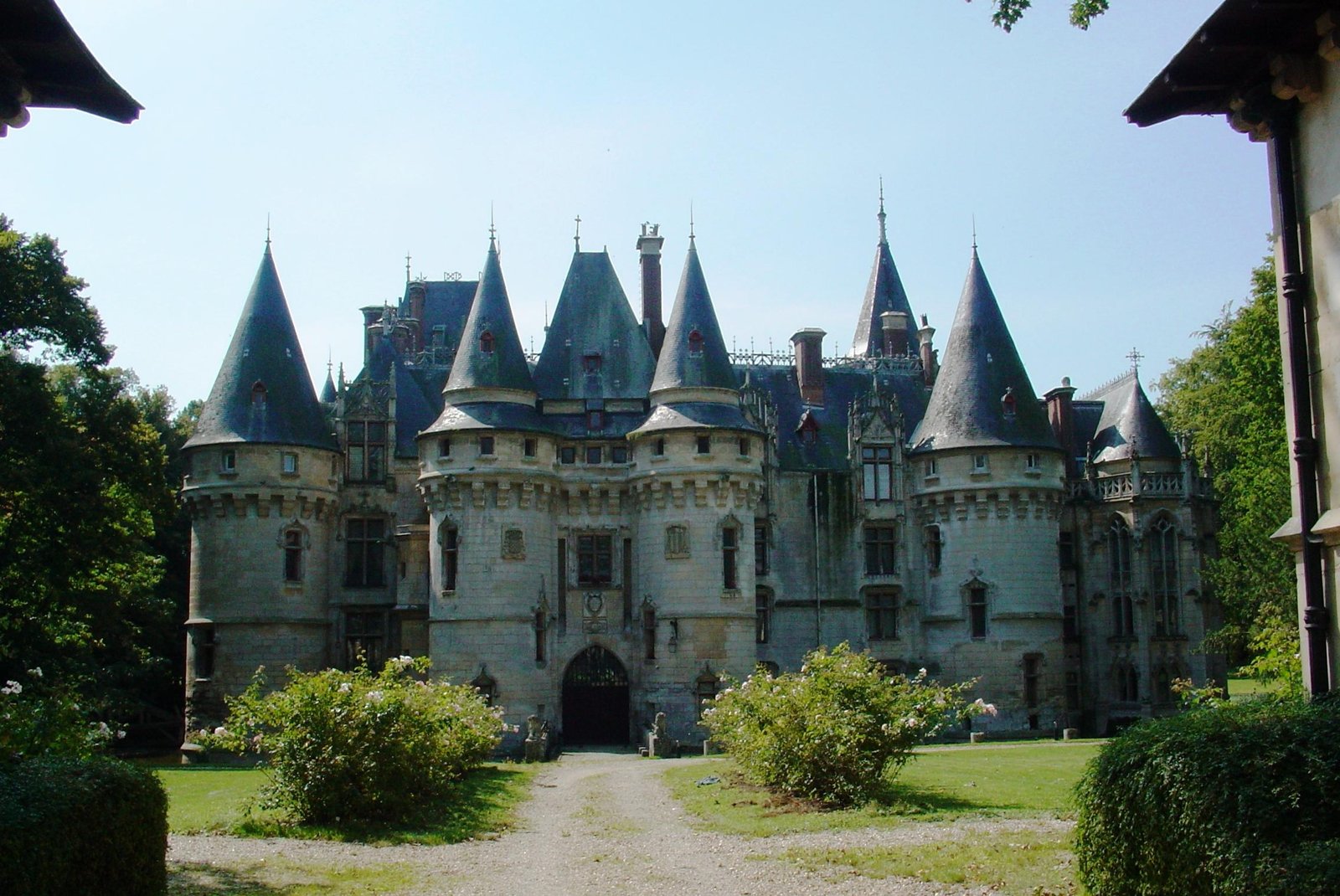
A Renaissance château transformed by romantic revival, the Château de Vigny rises from the Val d’Oise valley as a layered monument to French aristocratic ambition across five centuries.
At a glance
Built in 1504 for Cardinal Georges d’Amboise on the foundations of a medieval fortress, this château exemplifies the transition from medieval to Renaissance architecture. The 1880s saw dramatic reimagining in the troubadour style under Comte Philippe Vitali, Prince of Sant’Eusebio, whose additions reflect the Romantic era’s fascination with chivalric aesthetics.
History
The site has medieval origins, but the château as known today began in 1504, when Cardinal d’Amboise, a powerful churchman and politician, commissioned its construction. The cardinal’s patronage marked the building’s elevation from defensive stronghold to aristocratic residence.
Nearly four centuries later, the château underwent substantial alterations in the 1880s. Comte Philippe Vitali, then its owner, reimagined the structure in the troubadour style—a theatrical Gothic Revival aesthetic popular among French nobility seeking to evoke medieval romance. This transformation left visible traces across the building’s exterior and interiors.
In 1984, the château received official recognition as a monument historique (registered historic monument), acknowledging its architectural and historical significance.
What you see
The château embodies two distinct architectural moments. Its core Renaissance structure reveals the refined tastes of early 16th-century French nobility. The 1880s interventions introduce troubadour-style elements—decorative towers, romantic stonework, and period-appropriate embellishments—that layer theatrical medievalism over the original design.
Cultural significance
The château documents the evolution of French aristocratic taste and architecture from the Renaissance through the Romantic era. Its transformation under Comte Vitali reflects 19th-century French cultural movements that reinterpreted medieval history as a symbol of national identity and refinement.
Key facts
- Built 1504 for Cardinal Georges d’Amboise
- Substantially altered 1880s in troubadour style for Comte Philippe Vitali, Prince of Sant’Eusebio
- Located in Vigny, Val d’Oise, France
- Coordinates: 49.0767, 1.9261
- Listed as a monument historique in 1984
Practical information & getting there
The château is located in the commune of Vigny in Val d’Oise, roughly 40 kilometers northwest of Paris. Specific hours of operation and visit conditions should be verified in advance, as access may be restricted.
Sources & resources
Find it on the map
See this place and what’s around it →📷 Become a Cultural Heritage Online photographer
Share your photos of places: they stay published under your name as the author. The more they're seen, the more you get noticed — and soon a contest will reward the most appreciated photos.
Log in or sign up free to add a photoIs this page about you?
This page is read by travellers and heritage enthusiasts who find it on Google. Tell us how you are connected to this place and we will take it from there.