
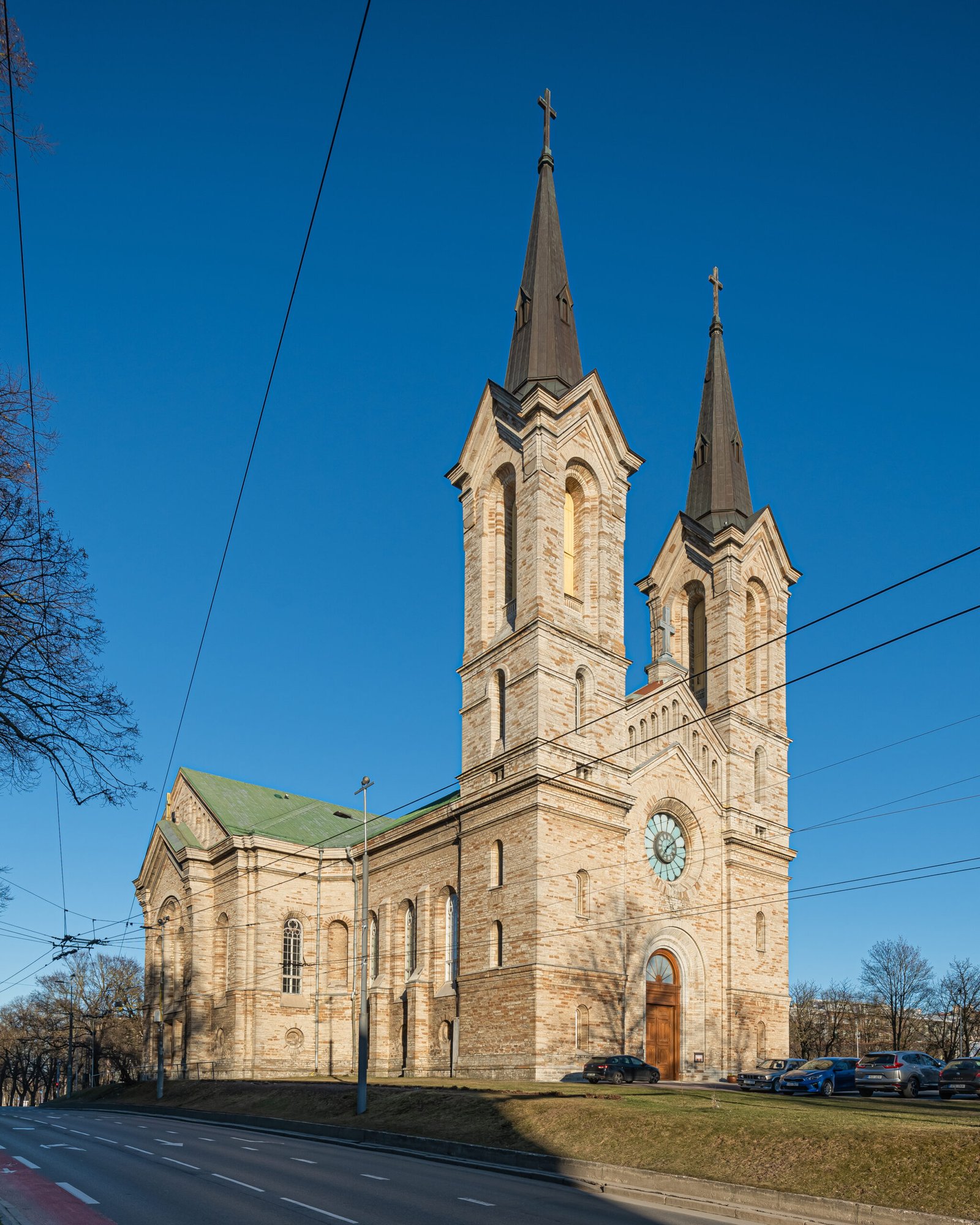
Tallinn’s grandest 19th-century church, a Romanesque Revival masterpiece crowned by twin western towers and containing Estonia’s first fresco by an ethnic Estonian artist.
At a glance
Charles’s Church stands on Tõnismägi hill, a site sacred to Tallinn’s Estonian and Finnish communities since at least the 14th century. Built between 1862 and 1870 to designs by Otto Pius Hippius, it replaced an earlier wooden structure destroyed during the Great Northern War. The church remains a beacon of mid-19th-century ambition and technical innovation in the Baltic region.
History
A chapel probably occupied this hilltop location since the 14th century. In 1670, during Swedish rule, King Charles XI commissioned a wooden church here to serve the Estonian and Finnish inhabitants of Tallinn, distinguishing them from the Baltic German population elsewhere in the city. The structure bore the king’s name.
That first church burned in 1710 as the Great Northern War swept through the region. For nearly a century and a half, reconstruction remained a distant dream. Only in the 1850s did donations begin flowing in earnest. The cornerstone of the new church was laid in 1862. Despite remaining incomplete, the building opened for worship in 1870. The twin western towers were enlarged nine years later, in 1882.
What you see
Hippius designed the church in the Romanesque Revival tradition, referencing Western European cathedrals. Twin towers flank a rose window on the western façade—a classical composition that commands the hill.
The interior reveals ingenious engineering. A Latin cross plan supports a vaulted ceiling without internal pillars, a solution Hippius developed in collaboration with Rudolf von Bernhardt. The apse glows with a fresco by Johann Köler, a watershed moment in Estonian art—the first fresco created by an ethnic Estonian artist.
Bells cast in Stockholm in 1696 for the original wooden church still ring within these stone walls, connecting present worship to three centuries of faith.
Cultural significance
Charles’s Church embodies the aspirations of Tallinn’s Estonian and Finnish communities at a moment of national awakening. Its construction in the mid-19th century, financed by popular donation, reflects growing civic pride and agency among non-German inhabitants of the city. The Köler fresco symbolizes the emergence of Estonian artists into prominence. The preserved 17th-century bells anchor the church to its past, grounding modern identity in historical continuity.
Key facts
- Location: Tõnismägi hill, Tallinn, Estonia (59.43°N, 24.74°E)
- Built: 1862–1870
- Architect: Otto Pius Hippius
- Style: Romanesque Revival
- Original bells: Cast in Stockholm, 1696
- Fresco artist: Johann Köler
Practical information & getting there
Charles’s Church is located in central Tallinn on Tõnismägi (Charles’s Hill). Public transport connects the city center to the area; the church’s prominent twin towers are visible from considerable distance. For current visiting hours, services, and any access information, consult local Tallinn tourism resources or the church directly.
Sources & resources
Find it on the map
See this place and what’s around it →📷 Become a Cultural Heritage Online photographer
Share your photos of places: they stay published under your name as the author. The more they're seen, the more you get noticed — and soon a contest will reward the most appreciated photos.
Log in or sign up free to add a photoIs this page about you?
This page is read by travellers and heritage enthusiasts who find it on Google. Tell us how you are connected to this place and we will take it from there.