

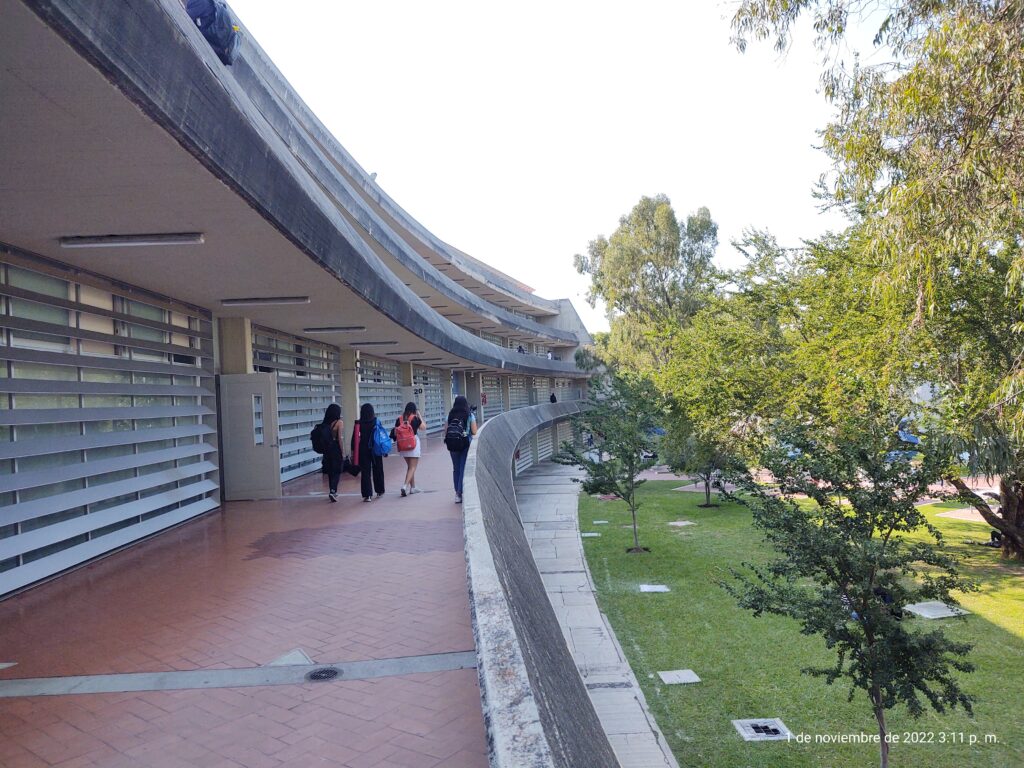
The Huentitán campus of the University of Guadalajara holds the Centro Universitario de Arte, Arquitectura y Diseño. Its north and south wings stand on the edge of the Barranca de Oblatos, above the ravine.
At a glance
The Centro Universitario de Arte, Arquitectura y Diseño, known as the CUAAD, is the arts, architecture and design centre of the University of Guadalajara. It works in three places: two former cloisters in the historic centre of the city, and a campus of modern buildings at Huentitán. The school of architecture opened there in 1969. The centre has grown round it since.
Key facts
- The arts, architecture and design centre of the University of Guadalajara
- Built out from a school of architecture founded in 1948
- Land at Huentitán awarded in 1968, first classes there in September 1969
- North and south wings above the Barranca de Oblatos
- Seventeen teaching programmes, from technical level to doctorate
- Two other seats in eighteenth-century cloisters in the historic centre
- Around 6,767 students and 619 teachers
History
The centre was formed from older schools. Architecture had been taught since 1948, the fine arts went back to 1925 and music to 1952. The architecture school began in the Escuela Vocacional and then in the central building of the Instituto Tecnológico de Guadalajara. In 1968 the university was granted land at Huentitán, and work started on the first stage of the South Wing and the administrative tower. The faculty moved there in September 1969, to the ground beside the Barranca de Oblatos.
In 1973 the school was formally made a faculty. Over time the three schools were drawn together into a single centre, with twelve departments in three divisions. Teaching is organised round the making of things: projects, representation, techniques and construction, theory and history.
Its two other seats are in the historic centre. One occupies the former cloister of Santa María de Gracia, on Calle Belén, whose church was the first cathedral of the city. The other occupies the former cloister of San Agustín, on Calle Morelos. Both were built in the eighteenth century and served over time as religious houses and as schools. The teaching of architecture thus sits inside two of the oldest buildings of Guadalajara.
The ravine shapes the teaching as well. The buildings look out over the Barranca de Oblatos. The centre runs degrees in architecture, urbanism, design in several branches, the visual and performing arts and music, and among its postgraduate programmes is a master's in cultural management.
What you see
The Huentitán campus is a group of modern blocks in concrete and brick, laid out on the plateau with the ravine at the edge of the ground. The North and South Wings hold the studios, with wide corridors and tall windows. The administrative tower stands at the entrance. Sculpture and mural work appears on the walls. From the walkways at the back the ground falls away into the Barranca de Oblatos.
This is a working campus, busy with students during term. Visitors reach it from Calzada Independencia Norte. The two seats in the historic centre keep their own hours and hold the schools of art and music.
Practical information
- Address: Calzada Independencia Norte 5075, Huentitán El Bajo, CP 44250, Guadalajara, Jalisco.
- Telephone: 33 1202 3000.
- Status: a working university campus; teaching buildings are not open as a monument.
- The other two seats are at Belén 120 (arts) and Morelos 191 (music), in the historic centre.
- Programme enquiries through the centre's academic offices.
Getting there
The campus lies north of central Guadalajara on Calzada Independencia Norte, at Huentitán El Bajo, on the road that runs along the rim of the barranca.
Nearby
- Barranca de Oblatos
- Zoológico Guadalajara
- Parque Mirador Independencia
Sources
Find it on the map
See this place and what’s around it →📷 Become a Cultural Heritage Online photographer
Share your photos of places: they stay published under your name as the author. The more they're seen, the more you get noticed — and soon a contest will reward the most appreciated photos.
Log in or sign up free to add a photoIs this page about you?
This page is read by travellers and heritage enthusiasts who find it on Google. Tell us how you are connected to this place and we will take it from there.
This entry stays online and free either way — and a free account lets you add to it yourself.