

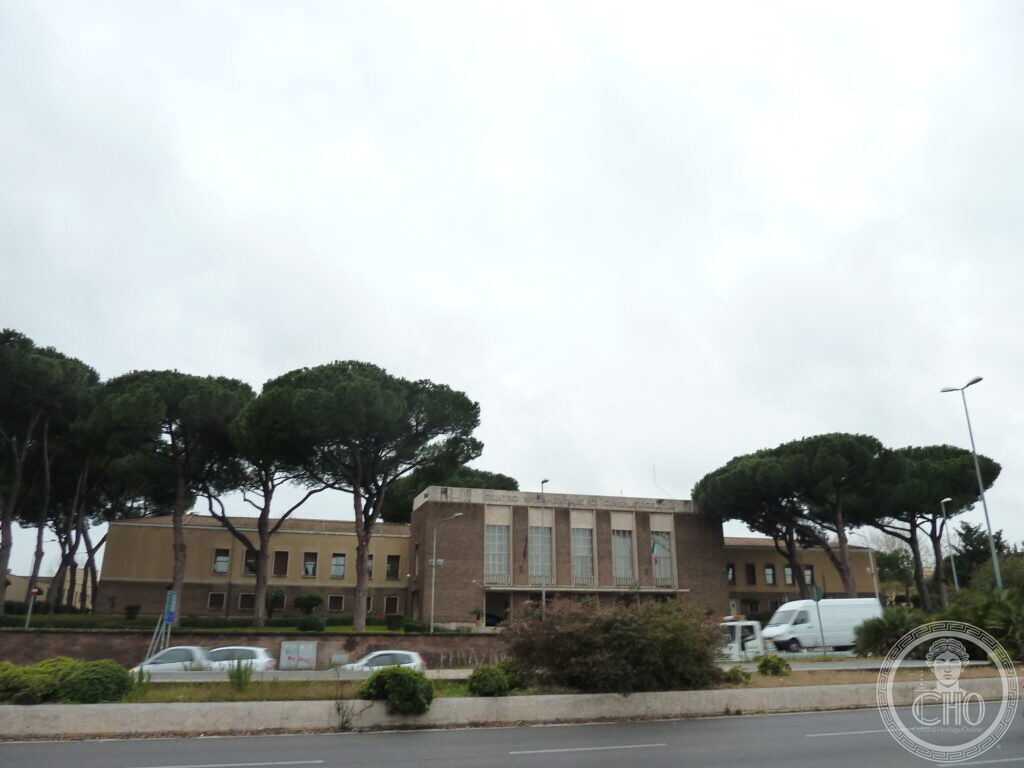
The national film school on Via Tuscolana in Rome, inaugurated in 1940 as the purpose-built home of the Experimental Cinematography Centre.
At a glance
The Centro Sperimentale di Cinematografia stands at Via Tuscolana 1520–1524, in the Cinecittà area of Rome. It is a polifunctional complex designed for the Scuola Nazionale di Cinema, described by Open House Roma as a rationalist work where functionality combines with beauty, liveability and balance.
Key facts
- Where: Via Tuscolana 1524, Roma
- What: Building
- When: 1935 (project), 1937 (construction start), 1940 (inauguration)
- GPS: 41.8509, 12.5696 · Open in Google Maps
History
The idea for a national cinematography school dates to 1930, when Alessandro Blasetti proposed it, and the following year Anton Giulio Bragaglia submitted a report describing an institute dedicated to training all cinema professions. A first school was created as a branch of the Conservatorio di Santa Cecilia, with Blasetti as director. In 1935 Luigi Freddi, head of the newly formed Direzione Generale per la Cinematografia, replaced that school with the Centro Sperimentale di Cinematografia and placed Luigi Chiarini at its head. The new centre began courses on 1 October 1935 in the basement of a middle school in Via Foligno, while the Via Tuscolana complex was being planned.
Chiarini was joined by Umberto Barbaro, translator of Eisenstein and Balázs, and by Francesco Pasinetti, who at twenty-three had directed Il canale degli angeli. Teaching was divided into five branches — acting, optics, sound, set design and production — with shared courses in aesthetics, film history, the social function of cinema and art history. The course lasted two years, with an optional third. The centre built up a library and a film archive, and began publishing the journal Bianco e Nero. From 1938 it collaborated on professional feature films, and in 1942 it self-produced Via delle cinque lune by Chiarini. In the final phase of the war the centre was forced to close and was looted by the Wehrmacht; most of the film archive’s materials disappeared, except for about ten films hidden by employees. The centre reopened in 1946 under Umberto Barbaro.
The school trained figures who shaped postwar Italian cinema, including Michelangelo Antonioni, Giuseppe De Santis, Luigi Zampa, Clara Calamai, Alida Valli, Pasqualino De Santis and Dino De Laurentiis. Since 1997 it has operated as the Scuola Nazionale di Cinema, a private-law foundation.
What you see
The photographs show a large brick and stucco complex seen from Via Tuscolana. The main facade has tall vertical windows, a row of entrance porches and a flagpole, with the inscription “CENTRO SPERIMENTALE DI CINEMATOGRAFIA” along the top. Side views reveal lower wings, roadside billboards and a low brick wall. The complex was designed by Antonio Valente with Pietro Aschieri; the construction, begun in 1937, used funds redirected from the Venice casino on Freddi’s initiative, and the result was described by the Fondazione CSC as a jewel of architecture, superbly equipped. Open House Roma notes that the complex includes an aula magna, a library, atriums, gardens, sound stages and a screening room.
Do you know more about this place?
If you know a date, a name, a document, a plaque or a photograph that tells its story, write to Sofia through the contact page. What arrives with a source goes into this page, with your name as the contributor.
Nearby
- None yet.
Gallery


Sources
- Fondazione Centro Sperimentale di Cinematografia, Storia – Centro Sperimentale di Cinematografia: origins, dates, founders, wartime closure, notable alumni
- Archivio Valente del Favero, Antonio Valente – portfolio: architect’s biography, role in the project, teaching post
- Open House Roma, Centro Sperimentale di Cinematografia: address, dates, architectural description, internal spaces
- Treccani, Centro sperimentale di cinematografia: foundation history, teaching structure, inauguration
- OpenStreetMap, Centro Sperimentale di Cinematografia: address and coordinates
- Stefano Vigolo, photographs and notes to the editorial staff (2026): identification of the subject. Not a published source.
Find it on the map
See this place and what’s around it →📷 Become a Cultural Heritage Online photographer
Share your photos of places: they stay published under your name as the author. The more they're seen, the more you get noticed — and soon a contest will reward the most appreciated photos.
Log in or sign up free to add a photoIs this page about you?
This page is read by travellers and heritage enthusiasts who find it on Google. Tell us how you are connected to this place and we will take it from there.