

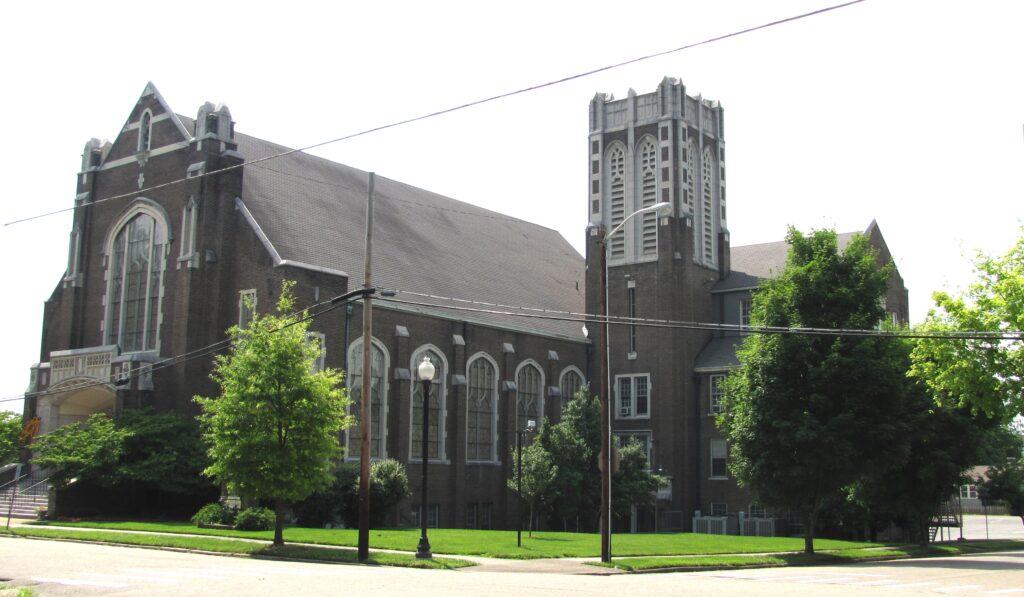
A 1927 Gothic Revival church in Knoxville, Tennessee, designed by R.H. Hunt and Baumann & Baumann, with a sanctuary that was the city’s largest church auditorium when completed.
At a glance
Central United Methodist Church stands at 201 East Third Avenue in Knoxville, Tennessee, within the Fourth and Gill Historic District. The congregation formed in 1924 from a merger of Broad Street Methodist and Centenary Methodist churches. Architects R.H. Hunt of Chattanooga and Baumann & Baumann of Knoxville designed the building, completed in 1927 in the Gothic Revival style. The exterior combines brick with stone, limestone, and marble. On November 9, 2005, the church was added to the National Register of Historic Places.
History
Central United Methodist Church traces its origin to 1924. That year Broad Street Methodist and Centenary Methodist churches merged after a fire destroyed the Broad Street building. The new congregation built the present structure, which was finished in 1927. At the time of completion, the sanctuary was Knoxville’s largest church auditorium, seating 1,600 people.
What you see
The church is primarily brick. Stone, limestone, and marble also appear on the exterior. Its Gothic Revival style gives the building a vertical emphasis and pointed arches typical of the form. Inside, the sanctuary seats 1,600. The original organ was purchased from the Riviera Theater in 1935. The current instrument, a 42-rank organ by M.P. Moller, was installed in 1958.
Cultural significance
The church is listed as a contributing property within the Fourth and Gill Historic District. Its 2005 listing on the National Register of Historic Places recognizes the building’s role in Knoxville’s architectural and religious history. The congregation is affiliated with the United Methodist Church.
Key facts
- Country: United States
- City: Knoxville, Tennessee
- Coordinates: 35.9783, -83.9222
- National Register of Historic Places: added November 9, 2005
Practical information & getting there
The church is located at 201 East Third Avenue in Knoxville, Tennessee. As an active place of worship, access to the interior is typically during services or by prior arrangement. Check with the congregation before visiting.
Sources & resources
Find it on the map
See this place and what’s around it →📷 Become a Cultural Heritage Online photographer
Share your photos of places: they stay published under your name as the author. The more they're seen, the more you get noticed — and soon a contest will reward the most appreciated photos.
Log in or sign up free to add a photoIs this page about you?
This page is read by travellers and heritage enthusiasts who find it on Google. Tell us how you are connected to this place and we will take it from there.
This entry stays online and free either way — and a free account lets you add to it yourself.