
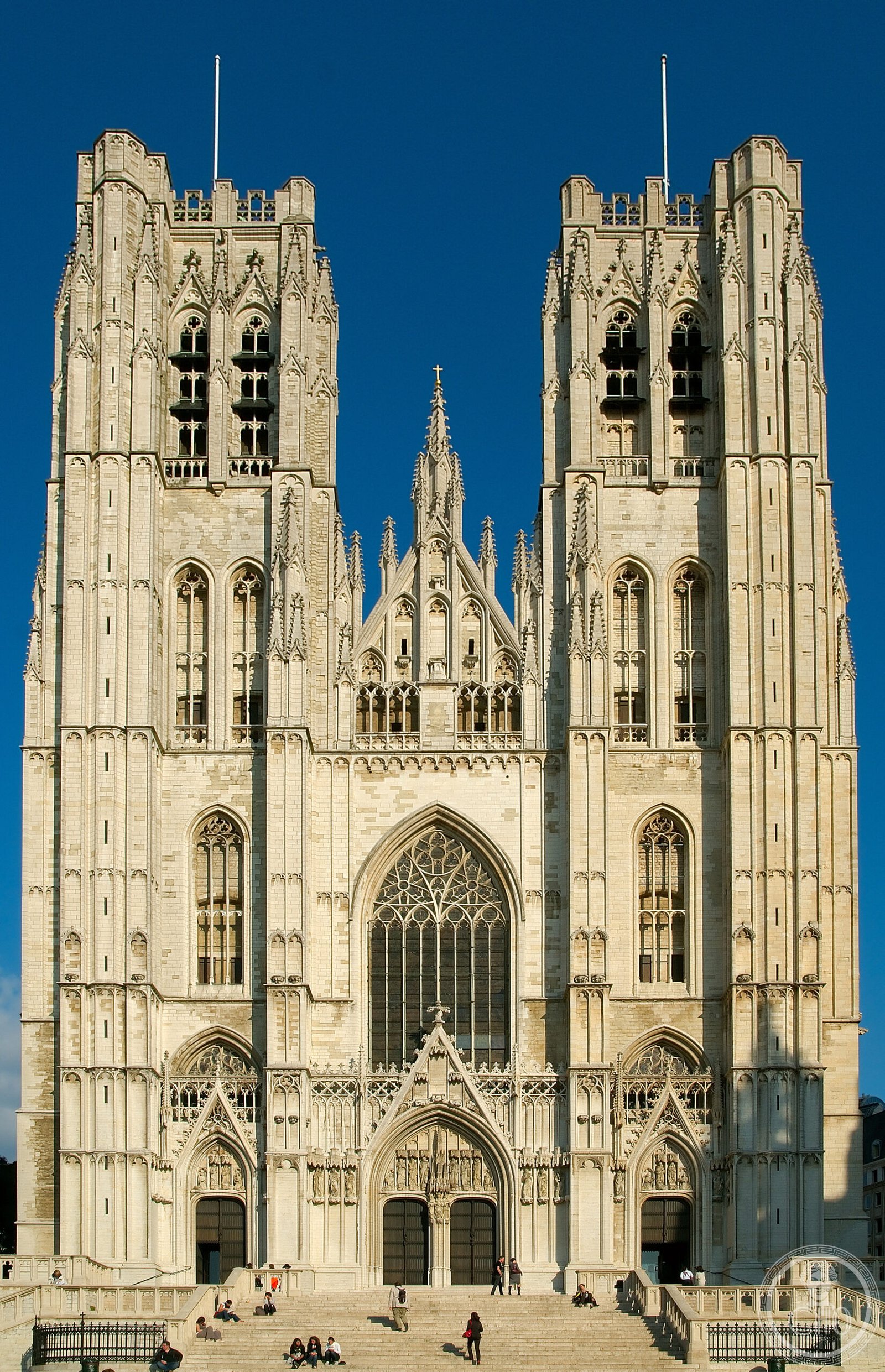
A medieval masterpiece of Brabantine Gothic, this cathedral has served as Belgium’s national church and the site of state ceremonies since its elevation to cathedral status in 1962.
At a glance
The Cathedral of St. Michael and St. Gudula stands in central Brussels as one of Belgium’s foremost examples of Gothic architecture. Dedicated to the city’s two patron saints, it combines Romanesque foundations with Gothic expansion, late-Gothic and Baroque chapels, and 19th-century neo-Gothic restorations. The cathedral is renowned for its two pipe organs and immense church bells.
History
Construction began in the 11th century on the site of an earlier chapel and progressed through the medieval period. By the 16th century, the structure had assumed largely its current Gothic form, though interior modifications continued for centuries afterward. The complex received official designation as a historic monument in 1936. In 1962, the church was elevated to cathedral status and became a co-cathedral of the Metropolitan Archdiocese of Mechelen–Brussels, sharing this role with St. Rumbold’s Cathedral in Mechelen. Since then, it has functioned as Belgium’s national church and the official seat of the Primate of Belgium.
What you see
The cathedral exemplifies Brabantine Gothic in its proportions and detail. Its late-Gothic and Baroque chapels punctuate the interior, while 19th-century restoration introduced neo-Gothic decorative elements and stained glass windows in the aisles. Two distinguished pipe organs and a notable set of church bells form integral architectural and acoustic features.
Cultural significance
As Belgium’s national church, the cathedral hosts royal weddings, state funerals, and official ceremonies of national importance. It celebrates the Te Deum on Belgian National Day and embodies the spiritual heritage of Brussels and the nation. The cathedral’s architectural synthesis—spanning Romanesque, Gothic, Baroque, and neo-Gothic periods—documents centuries of European religious artistic practice.
Key facts
- Country: Belgium
- City: Brussels
- Coordinates: 50.84777778, 4.36027778
- Construction: begun 11th century; largely complete in current form by 16th century
- Historic monument designation: 1936
- Cathedral status: 1962
- Architectural style: Brabantine Gothic with Romanesque, late-Gothic, Baroque, and neo-Gothic elements
Practical information & getting there
The cathedral occupies the Parvis Sainte-Gudule/Sinter-Goedelevoorplein in central Brussels, east of the Boulevard de l’Impératrice/Keizerinlaan. Access is convenient via Brussels-Central railway station and the Parc/Park metro station (lines 1 and 5). For current opening hours and visiting conditions, consult the cathedral’s official information.
Sources & resources
Find it on the map
See this place and what’s around it →📷 Become a Cultural Heritage Online photographer
Share your photos of places: they stay published under your name as the author. The more they're seen, the more you get noticed — and soon a contest will reward the most appreciated photos.
Log in or sign up free to add a photoDo you manage this place?
This page is read by travellers and heritage enthusiasts who find it on Google. Keep it accurate — and make it work for you. Free for non-profit heritage institutions.