

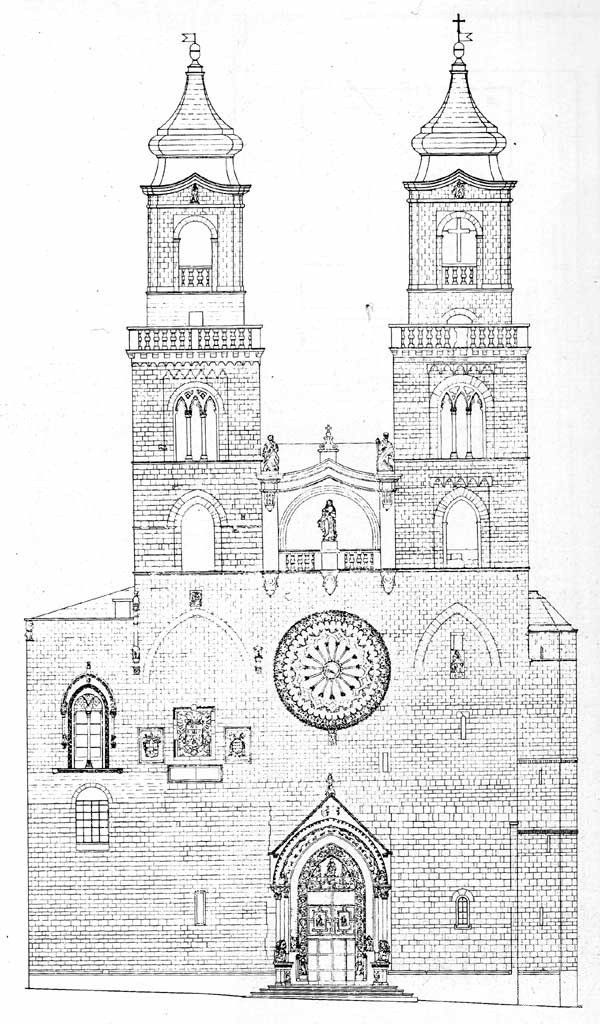
Frederick II founded it as a palatine chapel while he was repopulating the city, and the privilege he attached to it held until 1929. A collapse in January 1316 brought craftsmen from Bitonto, whose signature can still be read above the Angevin door.
At a glance
- Founded
- By will of Emperor Frederick II, traditionally 1232–1254
- Status
- Cathedral of the diocese of Altamura-Gravina-Acquaviva delle Fonti
- Protection
- Italian national monument, royal decree no. 1746 of 21 November 1940
- Portal
- Dated between 1356 and 1374 from its coats of arms
- Bell towers
- Twin tower and rose window added 1556–57; towers raised 1729
- Location
- Piazza Duomo, Altamura
Overview
Altamura was repopulated by Frederick II in the first half of the thirteenth century, and by a bull of 1232 he promoted both the building of this church and the resettlement of the town around it. He raised it as a palatine chapel, which carried a privilege: exemption from any jurisdiction but the sovereign’s.
That privilege outlasted every dynasty. Successive rulers confirmed it until 1929, when, after the Lateran Pacts, a pope in Rome was able to appoint the bishop of this cathedral for the first time.
History
The traditional dating of the fabric is 1232 to 1254, and the diocese still counts its anniversaries from 1232. Scholarship is less settled: the official record of the Italian episcopal conference treats 1232 as a terminus post quem and follows the works to 1267 and 1274, with a document of 1299 attesting that building continued under a master called don Domenico senex.
In 1285 the arrival of Sparano da Bari and the appointment of Pietro de Angeriac brought a remodelling on the model of the basilica of San Nicola in Bari, and the matronei were added.
On 22 January 1316, as an inscription on the northern portal records, a substantial collapse forced the planned enlargement to be cut back. The rebuilding was entrusted to craftsmen from Bitonto, the sons of a certain Mastro Consiglio, whose signature can still be read high on the Angevin door.
The orientation of the church was reversed, so that the facade now stands where the apse was. The episcopal conference places the reversal in the phase after 1316, together with the insertion of the Angevin portal; the town council dates it to 1534. The twin bell tower and the rose window came in 1556 and 1557, and the two towers were raised to their present height in 1729. In the nineteenth century the architect Travaglini redecorated the interior with marble revetments of Neapolitan taste and a wood and stucco false ceiling.
The cathedral was declared an Italian national monument by royal decree no. 1746 of 21 November 1940, and reopened for worship after restoration on 12 April 2017.
What you see
The portal is the great set piece, dated between 1356 and 1374 by the two coats of arms it carries, those of the Anjou of Naples and of the princes of Taranto, lords of Altamura. Twenty-two Gospel scenes run through the arches and the Last Supper is carved on the architrave. The stylophore lions below it are later, the work of Antonio da Andria in 1533. The rose window above is fourteenth-century, with fifteen rays and a relief of the Agnus Dei.
Of the Frederician church only the Byzantine-type capitals, the pillars and columns, the matronei and the apse remain visible. Inside are the choir of 1543, the pulpit of about 1545, an Assumption of the Virgin by Leonardo da Pistoia of 1546, the edicola dell’Assunta of 1743 and a Conversion of Saint Paul by Domenico Morelli of 1876.
On a cusp of the rear facade, visible from via Onorato Candiota, is the carved head long described as a two-faced herm and taken as evidence of a temple of Janus beneath the church. Restoration showed it has only one face: it is the head of a dark-skinned unbeliever, with copper plating and the folds of a turban, set there to ward off the fear of Saracen attack.
Practical information
- Address: Piazza Duomo 1, 70022 Altamura (BA)
- Opening: the parish and the town council run an extended opening scheme, “Cattedrale a porte aperte”, renewed each year — check the current dates and hours with the Comune di Altamura or the diocese before travelling
- Entry to the church is free; the matronei are visited on a separate ticket
- Diocese: diocesidialtamura.it
Sources
- Ministero della Cultura, Catalogo generale dei Beni Culturali, entry on the Duomo di Altamura, ed. Veronica Santoni, 2021 — catalogo.cultura.gov.it
- Conferenza Episcopale Italiana, BeWeB, official record of the cathedral church of Santa Maria Assunta (dating, the collapse of 22 January 1316, the reversal of orientation, the 1556–57 and 1729 campaigns, Travaglini)
- Comune di Altamura, official page on the cathedral, and the “Cattedrale a porte aperte” announcements
- Diocesi di Altamura-Gravina-Acquaviva delle Fonti, on the anniversary of the dedication
- Royal decree no. 1746 of 21 November 1940, declaring cathedral churches national monuments
Find it on the map
See this place and what’s around it →📷 Become a Cultural Heritage Online photographer
Share your photos of places: they stay published under your name as the author. The more they're seen, the more you get noticed — and soon a contest will reward the most appreciated photos.
Log in or sign up free to add a photoIs this page about you?
This page is read by travellers and heritage enthusiasts who find it on Google. Tell us how you are connected to this place and we will take it from there.