

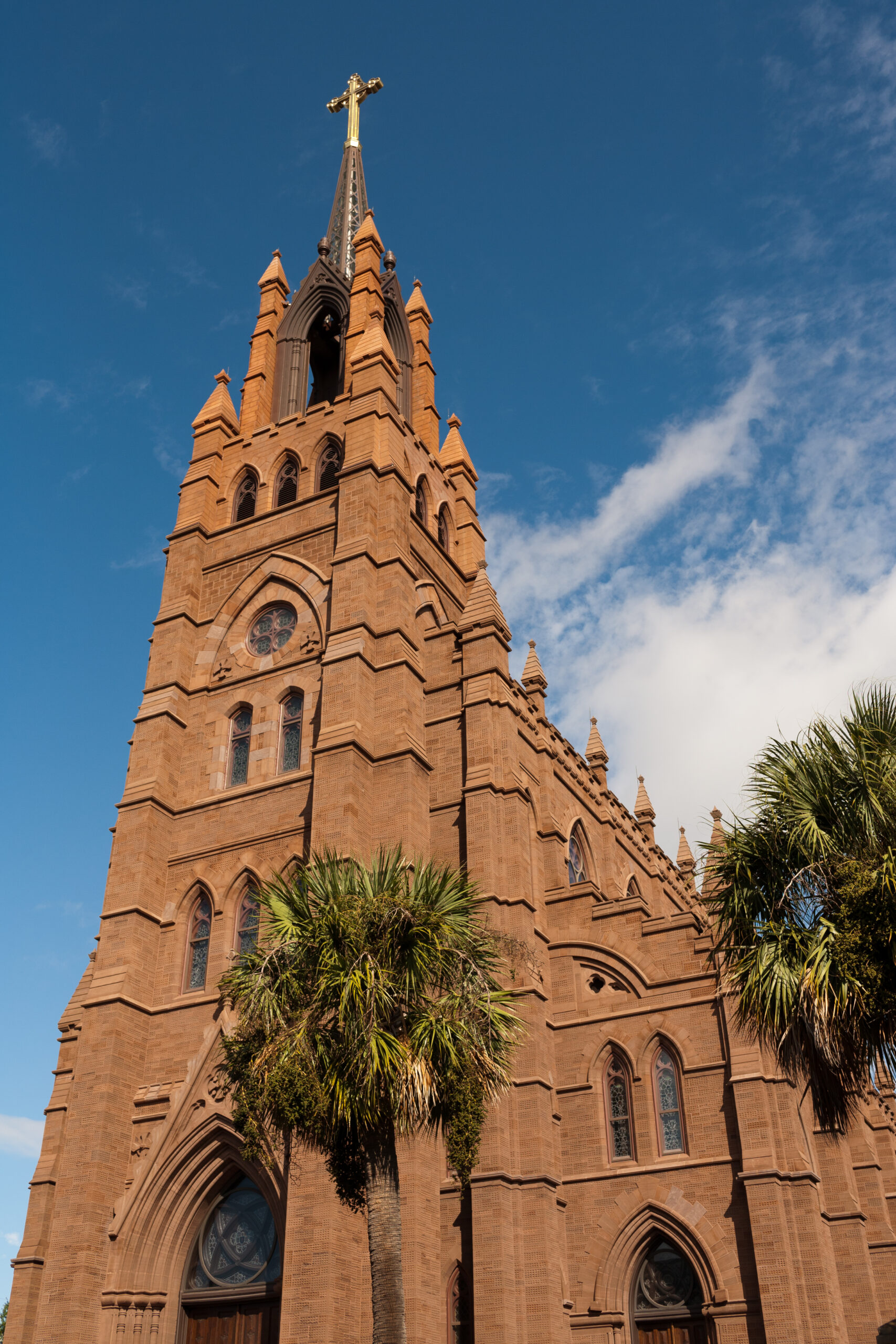
The mother church of the Roman Catholic Diocese of Charleston, built to replace a cathedral destroyed by fire in 1861.
At a glance
The Cathedral of St. John the Baptist is the mother church of the Roman Catholic Diocese of Charleston. Located in Charleston, South Carolina, it was designed by Brooklyn architect Patrick Keely. Construction began in 1890 and the cathedral was dedicated in 1907. It stands as the seat of the fourteenth bishop of Charleston.
History
The cathedral replaced an earlier one that burned down in 1861. Work on the new building started in 1890, following a design by Patrick Keely of Brooklyn. Dedication came in 1907. The cathedral has since remained the liturgical center of the diocese, with Bishop Jacques E. Fabre consecrated and installed there in 2022.
What you see
The cathedral has four chapels. One of them contains a crypt. Throughout the chapels, the doors and the upper church are numerous stained glass windows, all created in France. The upper church seats 720 worshippers. Its pipe organ was manufactured in the United States, while the steeple bells were cast in France.
Cultural significance
As the mother church of the Diocese of Charleston, the cathedral is the formal seat of the diocese’s bishop. It has witnessed the consecration of Bishop Fabre, the fourteenth bishop of Charleston, in 2022. The rector as of 2025 is the Very Rev. Gregory B. Wilson.
Key facts
- Country: United States
- City: Charleston
- Coordinates: 32.7765, -79.9345
Practical information & getting there
The cathedral is in Charleston, South Carolina. Specific visiting hours are not listed here; check local parish announcements before planning a visit.
Sources & resources
Find it on the map
See this place and what’s around it →📷 Become a Cultural Heritage Online photographer
Share your photos of places: they stay published under your name as the author. The more they're seen, the more you get noticed — and soon a contest will reward the most appreciated photos.
Log in or sign up free to add a photoIs this page about you?
This page is read by travellers and heritage enthusiasts who find it on Google. Tell us how you are connected to this place and we will take it from there.