

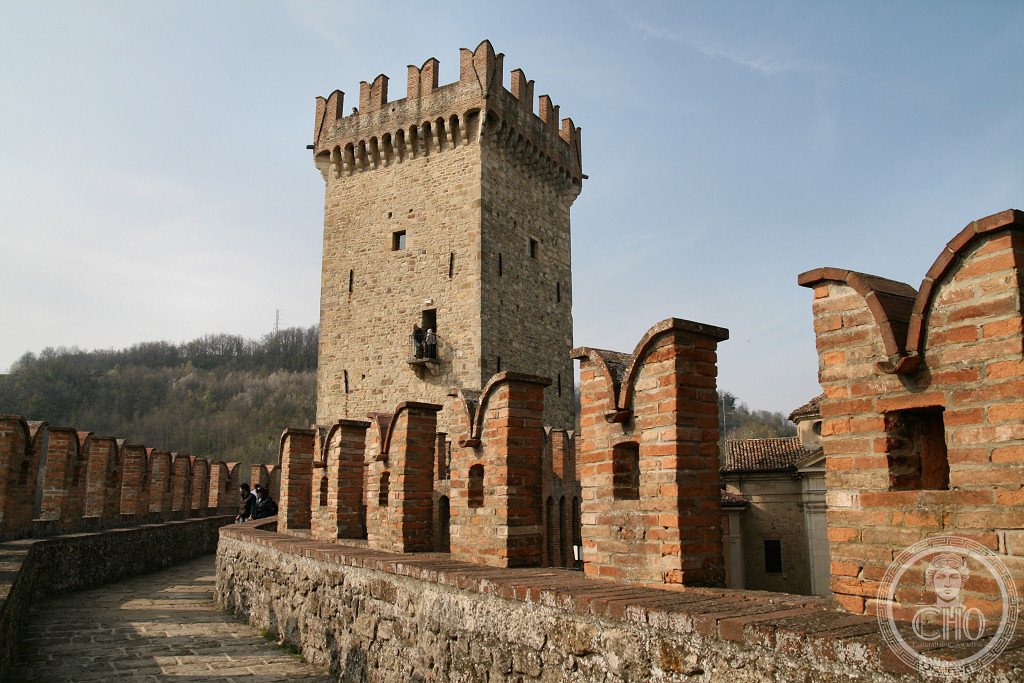
The Castle of Vigoleno is a remarkably well-preserved medieval fortified village in the municipality of Vernasca, in the Piacenza Apennine foothills of Emilia-Romagna, Italy. First documented in 1141 as a fief of the Pallavicino, later held by the Scotti, and substantially rebuilt in the 13th and 14th centuries, the castle retains its complete ring of crenellated walls, towers, and internal borgo, making it one of the most intact examples of medieval military architecture in northern Italy. The castle became a centre of cultural life in the 1920s under Princess Maria Ruspoli-Gramont, who bought it in 1921 and restored the interiors on historical lines, welcoming guests including Gabriele D’Annunzio, Riccardo Bacchelli, Arthur Rubinstein and Max Ernst.
At a glance
- Type
- Fortified medieval castle and walled village
- Period
- First documented 1141; major works 13th–14th century
- Style
- Medieval military architecture; Romanesque-Gothic
- Location
- Vigoleno, Vernasca, Province of Piacenza, Emilia-Romagna, Italy
- Coordinates
- 44.8166° N, 9.9012° E
Overview
Vigoleno occupies a naturally defensive ridge overlooking the Stirone river valley at an elevation of approximately 560 metres, with views extending across the Po Plain toward the Alps on clear days. The fortified complex comprises the castle proper with its keep, a walled borgo of medieval houses, a Romanesque parish church dedicated to San Giorgio, and a complete circuit of curtain walls with round and square towers. The entire settlement — castle, village, and walls — is enclosed within a single ring of defences that has remained almost unchanged since the 14th century.
History
The site appears in written records from 1141 as a fief of the Pallavicino, and passed in the 13th century to the Scotti, one of the great Piacenza families, who held it for several centuries. The castle was substantially rebuilt and reinforced in the 13th and 14th centuries, taking the form that survives today, including the distinctive square keep and the circuit of walls with their evenly spaced towers. Sold by the Scotti in 1908, the castle was bought in 1921 by Princess Maria Ruspoli-Gramont, who restored it and made it again a centre of cultural life until 1935; parts of Richard Donner’s film Lady Hawke were shot there in the early 1980s. The castle remains privately owned and is managed as a heritage accommodation and events venue.
What you see
The approach along a ridge road reveals the castle’s dramatic silhouette: a tall square keep rising behind a curtain wall punctuated by round corner towers, all in pale local limestone. Passing through the main gate, visitors enter a cobbled medieval village street lined with stone houses and a small piazza facing the Romanesque church of San Giorgio, whose interior contains 14th-century fresco fragments. The keep’s upper floors offer panoramic views of the surrounding Apennine valleys, and the walkway along the top of the walls provides a complete circuit of the fortifications.
Cultural significance
Vigoleno is one of the few Italian medieval villages to survive intact within its complete ring of defensive walls, a rarity that has led to its inclusion in the I Borghi più belli d’Italia (The Most Beautiful Villages of Italy) association. The castle’s early 20th-century associations with Italian literary and artistic figures — particularly Eleonora Duse and Gabriele d’Annunzio — give it additional cultural resonance as a site of the Belle Époque intellectual world. Its extraordinary state of preservation makes it a reference point for historians of medieval military architecture in the Po Valley.
Practical information
- Address
- Vigoleno, 29010 Vernasca PC, Italy
- Hours
- Check official website for current opening times; the castle operates as a private accommodation and events venue
Getting there
Vigoleno is located in the Apennine foothills approximately 40 kilometres south-east of Piacenza. The most practical access is by car via the SS359 from Alseno or Vernasca; the nearest railway station is at Fidenza (Parma–Milan line), from which the castle is approximately 25 kilometres by road. Limited local bus services connect Vernasca with Piacenza on weekdays, but a private vehicle is strongly recommended for visiting the castle.
Sources
Find it on the map
See this place and what’s around it →
Advertisement. Pictured, from the Cleveland Museum of Art (CC0) and not for sale: a parure of about 1850, a Lalique brooch, a Castellani bangle. How we handle this
📷 Become a Cultural Heritage Online photographer
Share your photos of places: they stay published under your name as the author. The more they're seen, the more you get noticed — and soon a contest will reward the most appreciated photos.
Log in or sign up free to add a photoIs this page about you?
This page is read by travellers and heritage enthusiasts who find it on Google. Tell us how you are connected to this place and we will take it from there.
This entry stays online and free either way — and a free account lets you add to it yourself.