
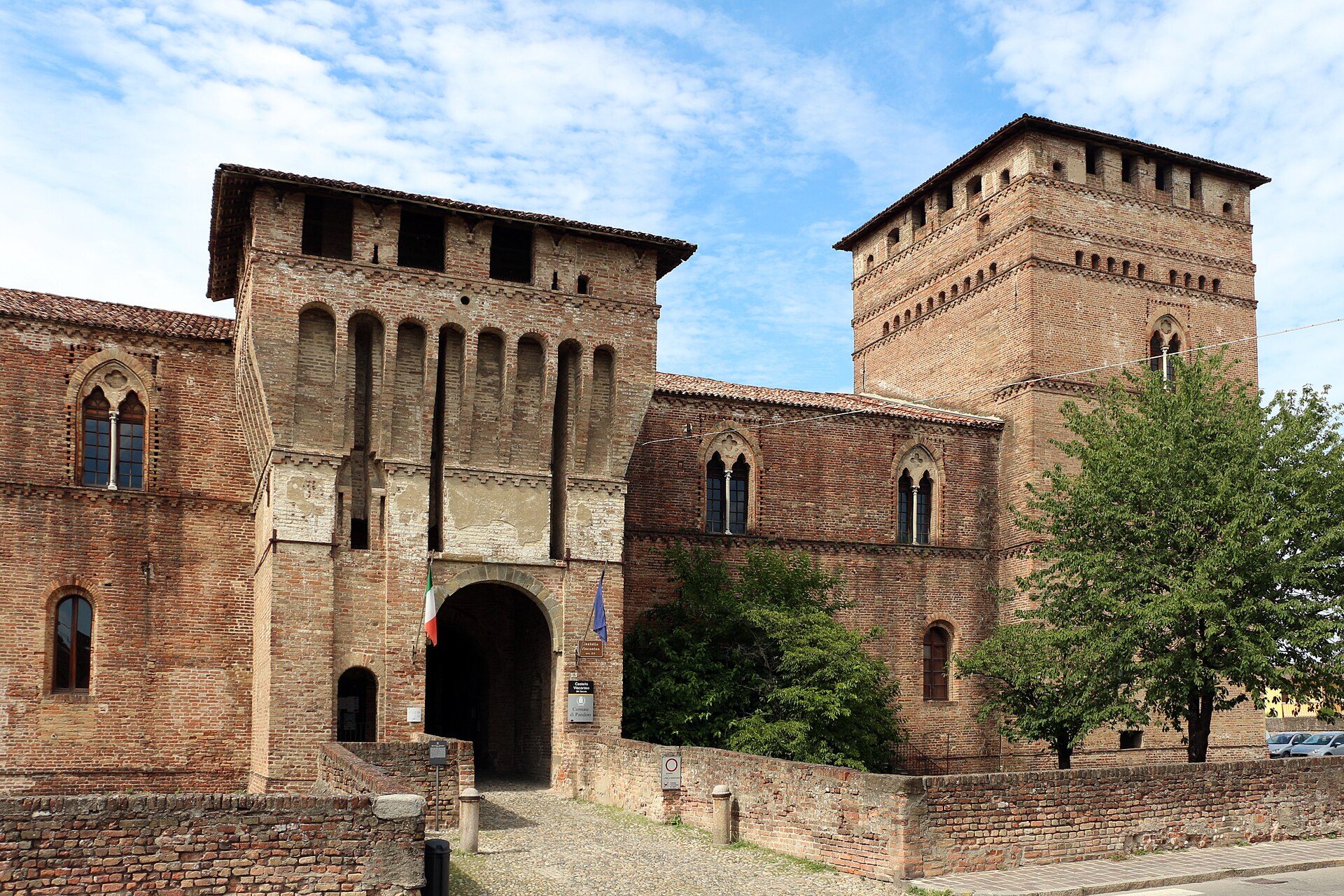
A fortified residence built by Bernabò Visconti in the mid-1300s, this castle exemplifies the military architecture of the Visconti lords in the Lombard plain.
At a glance
The Castello Visconteo di Pandino stands as a well-preserved example of 14th-century Visconti military design. Its austere geometry and functional fortifications reflect the practical demands of territorial control in medieval Lombardy.
History
Bernabò Visconti, the powerful lord of Milan, commissioned this castle around the middle of the 14th century. Built as a fortified residence, it served both as a seat of authority and a defensive stronghold for the Visconti domain across the Lombard plains.
What you see
The castle follows the typical formula of Visconti planimetry: a simple square floor plan anchored by four square corner towers. The elegant internal courtyard features ground-floor arcades with sharp pointed arches, while an upper loggia displays delicate square pilasters—a refined counterpoint to the fortress’s austere exterior walls.
Cultural significance
The Castello di Pandino represents a crucial phase in the architectural language of the Visconti, when military necessity and Renaissance sensibility began to merge. Its survival in excellent condition offers rare insight into how the Milanese lords balanced defense with domestic comfort during the Trecento.
Key facts
- Address: Via Castello, 15, 26025 Pandino
- Coordinates: 45.4057403, 9.552993
- Website: https://www.comune.pandino.cr.it/vivere-pandino/ufficio-turistico
- Phone: 0373 973318
Practical information
The castle is in excellent condition. Contact the tourist office for current opening hours, admission fees, and guided tour availability.
Getting there
Pandino is located in the province of Cremona in central Lombardy. The castle sits in the town center; consult local transport options and parking availability before your visit.
See the place
Sources & resources
- Comune di Pandino – Official tourism website
- Cultural Heritage Online
Find it on the map
See this place and what’s around it →📷 Become a Cultural Heritage Online photographer
Share your photos of places: they stay published under your name as the author. The more they're seen, the more you get noticed — and soon a contest will reward the most appreciated photos.
Log in or sign up free to add a photoIs this page about you?
This page is read by travellers and heritage enthusiasts who find it on Google. Tell us how you are connected to this place and we will take it from there.