
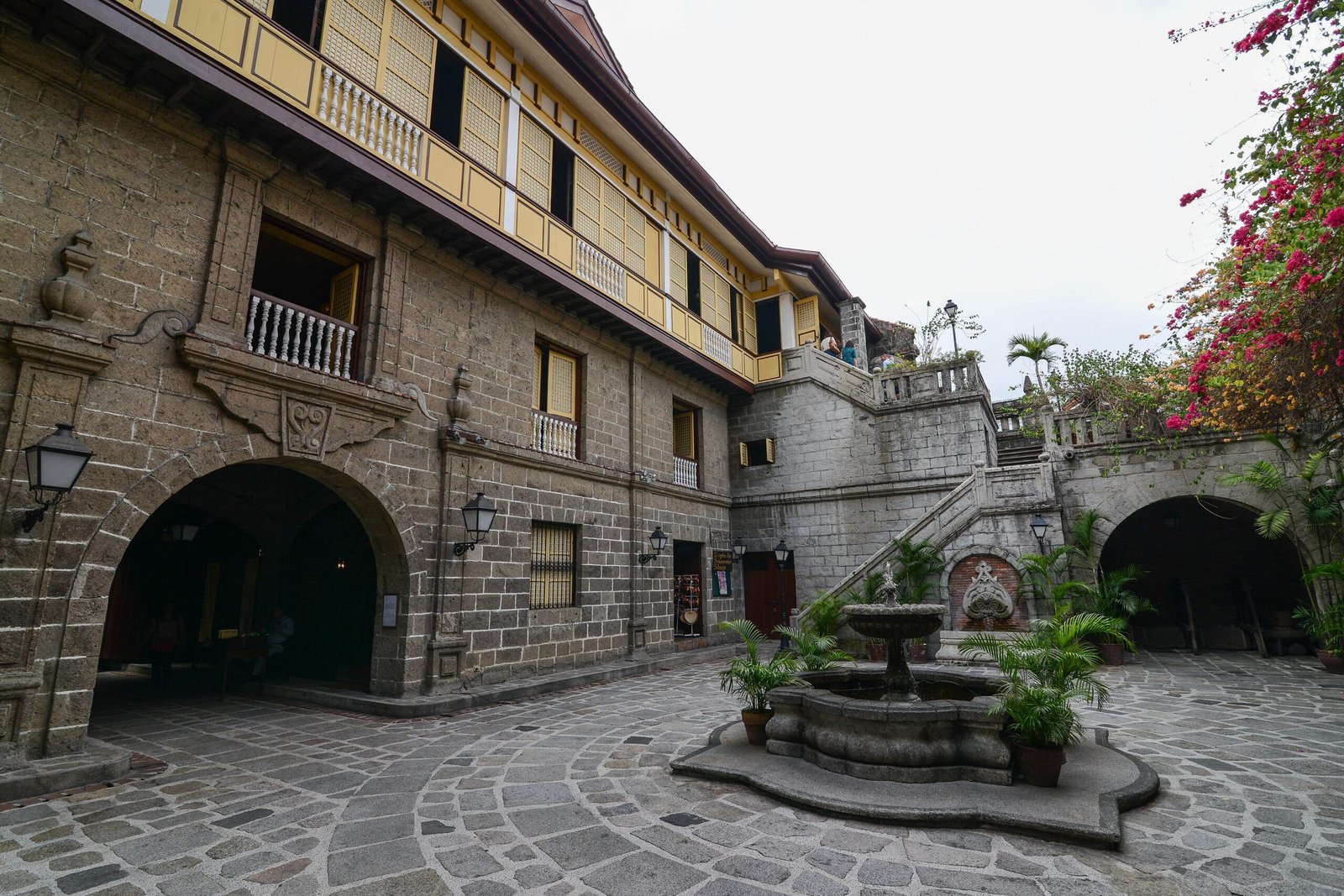
A colonial-era mansion in Intramuros preserving the domestic life and architectural aesthetics of Spanish rule in the Philippines.
At a glance
Casa Manila is a stone-and-wood museum house built circa 1850 in Barrio San Luis, one of Intramuros’ four original villages. It stands across from the historic San Agustin Church and anchors a district of three grand colonial residences. The museum interprets Spanish colonial domestic culture through period rooms and furnishings.
History
The building was originally a replica of the San Nicolas House, once located on Calle Jaboneros. Architect J. Ramon L. Faustmann designed Casa Manila. During the 1980s, Imelda Marcos led its reconstruction as a museum, restoring it according to Spanish colonial architectural principles and reopening it as a cultural institution devoted to the colonial period.
What you see
The museum building exemplifies 19th-century Spanish colonial design in stone and wood. It occupies a prominent corner lot bounded by Calle Real, General Luna, Cabildo and Urdaneta streets, positioning it prominently within the historic walled city. Interior spaces are arranged to reflect the domestic arrangements of an elite Spanish colonial household.
Cultural significance
Casa Manila documents the material culture and social hierarchies of Spanish colonial Manila. As a museum, it contextualizes the three surviving grand houses of Barrio San Luis—including the earlier Los Hidalgos (c. 1650) and the later Cuyugan Mansion (c. 1890)—within the broader urban fabric of Intramuros, the historic Spanish administrative center.
Key facts
- Location: Intramuros, Manila, Philippines
- Coordinates: 14.58966°N, 120.97514°E
- Original construction: circa 1850
- Architect: J. Ramon L. Faustmann
- Reconstructed: 1980s under Imelda Marcos
Practical information & getting there
Casa Manila is situated in Intramuros, Manila’s walled historical district, accessible via public transport and walking. The museum is positioned across San Agustin Church. Hours, admission fees and guided tour availability can be confirmed through official heritage tourism resources for Metro Manila.
Sources & resources
Find it on the map
See this place and what’s around it →📷 Become a Cultural Heritage Online photographer
Share your photos of places: they stay published under your name as the author. The more they're seen, the more you get noticed — and soon a contest will reward the most appreciated photos.
Log in or sign up free to add a photoIs this page about you?
This page is read by travellers and heritage enthusiasts who find it on Google. Tell us how you are connected to this place and we will take it from there.