

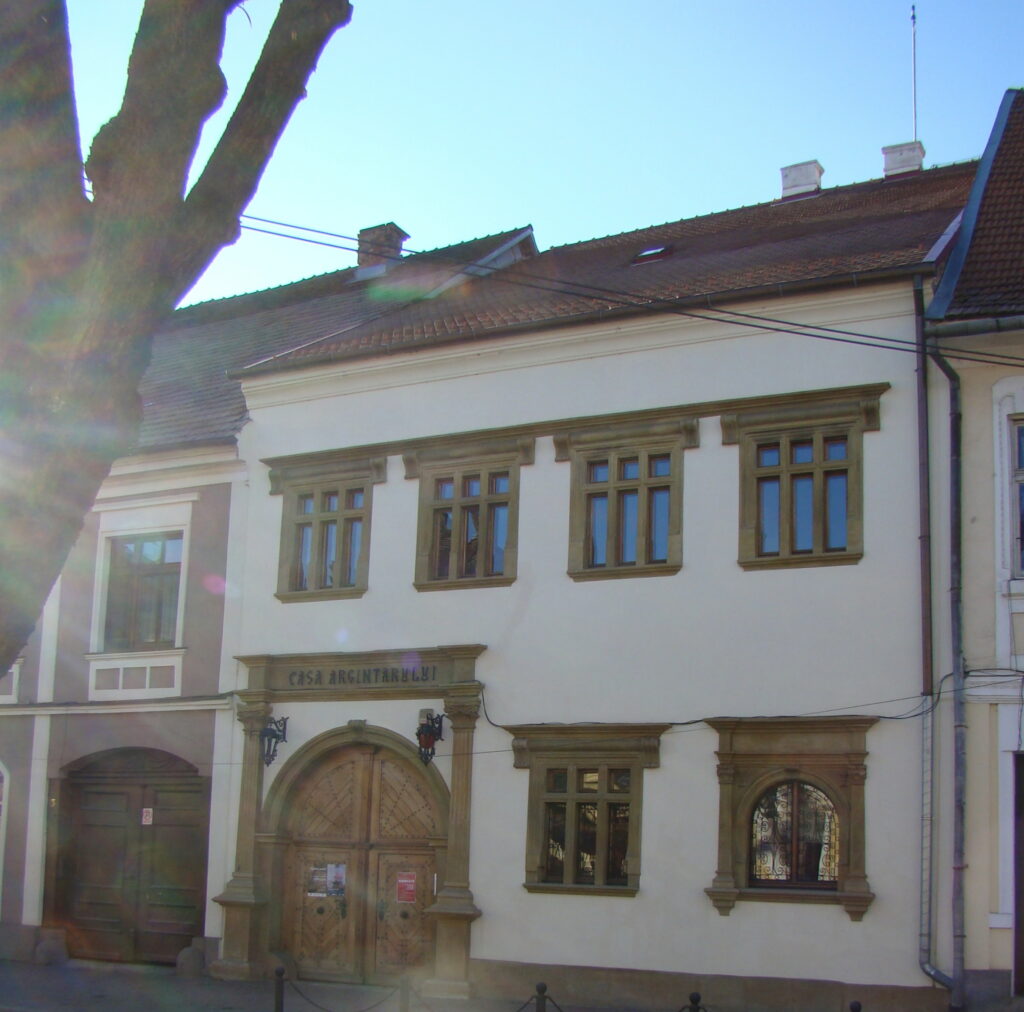
Casa Argintarului is a Renaissance house on Strada Dornei in the old centre of Bistrița, built in the first half of the 16th century. It now serves as the German Centre of the Bistrița-Năsăud museum complex.
At a glance
The house stands at Strada Dornei nr. 5. The Sugălete lanes are close by. Its original body is a rectangular two-storey block: three vaulted rooms on the ground floor, to the right of the carriage passage, and a broad double-ramp stair up to a hall and three rooms with Renaissance stone door surrounds. The Bistrița-Năsăud museum complex runs it as a German cultural centre, with exhibition rooms, a conference room and a library.
Key facts
- Built in the first half of the 16th century
- Named after two chalices carved in a ground-floor window arch, the emblem of the goldsmiths' guild
- Façade attributed to Petrus Italus de Lugano, in Bistrița between 1560 and 1563
- Saved from demolition in 1939 by Nicolae Iorga
- Historic monument BN-II-m-A-01482
- Rehabilitated between 2013 and 2015
History
The name comes from two chalices carved in the arch of a ground-floor window, of different shapes, the emblem of the goldsmiths' guild of Bistrița. The house belonged to the guild or to a master goldsmith, and its plan is that of a craftsman's dwelling: workshops at street level, living rooms above.
The carved detail on the façade resembles the portals of the Evangelical Church. That resemblance has led to the attribution of the façade to Petrus Italus de Lugano, who worked in Bistrița between 1560 and 1563. A strong fire damaged the house in 1758. By 1939 it had reached the point of demolition, and was saved thanks to the intervention of Nicolae Iorga.
From 1950 the house belonged to the state and went through a long restoration coordinated by the architect Șt. Balș. A second wing went up at that time, copying the surrounds of the original body. In 1969 the building opened with an exhibition of fine art, and until 1986 it housed the history section of the Bistrița-Năsăud county museum. It then served the School of Arts and Crafts. Between 2013 and 2015 it was rehabilitated under the Regional Operational Programme 2007-2013, and the building came back to the museum as the German Centre.
What you see
The façade carries a monumental semicircular portal, framed by pilasters on tall pedestals after the model of 15th-century Florentine architecture. The windows have rectangular Renaissance surrounds, richer on the façade, and one ground-floor window repeats the portal in reduced form. Inside, three vaulted rooms open to the right of the carriage passage.
The upper floor holds a hall and three rooms, with doors framed in Renaissance stone. The museum has added a conference room, exhibition spaces and the library of the German Centre on two levels.
Practical information
- Address: Strada Dornei nr. 5, Bistrița, Bistrița-Năsăud
- Open April to September 10am to 6pm, October to March 9am to 5pm; closed on Mondays
- Admission: 8 lei for adults, 4 lei for students, pensioners and military personnel, 2 lei for children and pupils
- Photography of the interior and exhibitions: 50 lei per hour, for personal use
- Contact: telephone 0745. 629 150, email [email protected]
Getting there
The house stands at Strada Dornei nr. 5, in the old centre of Bistrița, close to the Sugălete lanes.
Nearby
- Sugălete ensemble
- Evangelical Church, Bistrița
- Old City Hall of Bistrița
Sources
- https://complexulmuzealbn.ro/ro/sectii/casa-argintarului-centrul-german-bistrita
- https://ghidulmuzeelor.cimec.ro/id.asp?k=2064&-casa-argintarului-centrul-german-bistrita-bistrita-nasaud
- https://agerpres.ro/cultura-media/2018/09/10/cladirileromanieicentenare-casa-argintarului-din-bistrita-simbol-al-opulentei-breslei-aurarilor-si-a–173424
- https://www.bistrita.com/descopera/jq/casa-argintarului
Find it on the map
See this place and what’s around it →📷 Become a Cultural Heritage Online photographer
Share your photos of places: they stay published under your name as the author. The more they're seen, the more you get noticed — and soon a contest will reward the most appreciated photos.
Log in or sign up free to add a photoIs this page about you?
This page is read by travellers and heritage enthusiasts who find it on Google. Tell us how you are connected to this place and we will take it from there.
This entry stays online and free either way — and a free account lets you add to it yourself.