
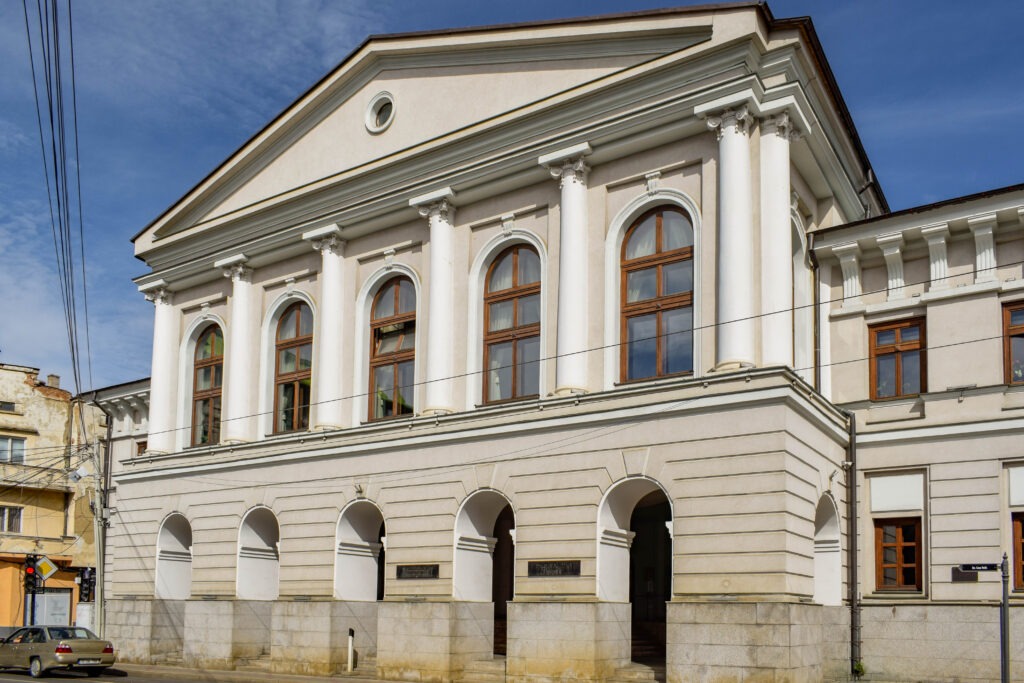
The first play in the Romanian language was acted in its first-floor salon. Thirty years later Liszt gave a concert in it. It is now a university and a philharmonic.
At a glance
The Alecu Balș House stands at 29 Strada Cuza Vodă in Iași, the old capital of Moldavia. Its first-floor salon saw the first performance of a play in Romanian, in 1817, and a concert by Franz Liszt in 1847. An addition was built in the extension of the old house between 1900 and 1910. After a long and interrupted restoration it now holds the George Enescu National University of Arts and the Moldova Philharmonic.
Key facts
- 1817: the first play in the Romanian language performed in the first-floor salon
- 1847: a concert by Franz Liszt held in the house
- 1900–1910: an addition built in the extension of the old Balș house
- Restoration: carried out in stages, with long interruptions
- Today: the George Enescu National University of Arts and the Moldova Philharmonic share the building; the rectorate is on the ground floor
- The first-floor hall: intended for the university orchestra to study and rehearse in, now also used for concerts and theatre
- The university: established on 1 October 1860 as the School of Music and Declamation, by decree of Prince Alexandru Ioan Cuza (one database gives 1836)
- GPS: 47.1643, 27.5854 · Open in Google Maps
History
Iași was the capital of Moldavia, and in the early nineteenth century it was where the Romanian language was arguing its way into public life. In 1817 a play was performed in Romanian, in the first-floor salon of this house: not in a theatre, because there was not yet one for it, but in a private room of the sort where new things in that period usually began.
In 1847 Franz Liszt, then in the middle of the years he spent crossing Europe as a travelling virtuoso, gave a concert in the same building. Iași was a long way from Paris and Vienna; that he came at all says something about the city.
The house changed hands and uses through the following century, with an addition built onto the old structure between 1900 and 1910. Its restoration was attempted in stages and abandoned more than once. When the last stage was finished, the building was given to music and theatre again: the George Enescu National University of Arts and the Moldova Philharmonic.
Who is there now
The university was founded on 1 October 1860, as the School of Music and Declamation, by decree of Prince Alexandru Ioan Cuza — the same ruler who was founding national institutions across the two principalities in those years. It carries the name of George Enescu, Romania’s greatest composer. Its rectorate is on the ground floor here, and the first-floor hall is where the university orchestra rehearses, in the room that heard Liszt.
What you see
A long nineteenth-century front on Strada Cuza Vodă, with tall windows and a columned entrance, and the early-twentieth-century addition continuing the line of the older house. The salon on the first floor is the room that matters: it is still a hall where music is played, which is the rarest kind of survival a building of this sort can manage.
Sources & resources
Find it on the map
See this place and what’s around it →📷 Become a Cultural Heritage Online photographer
Share your photos of places: they stay published under your name as the author. The more they're seen, the more you get noticed — and soon a contest will reward the most appreciated photos.
Log in or sign up free to add a photoIs this page about you?
This page is read by travellers and heritage enthusiasts who find it on Google. Tell us how you are connected to this place and we will take it from there.