
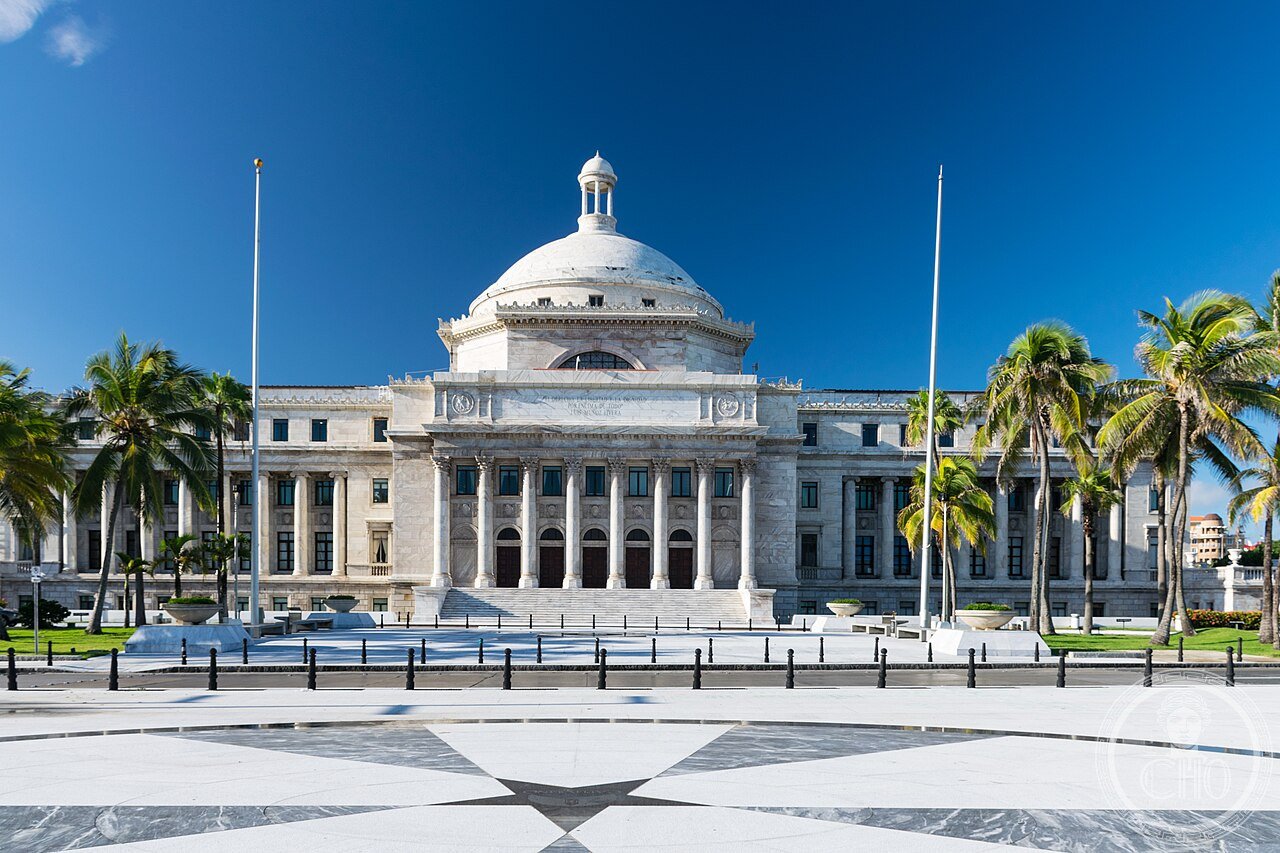
A gleaming white marble dome rising between the Atlantic Ocean and San Juan Bay, the Capitol of Puerto Rico is the most elegant civic building in the Caribbean and the seat of the island's Legislative Assembly since 1929.
At a glance
- Type
- Legislative palace
- Period
- 1925-1929
- Style
- Neoclassical / Beaux-Arts
- Location
- Puerta de Tierra, San Juan, Puerto Rico
- Coordinates
- 18.4666, -66.1011
- Architect
- Rafael Carmoega, Antonin Nechodoma
Overview
The Capitol of Puerto Rico stands on the Puerta de Tierra waterfront, occupying a commanding position between the Atlantic Ocean and San Juan Bay at the threshold of Old San Juan. Its central dome, modeled on the United States Capitol yet more ornate, is faced entirely in Vermont marble and surrounded by formal gardens. Construction began in 1925 and the building was inaugurated in 1929 as the permanent seat of the bicameral Legislative Assembly of Puerto Rico, then a U.S. territory since 1898. The structure represents the island's aspirations for self-governance and institutional dignity at a moment when full political status was still unresolved.
History
Puerto Rico passed from Spanish to United States sovereignty in 1898 following the Spanish-American War. For three decades the colonial legislature met in improvised quarters in Old San Juan. The decision to build a dedicated capitol was both practical and symbolic: it would assert Puerto Rico's political maturity and project permanence onto a relationship with Washington that remained constitutionally ambiguous. The cornerstone was laid in 1925; the main building opened in 1929, though ancillary wings were not completed until the 1960s. Inside the rotunda, the original copy of the Constitution of Puerto Rico of 1952 – the document that transformed the island into a Commonwealth – is displayed in a case of honor, making the building simultaneously a monument to legislative power and to constitutional identity.
Architecture and Design
Architects Rafael Carmoega and Antonin Nechodoma designed the Capitol in a Beaux-Arts interpretation of American Neoclassicism, drawing directly from the iconography of the U.S. Capitol in Washington while adding tropical and Puerto Rican decorative elements. The building is faced entirely in Vermont marble, giving it a pure white appearance that contrasts with the deep blue of the surrounding sea. The central dome is surmounted by a bronze lantern and adorned with four mosaic lunettes by Puerto Rican artist Rafael Rios Rey, depicting the history of the island from indigenous Taino civilization through Spanish colonialism and U.S. annexation. The main rotunda features four large murals representing four centuries of Puerto Rican history. Colonnaded porticos on the north and south facades open onto formal gardens; the overall composition is monumental but calibrated to a tropical scale.
Cultural significance
The Capitol is the primary symbol of Puerto Rican civic identity and the arena where the island's unresolved political status is perpetually negotiated. The rotunda's display of the 1952 Constitution makes every legislative session a reminder of the Commonwealth compact. The building has been the site of major political demonstrations for and against statehood, independence, and enhanced autonomy. Its mosaics – showing Taino, Spanish, and American chapters in a single visual narrative – represent one of the most ambitious attempts to synthesize Puerto Rican historical identity in a public monument. The view from the Capitol across the bay toward El Morro fortress compresses six centuries of Puerto Rican history into a single panorama.
Visiting today
Free guided tours are available on weekdays during legislative sessions; the building and its gardens are open to the public daily. The rotunda, with its mosaics and the displayed copy of the Constitution, is the primary attraction. The Capitol sits at the eastern end of the Condado/Santurce area, within walking distance of Old San Juan and easily combined with visits to El Morro, La Fortaleza, and the historic city walls.
Getting there
The Capitol is located on Avenida Ponce de Leon in Puerta de Tierra, roughly midway between Old San Juan and the Condado district. It is accessible by AMA public bus from Old San Juan (routes C45 and C46) or on foot from the western end of Condado (approximately 20 minutes walk). Taxis and rideshare services are readily available from both Old San Juan and the tourist hotel zone.
Sources and resources
Find it on the map
See this place and what’s around it →📷 Become a Cultural Heritage Online photographer
Share your photos of places: they stay published under your name as the author. The more they're seen, the more you get noticed — and soon a contest will reward the most appreciated photos.
Log in or sign up free to add a photoIs this page about you?
This page is read by travellers and heritage enthusiasts who find it on Google. Tell us how you are connected to this place and we will take it from there.