

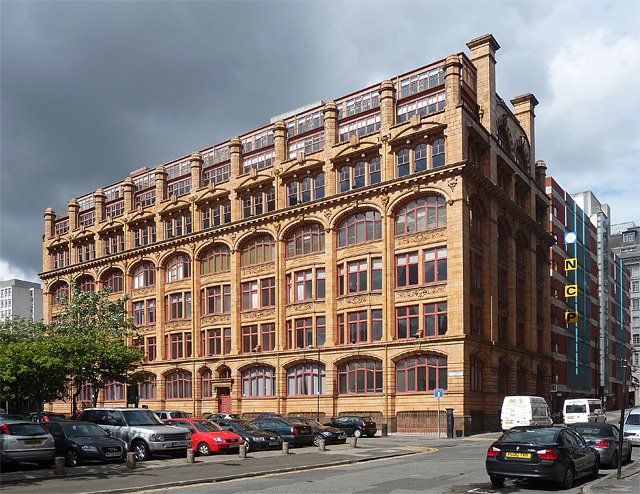
An Art Nouveau warehouse on Chepstow Street, designed by local brothers Walter and George Harry Higginbottom and completed in 1909, Canada House exemplifies early-twentieth-century Manchester commercial architecture with its distinctive terracotta exterior and refined decorative detailing.
At a glance
Canada House stands as a Grade-II listed office building in Manchester’s warehouse quarter. Originally constructed as a packing warehouse, it opened in 1909 and has served various commercial tenants including Historic England, architectural consultants, and international businesses.
History
The building opened in 1909, during Manchester’s zenith as a centre for trade and manufacturing. Designed by W & G Higginbottom—brothers Walter and George Harry Higginbottom—it belongs to a cohort of Manchester warehouses built to accommodate the city’s commercial expansion. The building underwent extensive renovation during the 1990s to adapt its interiors for modern office use.
What you see
Canada House exemplifies the Art Nouveau style applied to commercial architecture. Its defining feature is the terracotta exterior, modelled with the characteristic curves and organic motifs typical of the movement. The building’s fenestration and decorative brickwork reflect the refined taste of Edwardian Manchester design.
Cultural significance
Canada House belongs to a constellation of listed warehouses—including Watts Warehouse, Asia House, India House, and Churchgate House—that collectively document Manchester’s role as a global trading hub. These buildings illustrate how commercial architecture adopted progressive design languages to express civic ambition and mercantile prosperity.
Key facts
- Location: Chepstow Street, Manchester, United Kingdom
- Completed: 1909
- Architects: W & G Higginbottom (Walter and George Harry Higginbottom)
- Style: Art Nouveau
- Original use: Packing warehouse
- Listed status: Grade II
- Coordinates: 53.47549, −2.24337
Practical information & getting there
Canada House remains an active office building in central Manchester. While it is not open to the public as a visitor attraction, its exterior and street presence can be appreciated from Chepstow Street. The building is accessible via public transport in Manchester city centre.
Sources & resources
Find it on the map
See this place and what’s around it →📷 Become a Cultural Heritage Online photographer
Share your photos of places: they stay published under your name as the author. The more they're seen, the more you get noticed — and soon a contest will reward the most appreciated photos.
Log in or sign up free to add a photoIs this page about you?
This page is read by travellers and heritage enthusiasts who find it on Google. Tell us how you are connected to this place and we will take it from there.