

On the campo where the Strada Nova begins, a church rebuilt in 1575 around a chapel of the 1490s that held the tomb of a queen of Cyprus, under a bell tower finished by Andrea Tirali.
At a glance
- First certain date
- 1021, a radical reconstruction
- Present form
- The rebuilding of 1575, attributed to Alessandro Vittoria
- Bell tower
- Begun 1672; bell chamber and spire by Andrea Tirali in the eighteenth century; 47 m
- Corner chapel
- Built in the 1490s, attributed to Mauro Codussi
- Altarpiece
- The Communion of Saint Lucy by Giambattista Tiepolo, about 1748
- Entry
- Free; hours follow the services
Overview
The church stands on its own campo at the beginning of the Strada Nova, the nineteenth-century cut that carries most of the walking traffic between the station and Rialto. More people pass it than enter it, which is a pity, because it holds a chapel of the first rank and a late Tiepolo.
History
A tradition recorded by the eighteenth-century historian Flaminio Corner has the church founded by San Magno, bishop of Oderzo, who in a vision was told by the twelve apostles to build where he would find twelve cranes; the story places the foundation in the seventh century. It is a legend, and the sources that report it say so. A church may have stood here in the ninth century, but the reasoning is intuition rather than evidence: the first certain date is 1021, when the building was radically reconstructed.
What gives the church its present shape is the restructuring of 1575, entrusted — the attribution is probable rather than documented — to Alessandro Vittoria, who reused the load-bearing walls and turned the interior into a single unified space with pilasters framing the altars. Parts of the fourteenth-century frescoes and the Corner chapel were kept.
The bell tower was begun in 1672 and left unfinished; Andrea Tirali designed the bell chamber and the spire in the following century, bringing it to 47 metres.
The Corner chapel, built in the 1490s as the burial chapel of the Cornaro and attributed to Mauro Codussi, holds the funerary monuments of Marco Corner and of his son Giorgio. Caterina Corner, queen of Cyprus, who abdicated in 1489 and died on 10 July 1510, lay here until 1575, when the rebuilding moved her to a monument of her own in San Salvador.
What you see
The chapel is the reason to come in: a hemispherical dome on four tall slender columns, in fine marbles, with tomb sculpture associated with Tullio Lombardo and later Lombard hands. It is a compact, controlled piece of the early Renaissance inside a church that is otherwise sixteenth-century.
On an altar hangs Giambattista Tiepolo’s Communion of Saint Lucy, of about 1748. There is also a Last Supper by Cesare da Conegliano of 1583 and a Fall of the Manna attributed to Veronese.
The Campanile & Rusticated Portal
Rising 47 metres over the campo, the bell tower was begun in 1672 but left uncompleted for decades before the Venetian architect Andrea Tirali designed the upper bell chamber and soaring spire in the early eighteenth century. At its base on the campo stands a monumental doorway framed in heavy cushion rustication (bugnato a cuscino) of white Istrian stone, designed to provide a massive protective foundation against lagoon damp.
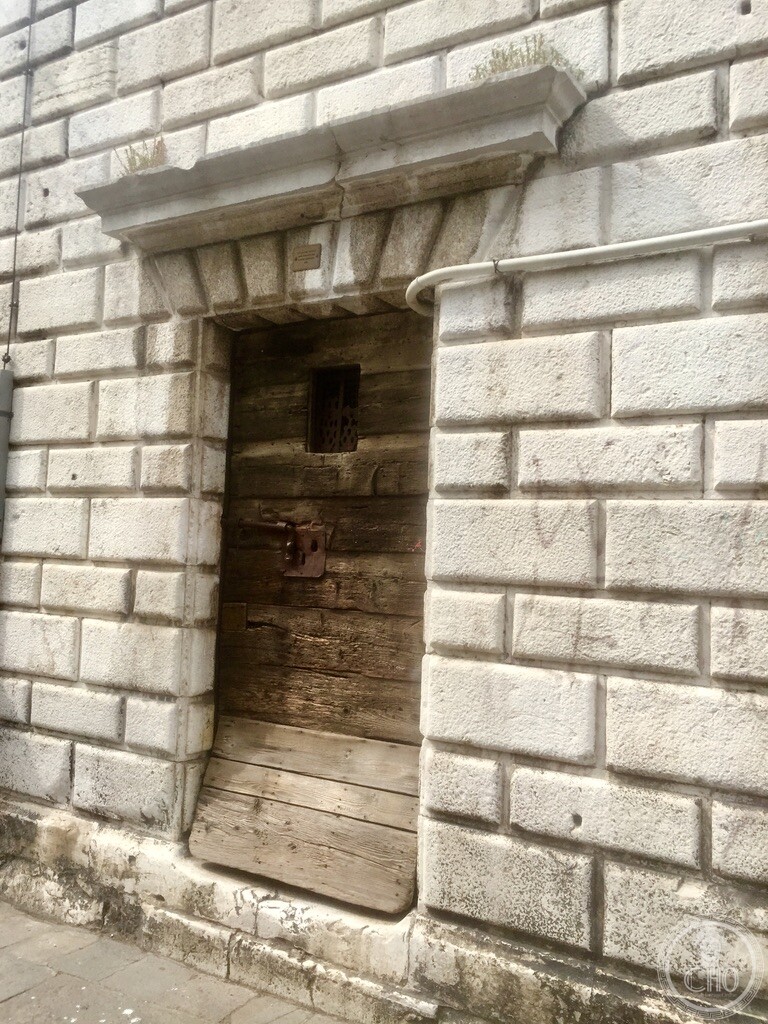
The antique wooden door, dark with centuries of patina, retains its original iron bolt and grilled peep-hole, while the lower boards show the reinforced timber floodboards (paratie) and tide marks left by recurrent acqua alta floodings.
Venetian Decorative Bronzes: The Neptune Door Knocker
Surrounding Campo Santi Apostoli, the private entrances of historic patrician residences display masterly decorative iron and bronze work. Chief among these is a remarkably preserved bronze door knocker (picchiotto or battacchio) cast in the high Renaissance Mannerist tradition.
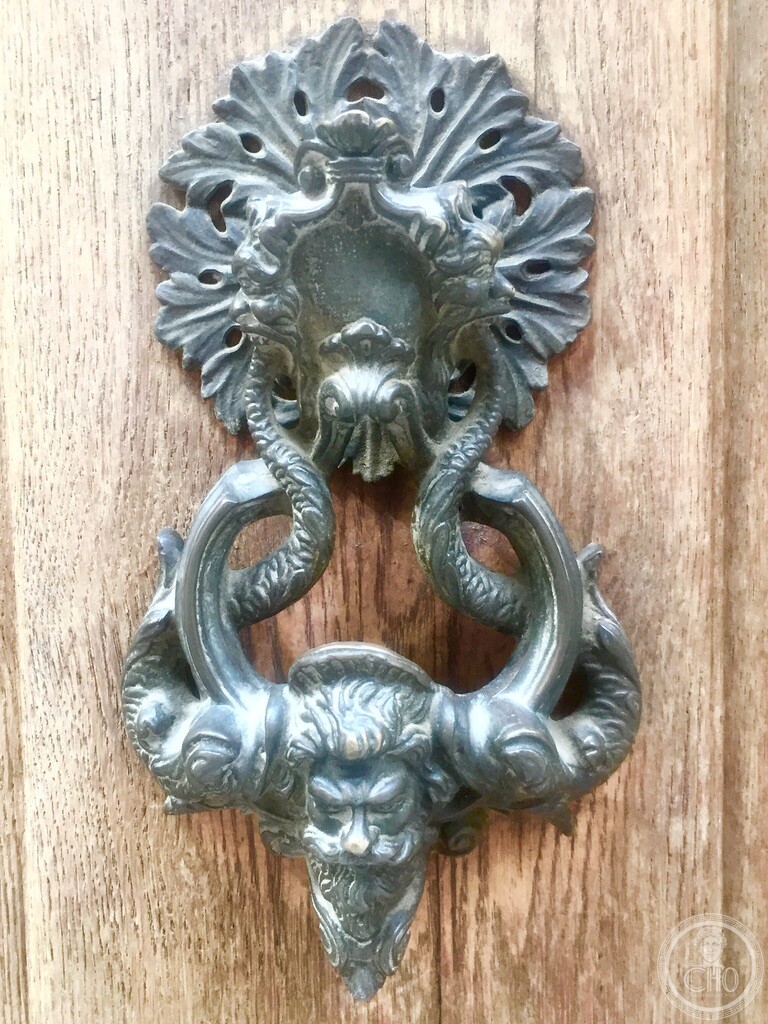
Anchored by an acanthus-leaf escutcheon, the knocker features the bearded head of the sea god Neptune flanked by twinned, serpentine dolphins. Such maritime bronzes were prestigious emblems of naval sovereignty and commercial fortune, cast by Venetian bronze-founders to protect the threshold against adversity.
Practical information
- Address: Campo Santi Apostoli, Cannaregio 4465, Venezia
- Entry is free. It is an active parish church and opening follows the times of services rather than published hours — the hours listed on tourist aggregators are not confirmed by any institution
- Telephone: +39 041 5238297
- It is not part of the Chorus circuit
Nearby
- Bacaro Ai Promessi Sposi — Bar, 61 m away
- Church of Santa Maria dei Miracoli — Church, 100 m away
- Manganer, event space — Cultural centre, 82 m away
- Casa di Tiziano ai Biri — about 400 m away
Sources
- Flaminio Corner, eighteenth-century account of the foundation legend, as reported by the standard literature
- Regione Veneto, minisite on Caterina Corner (the Corner chapel, the monuments of Marco and Giorgio, the transfer to San Salvador in 1575)
- Patriarcato di Venezia, parish of Santi XII Apostoli
See the place
Find it on the map
See this place and what’s around it →📷 Become a Cultural Heritage Online photographer
Share your photos of places: they stay published under your name as the author. The more they're seen, the more you get noticed — and soon a contest will reward the most appreciated photos.
Log in or sign up free to add a photoIs this page about you?
This page is read by travellers and heritage enthusiasts who find it on Google. Tell us how you are connected to this place and we will take it from there.