

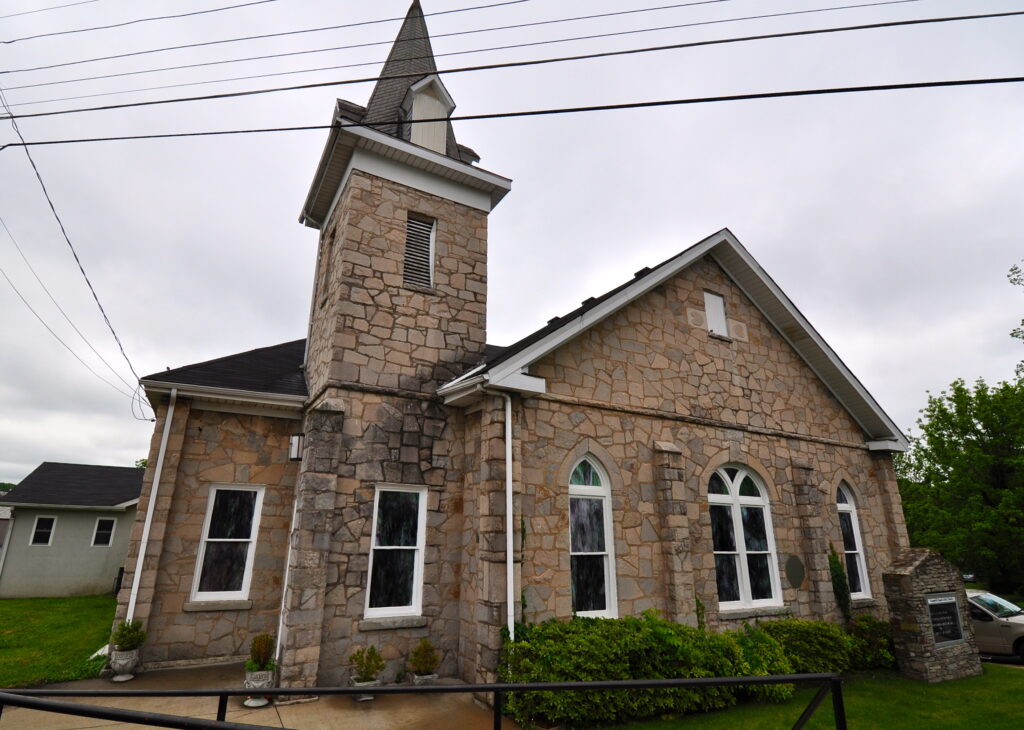
A 1925 Gothic Revival church in Pulaski, Tennessee, recognized for its stone masonry.
At a glance
Campbell Chapel African Methodist Episcopal Church stands in Pulaski, Tennessee. Built in 1925, the building follows the Gothic Revival style. Its National Register listing points to the quality of its stonework.
History
The congregation dates to 1873, in the late Reconstruction years, when the African Methodist Episcopal missionary Jordan W. Early worked across eleven Middle Tennessee counties to found churches among the newly freed. This was the first AME congregation in Giles County, named for Bishop J. P. Campbell. Its first trustees were Cliff Brown, Abe McKissack, Willie Daly, Jackson Taylor, Frank Coleman, Burrell Morrell and Andrew Givens.
The congregation first met in south-east Pulaski, in a neighbourhood known as the Methodist Bottom, and moved around 1900 to Belleview, at Mill and Church Street. That building burned in 1925, and the present stone church was raised the same year. George Smith is recorded as its builder. From 1925 until the Pulaski Rosenwald School opened in 1927 and 1928, the church also served as the local segregated school.
What you see
Seen from Mill Street the church steps down in three tiers: a gable-fronted block holding the sanctuary, a square stone tower with a steeple beside it, and a hip-roofed wing that originally contained classrooms, lavatories and the pastor’s office. All three went up in 1925 in uncoursed cut stone, smoothly finished, on a foundation of rubble and ashlar. Two Gothic windows with pointed lights and arched stone surrounds flank a wider central bay, where a small inverted triangle of glass turns the same window shape into a Romanesque arch with its own keystone. Projecting stone pilasters, each capped with a single stone, rise beside the central bay and at the corners. Under the apex of the gable, heart-shaped stones are set vertically on either side of a rectangular vent.
Inside, the sanctuary keeps its pressed metal ceiling, crown moulding, wooden pews, wooden floor and semicircular chancel rail. The windows are painted glass made to read as stained glass. A central aisle divides twenty original pews. A row of double-hung windows banks the north wall, four clear lights above a frosted one, separating the sanctuary from a multi-use room that is part of the original design. That room was the classroom space. A concrete addition of about 1970, holding a fellowship hall, kitchen and study, sits at the rear where it does not overwhelm the older work.
Cultural significance
The church was listed on the National Register of Historic Places in 2000, on two grounds. The first is its place in the African American history of Giles County, in religion and in education: a late Reconstruction congregation, the county’s first AME church, and for two years its Black school. The second is the stonework itself, held to be an exceptional example of early twentieth-century masonry craftsmanship.
Its Gothic Revival design is one of the two dominant styles of rural African American churches in the Jim Crow decades between 1890 and 1945, and the nomination calls it exceptional for the date it was built. Exterior and interior both keep most of their original materials and workmanship.
Key facts
- Country: United States
- City: Pulaski, Tennessee
- Coordinates: 35.225, -87.0375
Practical information & getting there
The church is located in Pulaski, Tennessee. Coordinates are 35.225, -87.0375.
Sources & resources
Find it on the map
See this place and what’s around it →📷 Become a Cultural Heritage Online photographer
Share your photos of places: they stay published under your name as the author. The more they're seen, the more you get noticed — and soon a contest will reward the most appreciated photos.
Log in or sign up free to add a photoIs this page about you?
This page is read by travellers and heritage enthusiasts who find it on Google. Tell us how you are connected to this place and we will take it from there.
This entry stays online and free either way — and a free account lets you add to it yourself.