

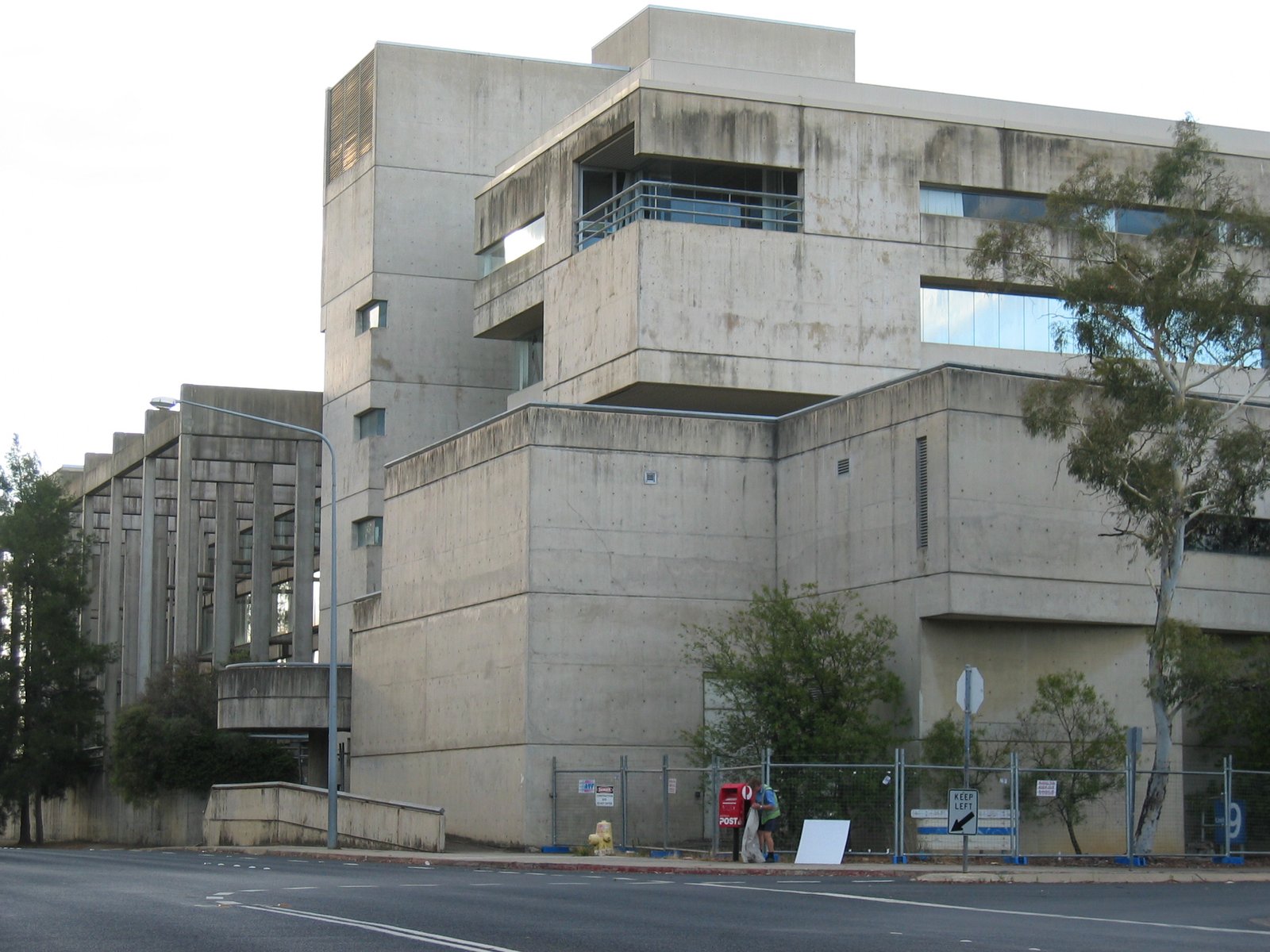
A Brutalist government complex designed by John Andrews, now partially preserved as a monument to Canberra’s architectural ambitions and repurposed for student housing.
At a glance
The Cameron Offices represent a bold experiment in Brutalist structuralism. Commissioned by the National Capital Development Commission, the complex once housed nine interconnected wings in Belconnen’s civic heart. Today, three wings and a pedestrian bridge survive as remnants of this distinctive modernist ensemble.
History
Construction of the offices spanned six years, from 1970 to 1976. For three decades, the Australian Bureau of Statistics occupied the complex as its primary tenant, making it a vital administrative hub. Wing 3 was home to the Commonwealth Superannuation Corporation. Beginning in 2007–08, six of the nine wings were demolished, leaving the site radically altered and its future uncertain.
What you see
John Andrews designed the offices in the Brutalist structuralism idiom, emphasizing bold geometric forms and exposed concrete. The three surviving wings (3, 4, and 5) retain the characteristic massive volumes and fortress-like presence of the style. A pedestrian bridge, equally austere, connects the remaining sections and offers views across Belconnen Town Centre.
Cultural significance
The Cameron Offices embody a pivotal moment in Canberra’s development as a modern capital. Though substantially dismantled, the surviving structures stand as evidence of 1970s faith in grand civic architecture. Wings 4 and 5 now serve the University of Canberra as student accommodation, giving the Brutalist forms new purpose and vitality.
Key facts
- Country: Australia
- City: Belconnen, Canberra
- Designed by: John Andrews
- Built: 1970–1976
- Partially demolished: 2007–08
- Coordinates: −35.2419, 149.0697
Practical information & getting there
The Cameron Offices are located in Belconnen Town Centre, in the district of Belconnen, Australian Capital Territory. Visitors can access the site by public transport or car. The surviving wings remain visible from surrounding streets; contact the University of Canberra for information about viewing the student accommodation areas.
Sources & resources
Find it on the map
See this place and what’s around it →📷 Become a Cultural Heritage Online photographer
Share your photos of places: they stay published under your name as the author. The more they're seen, the more you get noticed — and soon a contest will reward the most appreciated photos.
Log in or sign up free to add a photoIs this page about you?
This page is read by travellers and heritage enthusiasts who find it on Google. Tell us how you are connected to this place and we will take it from there.