

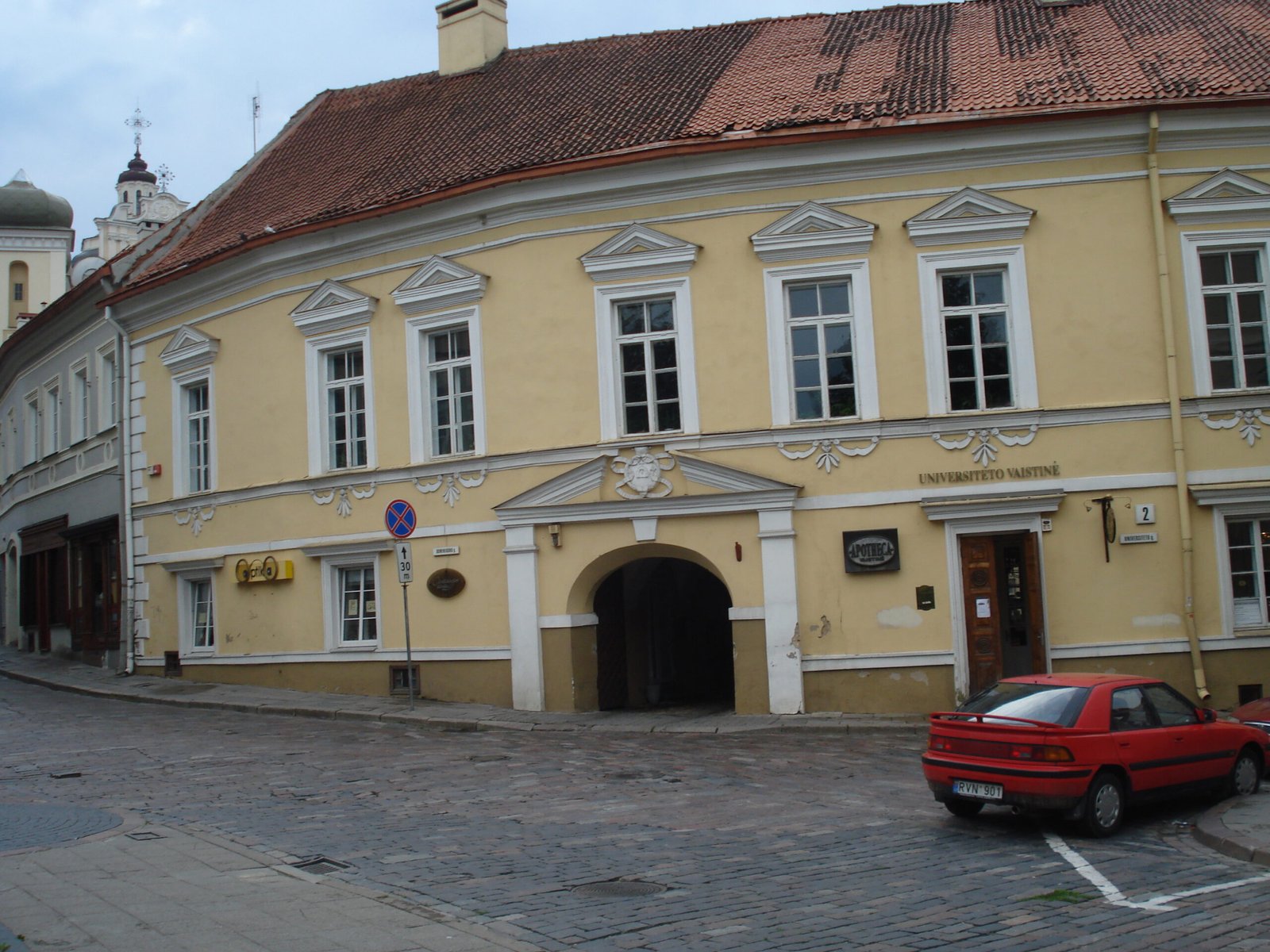
A refined townhouse in Vilnius’s medieval quarter, transformed from a merchant property into a aristocratic residence and rebuilt in the Baroque style during the 18th century.
At a glance
Brzostowski Palace stands in Vilnius Old Town as a landmark of Lithuanian aristocratic architecture. The building reflects successive waves of ownership and renovation across three centuries, evolving from a modest urban dwelling into an elegant Baroque palace before its modern conversion to mixed-use residential and commercial space.
History
The palace acquired its name in 1667 when Cyprian Paweł Brzostowski, Voivode of Trakai, purchased the building. Under his descendant Paweł Ksawery Brzostowski, the structure underwent comprehensive restoration in 1748 according to designs by Carlo Spampani, establishing its distinctive Baroque character.
Ownership passed to Jakub Ignacy Nagórski in 1772 and subsequently to the prominent Ogiński family in 1802. The architect Cyprian Maculewicz oversaw significant renovation work between 1888 and 1890, adapting the palace for the modern era. Residential conversions in 1957 and 1982 subdivided the interior into apartments.
What you see
The palace’s current exterior and interior arrangement date primarily from the 1748 restoration executed under Spampani’s direction. The Baroque interventions of that period remain the building’s defining architectural feature, though later 19th-century modifications by Maculewicz introduced contemporary refinements and the 20th-century conversions have altered the interior layout significantly.
Cultural significance
Brzostowski Palace exemplifies the architectural evolution of Vilnius’s Old Town, where medieval street patterns accommodate buildings spanning multiple centuries and styles. The palace documents the interplay between noble patronage and urban development in the Grand Duchy of Lithuania, while its modern adaptive use reflects the practical challenges of preserving historic structures in living city centers.
Key facts
- Country: Lithuania
- Location: Vilnius Old Town
- Coordinates: 54.68166667°N, 25.28611111°E
- Major restoration: 1748 (Carlo Spampani, architect)
- Secondary renovation: 1888–1890 (Cyprian Maculewicz, architect)
Practical information & getting there
The palace is located within Vilnius’s UNESCO-listed Old Town, accessible on foot from the city center. The building currently operates as a residential and commercial property; exterior viewing is possible from the street, though interior access is not publicly available.
Sources & resources
Find it on the map
See this place and what’s around it →📷 Become a Cultural Heritage Online photographer
Share your photos of places: they stay published under your name as the author. The more they're seen, the more you get noticed — and soon a contest will reward the most appreciated photos.
Log in or sign up free to add a photoIs this page about you?
This page is read by travellers and heritage enthusiasts who find it on Google. Tell us how you are connected to this place and we will take it from there.