
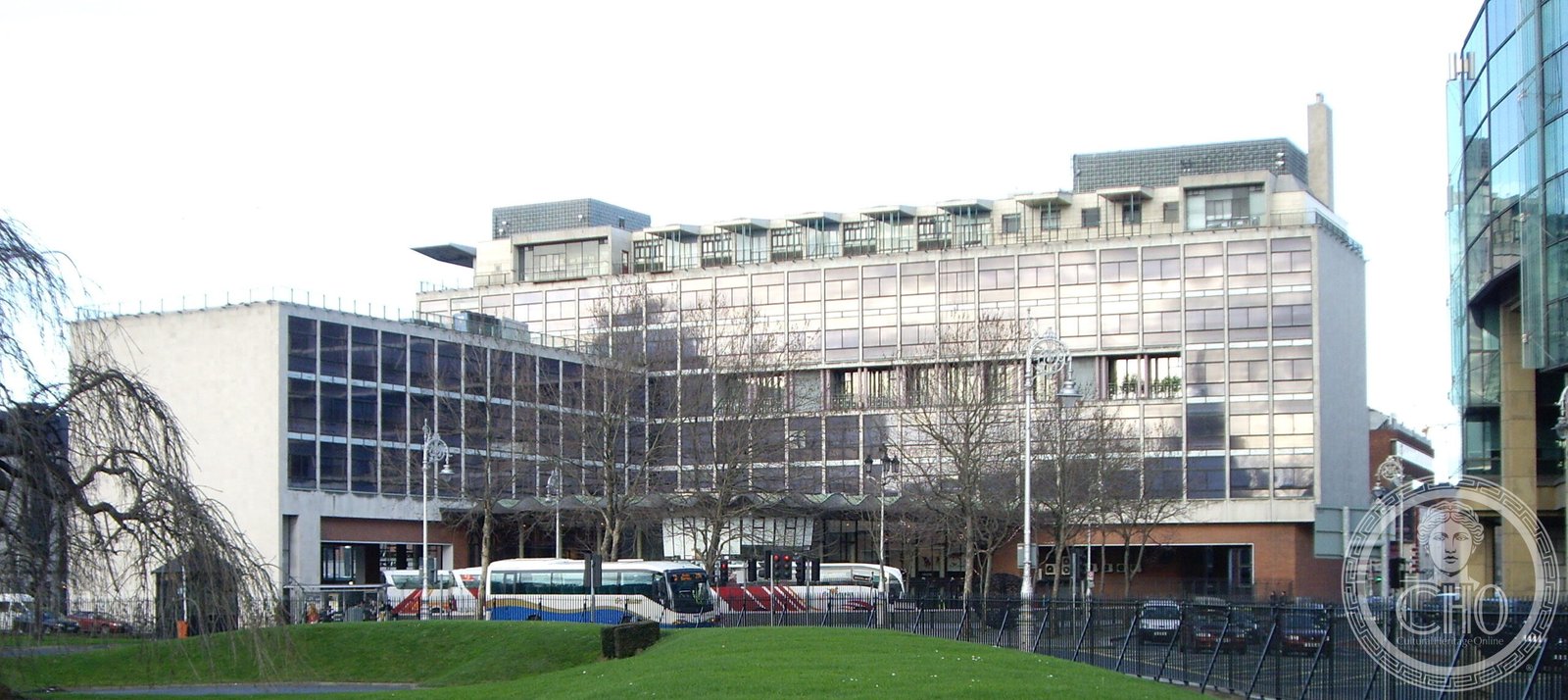
Dublin’s Busaras — Bus Áras in Irish — stands as the most significant twentieth-century building on the island of Ireland. Completed in 1953 as the headquarters of CIE, Ireland’s national transport company, it introduced an entire generation of Irish architects and civic leaders to the principles of international Modernism at a moment when the country was still deeply ambivalent about its relationship with contemporary European culture. Designed by Michael Scott, who had studied Le Corbusier’s work extensively during years spent in Paris, the building was the first in Ireland to employ a glass curtain-wall facade, the first to use cantilevered floors, and the first to apply Le Corbusier’s five points of modern architecture — pilotis, free plan, horizontal windows, free facade, roof terrace — to a major Irish public commission. Nothing quite like it had been built in Ireland before, and its arrival provoked a fierce public debate that lasted years, crystallising a cultural divide between Irish Revivalism and international Modernism that shaped Irish architecture for decades.
At a glance
- Type
- Bus terminal and office building
- Period
- Completed 1953
- Style
- International Modernism
- Location
- Store Street, Dublin 1, Ireland
- Coordinates
- 53.3495, -6.2484
- Architect
- Michael Scott
Overview
Busaras occupies a prominent position on Store Street near the Custom House and the River Liffey, just north of Dublin’s city centre. The building serves a dual function: its ground floor houses the central bus station with bays for long-distance coaches, while the upper floors contain offices originally used by CIE and now by the National Transport Authority. The structure is organised as a low horizontal bus hall with a taller office block rising above, clad in green mosaic and glass. A dramatic cantilevered canopy extends over the bus bays, and the office block features a staircase tower that reads as a separate vertical element — a compositional move directly influenced by Le Corbusier’s work. Even today, arriving by coach into Busaras conveys a sense of civic arrival that few modern transport termini achieve.
History
The commission for a new central bus station was awarded to Michael Scott in 1945, part of a government effort to modernise Irish infrastructure after the Second World War. Scott, who had spent time studying in Paris and was deeply influenced by Le Corbusier, saw the project as an opportunity to introduce Modernism to Ireland in a high-profile civic context. Construction proceeded slowly through the late 1940s and early 1950s, partly due to post-war material shortages and partly due to political controversy over the building’s radical appearance. When it opened in 1953, the reaction was sharply divided: architectural critics — including those writing in The Architectural Review in London — praised it as a masterpiece of postwar European Modernism; Irish nationalist politicians and newspaper columnists denounced it as alien, foreign, and wasteful. The building was eventually recognised as a protected structure under Irish heritage law, and it now carries the designation of a National Monument.
Architecture and Design
Scott’s design is organised around three elements: the low bus hall at ground level, the elevated office block, and the staircase tower. The bus hall sits on pilotis, freeing the ground plane and allowing vehicles to pass under the building. Above it, the office block is clad in a curtain wall of glass and green mosaic — the mosaic work was designed by Patrick Scott and is among the earliest examples of artistic integration in an Irish public building. The cantilevered canopy over the bus bays extends twelve metres without intermediate support, a technical achievement that impressed European critics. The staircase tower is faced in contrasting dark stone, giving the composition a vertical accent that balances the horizontal mass of the office block. Interior spaces include a generous public hall with terrazzo floors and integrated lighting designed as part of the architecture rather than added to it.
Cultural significance
Busaras is the ground zero of Irish architectural Modernism. Before it was built, the debate about international styles was theoretical; after it was built, the debate was concrete and unavoidable. The building forced Irish cultural and political institutions to take a position on whether Ireland’s built environment should reflect a backward-looking Revivalist aesthetic or engage with the international architectural conversation. That this happened at a bus station — a prosaic infrastructure type — rather than a museum or government building made the confrontation all the more democratic. Busaras also established Michael Scott as the leading figure in Irish Modernism. The building’s influence is traceable in virtually every significant Irish public building constructed between 1953 and 1990, and it appears in international surveys of European postwar architecture.
Visiting today
Busaras remains fully operational as Dublin’s central bus station, serving Bus Éireann intercity and regional coach services across Ireland. Visitors can walk through the public areas of the bus hall freely; the building’s exterior is best viewed from across Store Street. The mosaic facade and cantilevered canopy are the key elements to look for. The building’s interior retains much of its original terrazzo flooring and joinery. An Taisce and various Irish architectural organisations periodically offer guided tours; check their programmes in advance.
Getting there
Busaras is on Store Street, Dublin 1, a five-minute walk north of O’Connell Street. The building is directly served by the Luas Red Line at the Busaras tram stop immediately outside, and is ten minutes’ walk from Connolly Station. Dublin Bus routes serving the city centre pass within three minutes’ walk. The Custom House and the Hugh Lane Gallery are both within fifteen minutes’ walk on foot.
Sources and resources
Find it on the map
See this place and what’s around it →📷 Become a Cultural Heritage Online photographer
Share your photos of places: they stay published under your name as the author. The more they're seen, the more you get noticed — and soon a contest will reward the most appreciated photos.
Log in or sign up free to add a photoIs this page about you?
This page is read by travellers and heritage enthusiasts who find it on Google. Tell us how you are connected to this place and we will take it from there.