
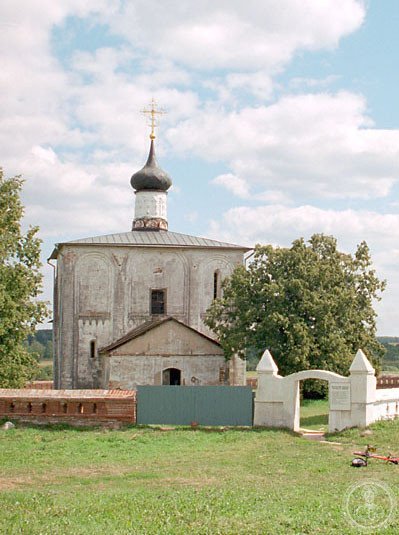
A limestone church built in 1152 by Prince Yuri Dolgoruky, this modest Vladimir-Suzdal structure preserves twelfth-century frescoes and stands as one of the few surviving churches commissioned by the prince.
At a glance
Built in 1152 at the orders of Prince Yuri Dolgoruky, the Church of Boris and Gleb originally stood within a princely palace complex in Kideksha, four kilometers east of Suzdal. Though Dolgoruky abandoned the site within three years to assume the title of Grand Prince of Kiev, the church endured through centuries of change and decline—most notably when Mongol invasions reduced Kideksha from an important medieval town to a village.
History
The church was erected on land sacred to Russian Orthodoxy, described in historical sources as “where the encampment of Saint Boris had been.” Dolgoruky built it as part of his ambitious architectural campaign, though his tenure at Kideksha proved brief. After his departure in 1155, the church’s fate reflected the settlement’s trajectory: it served as a monastic center during the medieval period before becoming a parish church. The structure witnessed repeated alterations—losing its original vaulting and dome by the seventeenth century, when new roofing and a smaller dome were installed. The nineteenth century brought a porch addition. The apses, now roughly half their original height, were truncated when the medieval roof collapsed.
What you see
Architects probably from Galicia built the church in white limestone, following the Vladimir-Suzdal school of design. The four-piered, three-apse structure displays the restrained elegance typical of the period. Fragments of twelfth-century frescoes remain visible on interior walls, offering glimpses of medieval religious art. The current seventeenth-century dome and roof differ substantially from the original configuration, and the truncated apses hint at grander proportions lost to time.
Cultural significance
The Church of Boris and Gleb is both a rare survivor—one of few churches commissioned by Dolgoruky that still stands—and a key monument of the Vladimir-Suzdal architectural tradition. Its inclusion in the UNESCO World Heritage Site “White Monuments of Vladimir and Suzdal” recognizes its importance to Russian medieval heritage. The church also belongs to the Golden Ring of Russia, a tourist circuit celebrating the region’s architectural legacy. In 2002, the St. Petersburg Mint featured the church on a three-ruble commemorative coin, alongside the St. Stephen’s Church and bell-tower that were constructed nearby in later centuries.
Key facts
- Built: 1152, by order of Prince Yuri Dolgoruky
- Location: Kideksha, 4 km east of Suzdal, Russia
- Coordinates: 56.425°N, 40.529°E
- Architectural style: Vladimir-Suzdal school
- Material: White limestone
- UNESCO World Heritage Site: “White Monuments of Vladimir and Suzdal”
- Notable features: Twelfth-century fresco fragments; four-piered, three-apse design
Practical information & getting there
The church is located in Kideksha village, approximately 4 kilometers east of Suzdal in Vladimir Oblast. Suzdal is accessible by road or rail from Moscow (approximately 220 km northeast). The church is part of the UNESCO-protected White Monuments complex and can be visited as part of a tour of the region’s medieval churches. Current opening hours, admission fees, and accessibility information are best confirmed locally before your visit.
Sources & resources
Find it on the map
See this place and what’s around it →📷 Become a Cultural Heritage Online photographer
Share your photos of places: they stay published under your name as the author. The more they're seen, the more you get noticed — and soon a contest will reward the most appreciated photos.
Log in or sign up free to add a photoIs this page about you?
This page is read by travellers and heritage enthusiasts who find it on Google. Tell us how you are connected to this place and we will take it from there.