

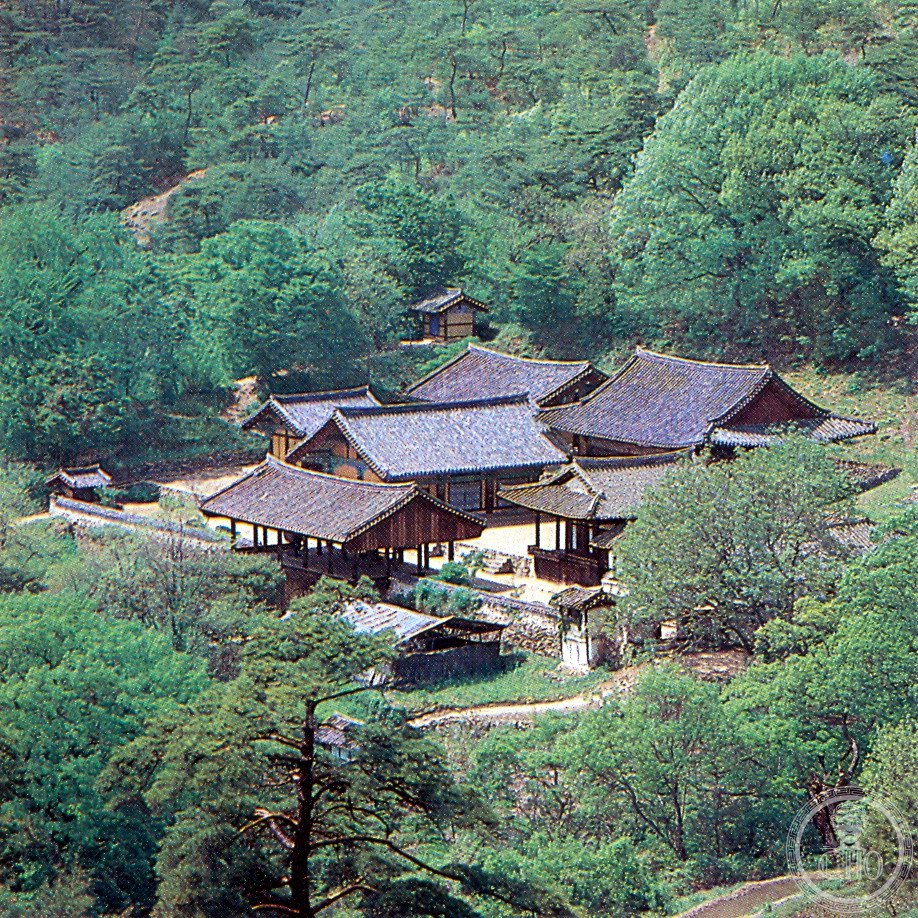
A Buddhist temple on Mount Cheondeung housing Korea’s oldest wooden building, Geungnakjeon, and representing the nation’s earliest example of timber architecture.
At a glance
Bongjeongsa occupies 1,650 m² on the slopes of Mount Cheondeung in Andong, North Gyeongsang Province. It is a subsidiary temple of Gounsa, the head temple of the 16th branch of the Jogye Order. The main temple comprises 10 buildings, with an additional 9 structures distributed across two sub-temples to the east and west.
History
Bongjeongsa stands as the oldest example of wooden architecture surviving in Korea. Its most significant structure, Geungnakjeon, represents the earliest known wooden building in the country, making the temple site archaeologically and culturally essential to understanding Korean Buddhist architecture.
What you see
The temple complex demonstrates traditional Korean Buddhist design principles. Geungnakjeon exemplifies ancient wooden construction techniques. The arrangement of the main temple buildings and two subsidiary complexes reflects the hierarchical spatial organization characteristic of major Korean Buddhist temples.
Cultural significance
Bongjeongsa preserves Korea’s most important early wooden architectural heritage. During a 1999 visit, Queen Elizabeth II of the United Kingdom was particularly impressed by the scale and beauty of the temple. The site remains central to understanding the development of Buddhist architecture on the Korean peninsula.
Key facts
- Location: Andong, North Gyeongsang Province, South Korea
- Coordinates: 36.6533, 128.662
- Size: 1,650 m² (17,760 ft²)
- Main buildings: 10 at central complex, 9 additional at sub-temples
- Affiliation: Subsidiary of Gounsa; Jogye Order, 16th branch
Practical information & getting there
Bongjeongsa is located on Mount Cheondeung in Andong city. As one of South Korea’s most historically significant Buddhist temples, it welcomes visitors interested in Korean architectural heritage and Buddhist culture. Check local resources for current access information and visiting hours.
Sources & resources
Find it on the map
See this place and what’s around it →📷 Become a Cultural Heritage Online photographer
Share your photos of places: they stay published under your name as the author. The more they're seen, the more you get noticed — and soon a contest will reward the most appreciated photos.
Log in or sign up free to add a photoIs this page about you?
This page is read by travellers and heritage enthusiasts who find it on Google. Tell us how you are connected to this place and we will take it from there.