
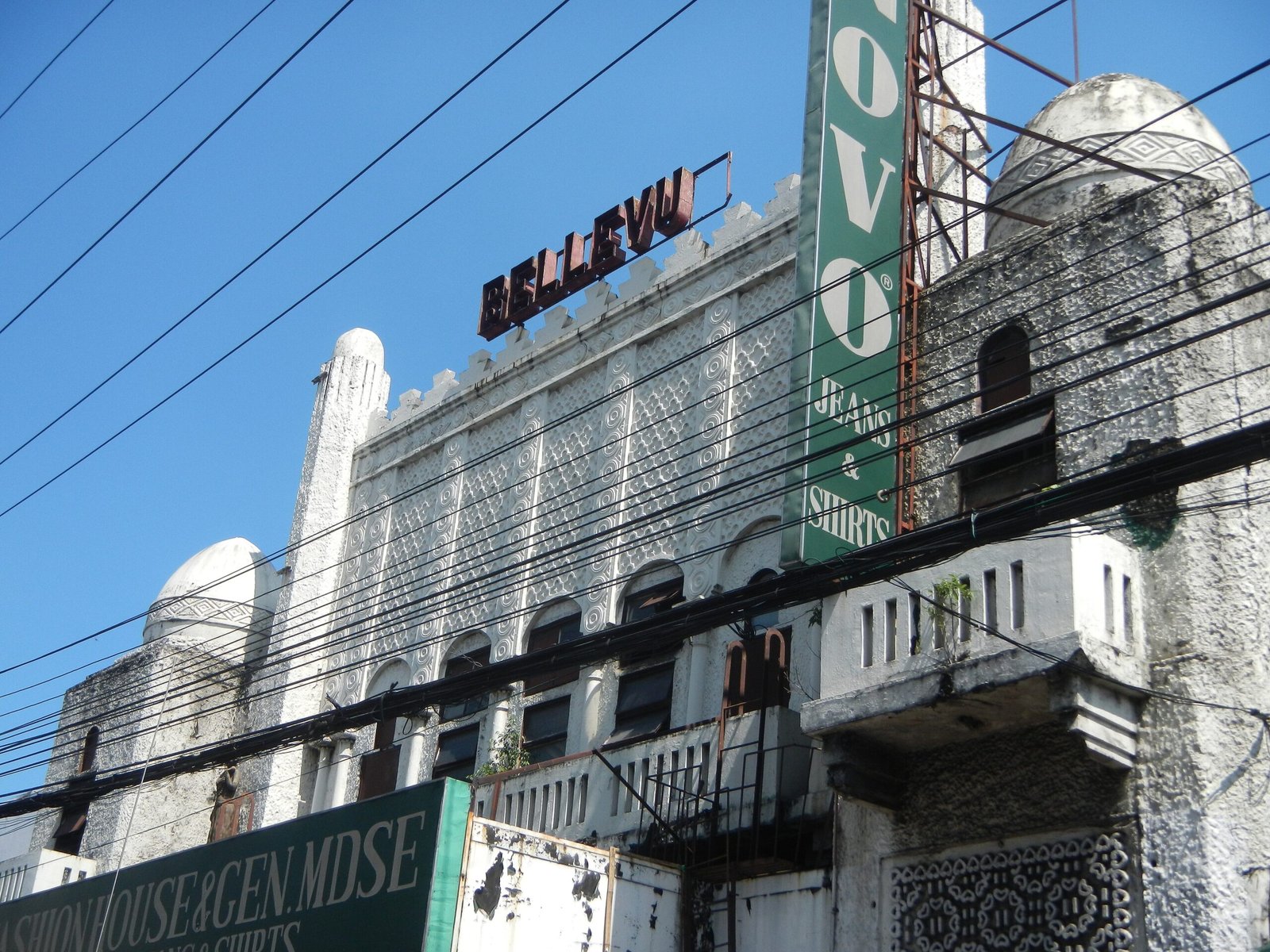
A small Art Deco cinema in Paco district that dressed itself in Islamic-inflected ornament, borrowing gestures from the old moro-moro stage tradition rather than from any single foreign source.
At a glance
Cine Bellevue opened in 1933 as one of roughly twenty movie houses catalogued by the American Express Company for tourists visiting Manila. Today it is a clothing store. Its shell survives as one of only two theaters from that 1930s list still standing, alongside the Manila Metropolitan Theater.
History
The theater belongs to Manila’s first great cinema boom, when picture houses multiplied across the city and each tried to outdo its neighbors in spectacle. Bellevue’s builders chose something unusual. Instead of the Egyptian or Chinese exoticism popular elsewhere, they drew on moro-moro theatrical scenography, the local dramatic tradition depicting conflicts between Christians and Muslims. That choice gave the building a distinctly Philippine variant of Orientalist Art Deco, sometimes described as Neo-Mudejar in strain. It functioned, notably, as the country’s last fully operational single-screen theater before ceasing that role.
What you see
The facade is symmetrical. A central plane of decorative concrete pierced work spans almost the entire front, screening light and view the way a wooden lattice might in a mosque or a moro-moro set. Two rectangular volumes flank this center, each capped with a dome. Pointed arches frame a pair of emergency doors at street level. Step inside and a small foyer once opened onto a pseudo-grand staircase. Sculptures of harem maidens stood guard on either side, theatrical props made permanent in plaster.
Cultural significance
Bellevue matters as evidence of how Manila’s cinema architects localized a global style. Art Deco arrived worldwide with its own vocabulary of zigzags and stepped forms. Here it absorbed indigenous theatrical imagery instead of importing wholesale exoticism from elsewhere. That fusion, rare among surviving Philippine cinemas, makes the building a document of 1930s taste as much as a place of entertainment history. Its survival, even repurposed, keeps that hybrid vision visible on a Paco street.
Key facts
- Location: Paco district, Manila, Philippines
- Opened: 1933, as Cine Bellevue
- Style: Art Deco with Neo-Mudejar, moro-moro-inspired ornament
- Current use: clothing store
- Rarity: one of only two survivors from a 1930s tourist survey of twenty Manila movie houses
Practical information & getting there
The building sits within Paco district, a short trip from central Manila. It now operates as a retail space, so visits are informal and exterior-focused. Look closely at the facade’s pierced concrete screen and the domed side volumes. No admission or opening-hours information is publicly documented for heritage viewing.
Sources & resources
Find it on the map
See this place and what’s around it →📷 Become a Cultural Heritage Online photographer
Share your photos of places: they stay published under your name as the author. The more they're seen, the more you get noticed — and soon a contest will reward the most appreciated photos.
Log in or sign up free to add a photoIs this page about you?
This page is read by travellers and heritage enthusiasts who find it on Google. Tell us how you are connected to this place and we will take it from there.