

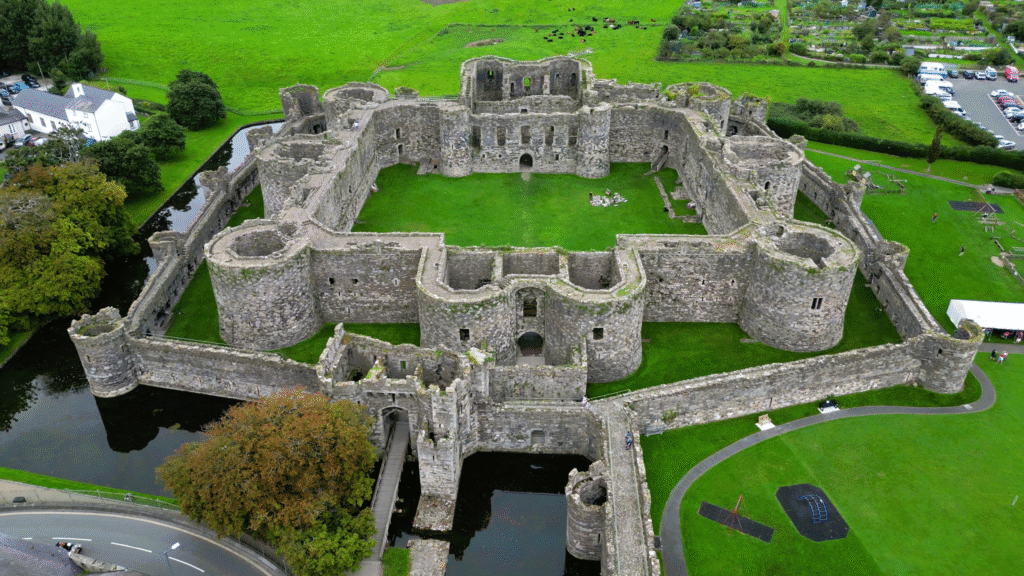
Edward I’s unfinished masterpiece of military design: a symmetrical concentric fortress built to consolidate English rule over north Wales, now a UNESCO World Heritage Site.
At a glance
Beaumaris Castle stands as one of Europe’s finest examples of late medieval military architecture. Built on the island of Anglesey between 1295 and 1330, it was designed under the direction of James of St George, Edward I’s master engineer. Though never completed despite expenditure of £15,000—an enormous sum for the period—the castle remains Britain’s most perfect example of symmetrical concentric planning.
History
Construction began in 1295, following the Madog ap Llywelyn uprising, after initial plans in 1284 were delayed by funding constraints. Edward I’s invasion of Scotland diverted resources, halting work until an invasion scare in 1306 prompted resumption. The project was finally abandoned around 1330 while still incomplete.
The castle fell to Welsh forces under Owain Glyndŵr in 1403 but was recaptured by royal forces two years later. During the English Civil War, Royalist garrisons held it until 1646, when it surrendered to Parliamentary armies. It escaped demolition and was garrisoned by Parliament, but declined into ruin around 1660.
In 1592, Welsh priest and martyr William Davies was imprisoned here; he was hanged, drawn and quartered on 27 July 1593. By the 19th century, the ruins became part of a stately home and park.
What you see
The castle displays concentric military planning at its finest. Built of local stone, it comprises a moated outer ward defended by twelve towers and two gatehouses, all overlooked by an inner ward. The inner fortification features two large D-shaped gatehouses and six massive towers, designed to accommodate domestic ranges supporting two major households.
The south gate could be reached by ship, enabling direct sea supply—a strategic advantage. Though walls and towers remain impressive, the castle’s incompletion means some structures were never built.
Cultural significance
UNESCO recognises Beaumaris as one of the finest examples of late 13th and early 14th century military architecture in Europe. Historian Arnold Taylor’s assessment as Britain’s “most perfect example of symmetrical concentric planning” underscores its architectural importance. The castle embodies Edward I’s ambitious conquest strategy and remains a landmark in medieval military design, despite never serving its intended purpose.
Key facts
- Country: United Kingdom
- Location: Anglesey, Wales
- Coordinates: 53.2648, -4.0897
- Construction period: 1295–c. 1330
- Designed under: James of St George
- UNESCO World Heritage Site: Yes
Practical information & getting there
Beaumaris Castle is open to visitors and managed as a historic monument. It remains accessible as a tourist attraction on Anglesey. For current opening hours, admission fees and detailed visitor information, consult the relevant heritage authority or local tourism website.
The outer walls alone carried 300 arrow loops, part of four concentric rings of defence built around a water-filled moat with its own dock.
Sources & resources
Find it on the map
See this place and what’s around it →
Advertisement. Pictured, from the Cleveland Museum of Art (CC0) and not for sale: a parure of about 1850, a Lalique brooch, a Castellani bangle. How we handle this
📷 Become a Cultural Heritage Online photographer
Share your photos of places: they stay published under your name as the author. The more they're seen, the more you get noticed — and soon a contest will reward the most appreciated photos.
Log in or sign up free to add a photoIs this page about you?
This page is read by travellers and heritage enthusiasts who find it on Google. Tell us how you are connected to this place and we will take it from there.
This entry stays online and free either way — and a free account lets you add to it yourself.